
Push Button Game Wall: Commercial Reaction Room Guide for FECs (2026)
Most FEC operators discover the same thing after opening their first active gaming room: the attraction that drives the most replays is not always the one they expected.
The interactive game floor often gets the loudest first reaction. The laser maze creates dramatic moments. The climbing game wall looks highly visual from outside the room. But the push button game wall is often where groups keep coming back.
The reason is simple. When a team loses by one missed button at the end of a round, they know exactly what went wrong. Someone missed the left side. Someone reacted too late. Someone forgot the pattern. That specific failure creates a very clear reason to try again.
That is why a push button game wall works so well inside commercial active gaming venues. It is not only a reaction test. It is a short-cycle, team-based, score-driven challenge that creates immediate replay behavior.
This guide is written for FEC owners, mall attraction investors, indoor entertainment operators, and active gaming room buyers who want to understand how this attraction works commercially, how it fits with other game rooms, and what to check before buying from a manufacturer.
What Is a Push Button Game Wall?
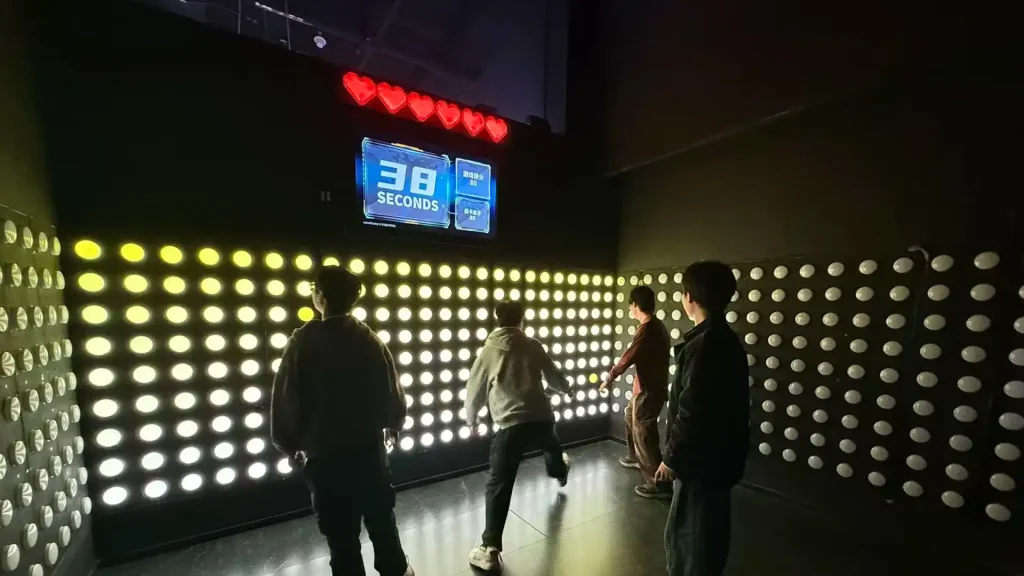
A push button game wall is an interactive wall attraction where LED buttons are installed across a vertical play surface. The software controls which buttons light up, how fast they appear, what sequence players must follow, and how the score is calculated.
Players press the illuminated targets before the time window closes. Depending on the game mode, they may need to react quickly, remember color sequences, avoid wrong buttons, or divide wall sections between team members.
The concept is easy to understand within seconds. That matters in a commercial venue. A good push button game wall does not require a long tutorial, special equipment, or complicated staff instruction. A first-time player can walk in and contribute during the first round.
Commercial systems are different from sports reaction training walls. A fitness reaction wall is usually designed to test athletic response time. A commercial push button game wall is designed for entertainment revenue. It needs multiple game modes, difficulty levels, scoreboards, team play, replay value, and room integration.
That difference is important. Two walls may look similar in photos, but they can perform very differently inside an FEC.
Why Push Button Game Walls Work Best Inside Active Gaming Rooms
Operators should rarely think about a push button game wall as a completely isolated attraction. The better question is where the reaction room fits inside a complete active gaming room.
Modern active gaming venues usually operate with a room-rotation model. Players buy session time and move between different challenge rooms. One room may test speed. Another tests balance. Another tests memory. Another tests precision. The goal is not to make one attraction carry the whole venue, but to create a game mix that keeps groups engaged across the full session.
This is exactly where a push button game wall earns its place.
After a high-energy floor game, the push room gives players a focused reaction challenge. After a laser maze, it raises the tempo again. After a climbing wall challenge, it brings the group back into fast team coordination.
In a well-planned interactive gaming room games mix, the push room adds:
- Fast reaction gameplay
- Team communication
- Short replay cycles
- Score-based competition
- Low staff involvement
- Strong group booking appeal
This is also why Activate-style venues include rooms such as Push and Press. Activate’s public Push room page shows how dense illuminated button layouts can support reaction, memory, teamwork, and timing challenges. You do not need to copy that exact format, but the market signal is clear: reaction rooms are now part of the active gaming category.
How a Push Button Game Wall Creates Replay Value
A lot of attractions are exciting during the first visit. Fewer stay interesting after the fifth.
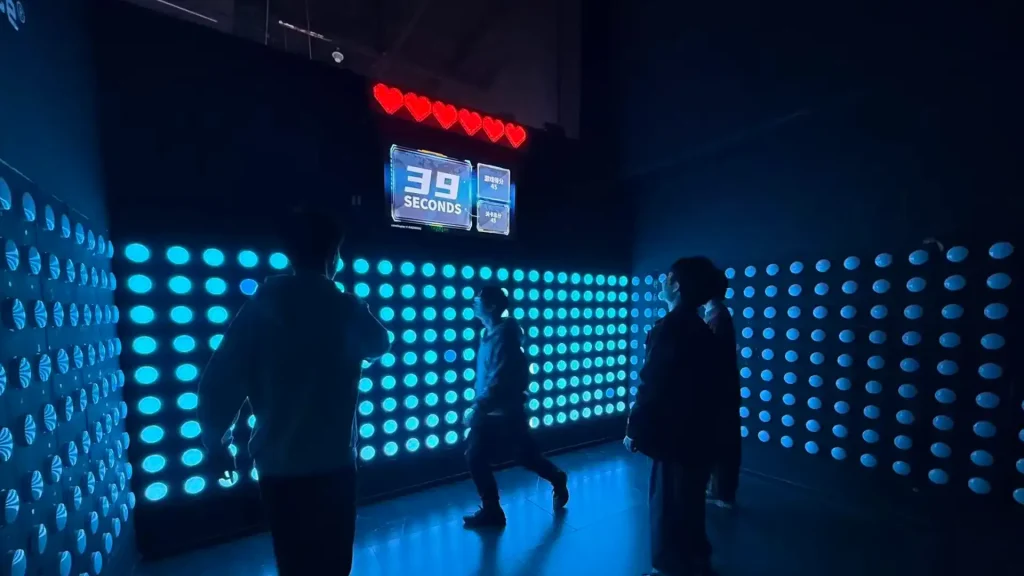
A push button game wall creates replay value because the failure is specific. If a team loses, they know why. They missed a button. They reacted too slowly. They covered the same zone twice. They forgot the color pattern. That makes improvement feel achievable.
The game does not simply tell players they lost. It shows them how close they were to winning.
Short rounds also help. Many reaction games last between 60 and 120 seconds. Because each attempt is short, players do not hesitate to replay. They are not committing to a long experience. They are simply trying to fix one mistake.
Difficulty progression adds another layer. A group that completes the medium level wants to reach the hard level. A team that beats one score wants to climb the leaderboard. A birthday group wants a rematch. A corporate group wants to prove the other team got lucky.
That behavior is commercially valuable. Replay value is not only about entertainment quality. It affects session length, perceived value, return visits, party package strength, and group booking performance.
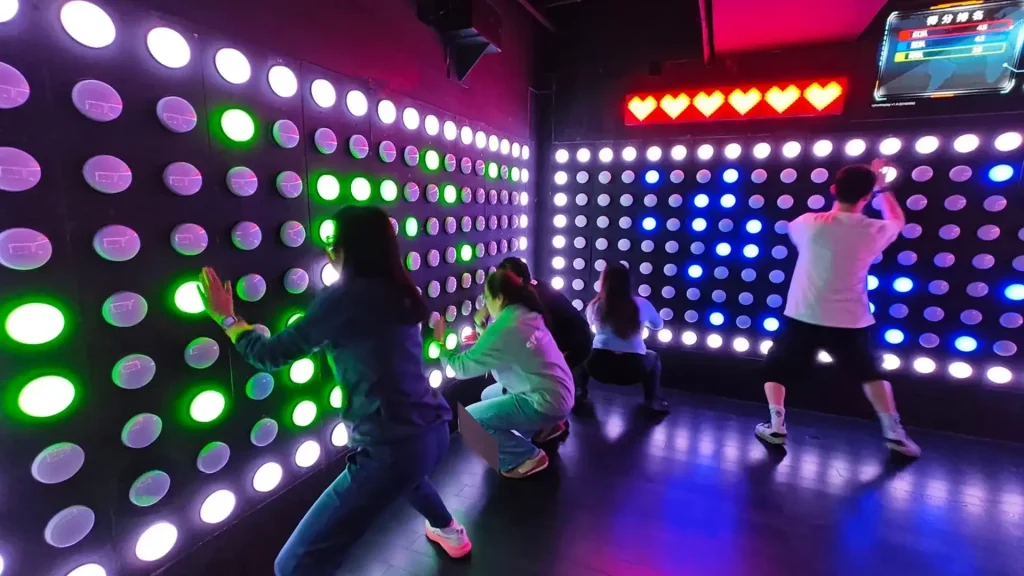
[Image: push-button-game-wall-team-play-challenge.webp]
Title: Team Playing Push Button Game Wall Challenge
Alt: A group of players working together on a push button game wall reaction challenge inside an active gaming venue
Description: Team-based push button game wall session showing players coordinating to respond to illuminated LED button patterns.
Position: After this section
How a Push Room Fits the Multi-Room Active Gaming Model
The room-based active gaming model changes how operators should plan attractions.
In a traditional FEC, each attraction is usually sold as a separate experience. Visitors choose one game, pay, play, and move on. In an active gaming room, players often buy a timed session and rotate through multiple rooms. The value comes from the complete experience.
A push button game wall works well in this format because it has a compact footprint and a clear role. It does not need to occupy the largest space in the venue. The interactive game floor usually acts as the anchor attraction — view our interactive game floor product page for configuration details.
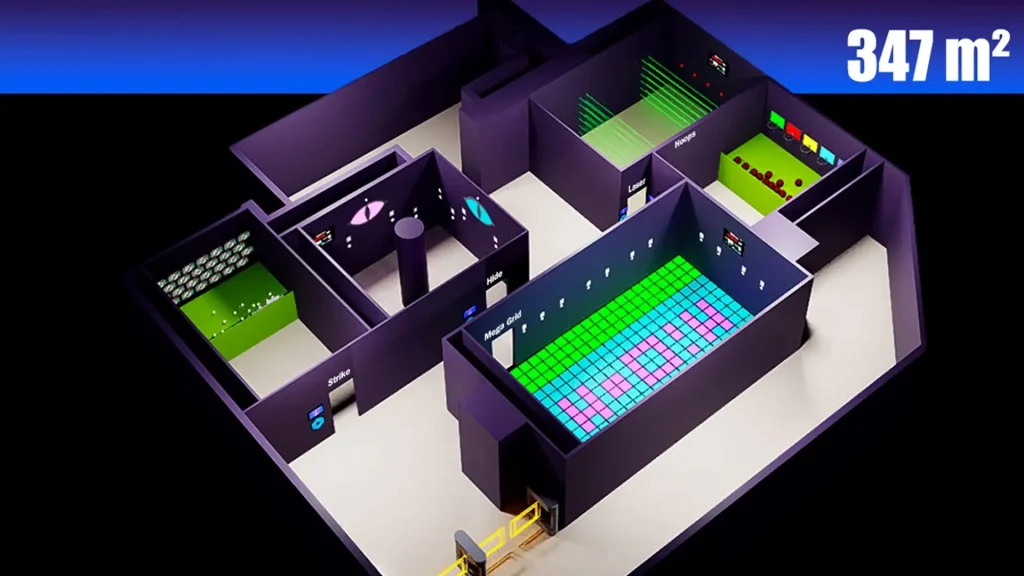
The push room can fit beside the laser maze game, climbing wall challenge, Evil Eyes Hide room, interactive hoops challenge, or ball pipe wall.
The basic layout requirement is straightforward. Players need a clear movement zone in front of the wall, usually around three to five meters depending on room size and player count. The wall needs a stable mounting surface, power access, controller placement, and enough visibility for staff or other visitors to understand what is happening.
Visibility matters more than many operators expect. If the wall is hidden in a back corner, it loses part of its marketing value. When visitors can see players pressing lights, shouting directions, and reacting to scores, the room creates its own attention.
For larger planning, your push room should connect naturally with the full venue flow. If you are still designing the full attraction mix, our interactive game floor cost guide explains how operators can think about ROI, throughput, and commercial attraction budgeting.
[Image: push-button-game-wall-active-gaming-venue-layout.webp]
Title: Push Button Game Wall Layout Inside Active Gaming Venue
Alt: Active gaming venue layout showing push button game wall room alongside interactive game floor and laser maze challenge rooms
Description: Venue layout illustration showing how a push button game wall fits as one challenge room within a complete multi-room active gaming venue design.
Position: After this section
Commercial Push Button Game Wall vs Sports Reaction Wall
One common purchasing mistake is choosing a sports reaction wall because it appears cheaper and looks similar in photos.
The hardware similarity is real. Both may use lights, buttons, sensors, and timers. But the commercial purpose is different.
| Feature | Commercial Push Button Game Wall | Sports Reaction Training Wall |
|---|---|---|
| Main Use | FEC entertainment and group play | Athletic reaction training |
| Game Modes | Multiple themed games | Basic reaction drills |
| Team Play | Strong | Limited |
| Scoreboard | Designed for competition | Often basic |
| Replay Value | High when software is strong | Medium |
| Venue Fit | Active gaming rooms, FECs, malls | Gyms, sports training centers |
| Revenue Role | Drives replays and group bookings | Supports training sessions |
A sports training wall is designed to measure performance. A commercial push button game wall is designed to create repeat entertainment.
That difference affects everything: software design, visual feedback, sound effects, scoreboard style, difficulty progression, and group play. If the product does not create replays, it is not doing the job an FEC operator needs it to do.
This is why operators should evaluate game software before they evaluate button count. More buttons do not automatically mean better revenue. Better games, better difficulty logic, and better team formats usually matter more.
[Image: push-button-game-wall-vs-reaction-training-wall-comparison.webp]
Title: Push Button Game Wall vs Sports Reaction Training Wall
Alt: Comparison showing commercial push button game wall for FEC versus sports training reaction wall for gym use
Description: Visual comparison between a commercial entertainment push button game wall and a sports training reaction wall, highlighting the difference in game design and venue suitability.
Position: Before or after this comparison section
Push Button Game Wall ROI for FEC Operators
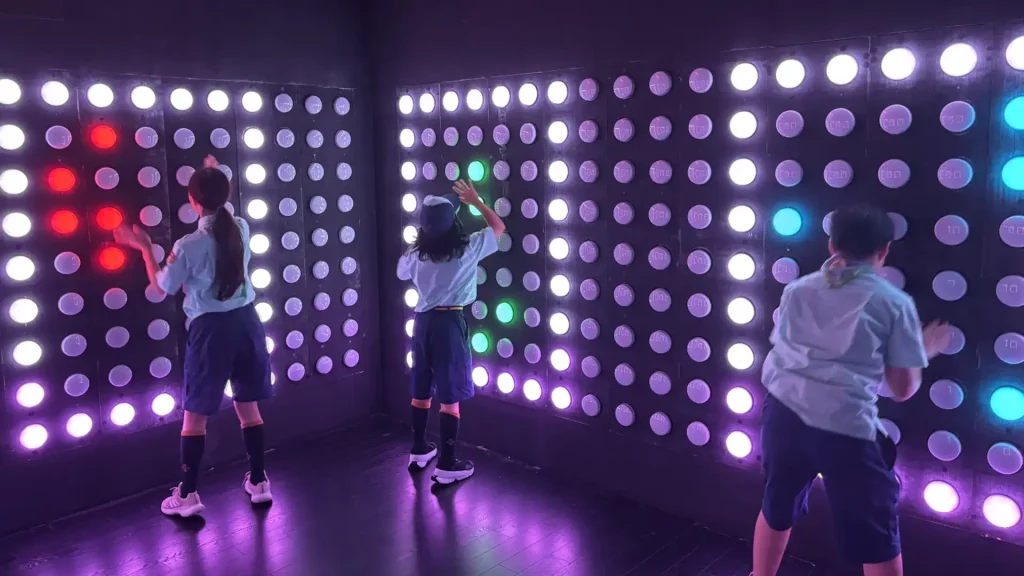
The commercial value of a push button game wall usually appears across several booking types.
Birthday parties are often strong performers. The game is easy to explain, competitive, and fast enough for repeated attempts. Mixed-age groups can play together because success depends on coordination, memory, and communication, not only physical strength.
Corporate team-building groups also respond well to reaction rooms. The best teams are not always the fastest. They are usually the groups that divide the wall properly, communicate clearly, and adjust after mistakes. That makes the game feel more meaningful than a simple speed test.
School groups benefit from the short session format. Staff can rotate players quickly, adjust difficulty, and keep groups moving without long reset times.
Walk-in visitors use the push room differently. For them, leaderboards and difficulty progression matter. If they see a score they almost beat, they have a reason to return.
The key ROI factors include:
| Revenue Factor | Why It Matters |
|---|---|
| Short rounds | More attempts per session |
| Team play | Works for parties and group bookings |
| Clear scoring | Creates competition and replay |
| Compact footprint | Easier to add beside other rooms |
| Low staffing | One staff member can monitor multiple rooms |
| Software updates | Keeps repeat visitors engaged |
A push button game wall should not be judged only by hardware price. It should be judged by replay behavior, booking fit, staff efficiency, and how well it supports the full active gaming model.
For broader investment planning, our interactive game floor cost guide explains how operators can think about ROI, throughput, and commercial attraction budgeting.
[Image: push-button-game-wall-birthday-party-group-fec.webp]
Title: Birthday Party Group at Push Button Game Wall
Alt: Birthday party group playing push button game wall challenge in a commercial active gaming venue
Description: A birthday party group competing on a push button game wall inside an active gaming room, showing the social and competitive dynamics that drive repeat play.
Position: After this ROI section
How to Combine a Push Button Wall With Other Attractions
The strongest active gaming venues are not random collections of equipment. They are built around different types of player challenge.
A push button game wall covers speed, reaction, memory, and coordination. It pairs well with attractions that create different player states.
An interactive game floor creates full-body movement and high visual energy. A commercial laser maze game slows the session down and rewards precision. An interactive climbing wall adds vertical movement and physical confidence. An Evil Eyes Hide room introduces stealth and timing. Interactive hoops create sports-style competition.
Together, these rooms create variety. That variety is what makes players feel the session is worth repeating.
A simple active gaming room mix might include:
| Room Type | Player Experience |
|---|---|
| Interactive Game Floor | Fast movement, team competition, visual energy |
| Push Button Game Wall | Reaction, memory, wall coordination |
| Laser Maze | Precision, patience, body control |
| Climbing Game Wall | Vertical movement, touch targets |
| Hide Room | Strategy, stealth, timing |
| Hoops Challenge | Competitive shooting and scoring |
For a full breakdown of how these game types work together as a commercial system, see our interactive gaming room games guide.
For operators with limited space, I usually recommend starting with an anchor floor attraction, then adding one or two compact rooms such as push wall and laser maze. For larger venues, the push room becomes one part of a broader game rotation.
The commercial goal is not to make every room equally intense. It is to create enough contrast that players stay engaged from the first minute to the last.
Common Mistakes When Buying a Push Button Game Wall
Choosing a Training Wall Instead of a Game Wall
A training wall may look cheaper, but it is not built for FEC replay value. If the software only measures reaction time, players may try it once and move on. A commercial push button game wall needs entertainment-focused game modes, team formats, and difficulty progression.
Focusing Only on Button Count
Button count matters, but it is not the whole product. A wall with fewer buttons and better software can outperform a larger wall with weak game design. Ask what games are included, how scoring works, and whether difficulty can be adjusted for different age groups.
Poor Visibility Placement
The push room should be visible enough to create curiosity. If visitors can see the illuminated buttons and hear groups reacting to scores, the wall becomes part of the venue’s marketing.
Ignoring Software Updates
A fixed game library becomes familiar quickly. Operators should ask whether new games, difficulty settings, or seasonal content can be added after installation.
Not Planning the Room Mix
A push room performs best when it complements other rooms. If every attraction tests the same skill, the session becomes repetitive. The push button game wall should add a distinct challenge to the venue, not duplicate another room.
Work With a Push Button Game Wall Manufacturer
The right configuration depends on your room size, player capacity, target age group, and how many attractions you plan to include in the active gaming room.
As a manufacturer, we usually review the whole project before recommending a push wall configuration. A small FEC may need a compact wall beside an interactive game floor. A larger venue may need a dedicated reaction room with team modes and scoreboard visibility. A mall project may need stronger visual placement to attract walk-in traffic.
You can view our push button game wall product page for configuration details, or send us your room size, floor plan, expected player volume, and target audience via WhatsApp.
If you are still planning the full venue, start with our interactive gaming room games guide and then review how each attraction supports replay value, group bookings, and long-term ROI.
Push Button Game Wall FAQ
What is a push button game wall?
A push button game wall is a commercial interactive wall attraction where players press illuminated LED buttons according to game rules, patterns, colors, or timing challenges. In FECs and active gaming rooms, it is used for reaction games, memory challenges, team competition, and scored replay sessions.
How does a push button game wall create replay value?
It creates replay value because the failure is specific. Players know exactly which button they missed or where the team communication failed. Short rounds, scoreboards, difficulty levels, and team formats make players want another attempt immediately.
Is a push button game wall suitable for adults and children?
Yes. Children enjoy the simple visual reaction format, while teenagers and adults often respond strongly to team competition and higher difficulty levels. For FEC operators, the attraction works best when the software supports multiple difficulty settings.
How does a push room fit into an active gaming venue?
A push room works as one challenge module inside a multi-room active gaming venue. It adds reaction speed, memory, and team coordination to the attraction mix. It is commonly combined with interactive game floors, laser mazes, climbing game walls, Hide rooms, hoops challenges, and other active gaming attractions.
What is the difference between a push button game wall and a reaction training wall?
A reaction training wall is usually designed for sports performance measurement. A commercial push button game wall is designed for entertainment revenue, group play, score competition, replay value, and FEC operation.
Can the game content be updated after installation?
A commercial system should support software updates. Before purchasing, operators should confirm whether new game modes, difficulty adjustments, language options, and content updates can be added remotely after installation.
Can a push button game wall be customized?
Yes. Customization may include wall size, button layout, game modes, difficulty settings, interface language, branding, colors, score display, and integration with other active gaming room attractions.
Ready to Add a Push Button Game Wall to Your Venue?
A push button game wall can be one of the most effective reaction-based attractions inside a modern active gaming venue. When combined with an interactive game floor, laser maze, climbing game wall, or other challenge rooms, it helps create the variety and replay value that drive repeat visits and group bookings.
Whether you are building a new family entertainment center, upgrading an indoor playground, or planning a complete active gaming room project, choosing the right room mix is often more important than choosing individual attractions.
If you’re evaluating a push button game wall for your project, we can help review:
- Available room space
- Expected player capacity
- Target age groups
- Venue layout planning
- Attraction combinations
- Installation requirements
- Custom branding options
You can start by exploring our Push Button Game Wall solution, or send us your floor plan and project requirements for a free layout consultation.
👉 Related Resources