
A layout, age-group, safety, and procurement checklist for operators.
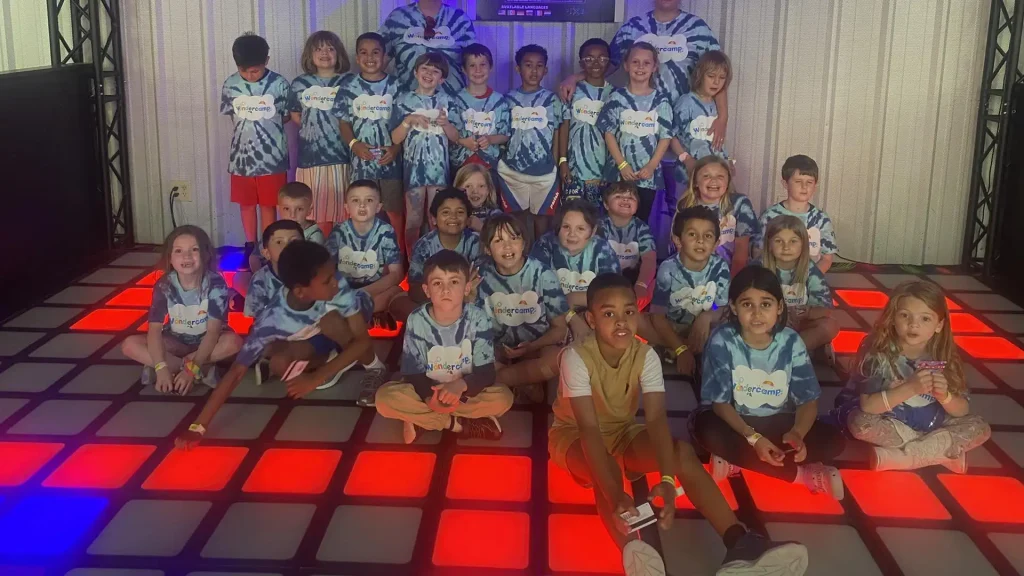
Interactive Game Floor for Indoor Playgrounds: Is It Right?
Written by the Victor Activate Games product team. Last updated: August 17, 2026. Based on product specifications, published safety standards (ASTM F1918-21, EN 1176-10:2023), and publicly available information about the referenced venues — see sources linked throughout.
An interactive game floor for indoor playgrounds can be a useful addition when a venue needs a clearly separated activity for older children, rather than more toddler soft play. Whether it’s the right fit depends on the available footprint, supervision plan, target age mix, and the supplier’s documented technical requirements. It’s not a substitute for soft play, and it generally shouldn’t be placed inside a toddler-focused play structure. Before requesting a quote, it’s worth answering four practical questions: which age group the zone is meant to retain, where staff or parents can actually supervise it, how it fits into your existing traffic flow, and what your site can technically support. This guide walks through those decisions, plus what a supplier should be able to tell you before you commit.
60-Second Fit Check for an Interactive Game Floor for Indoor Playgrounds
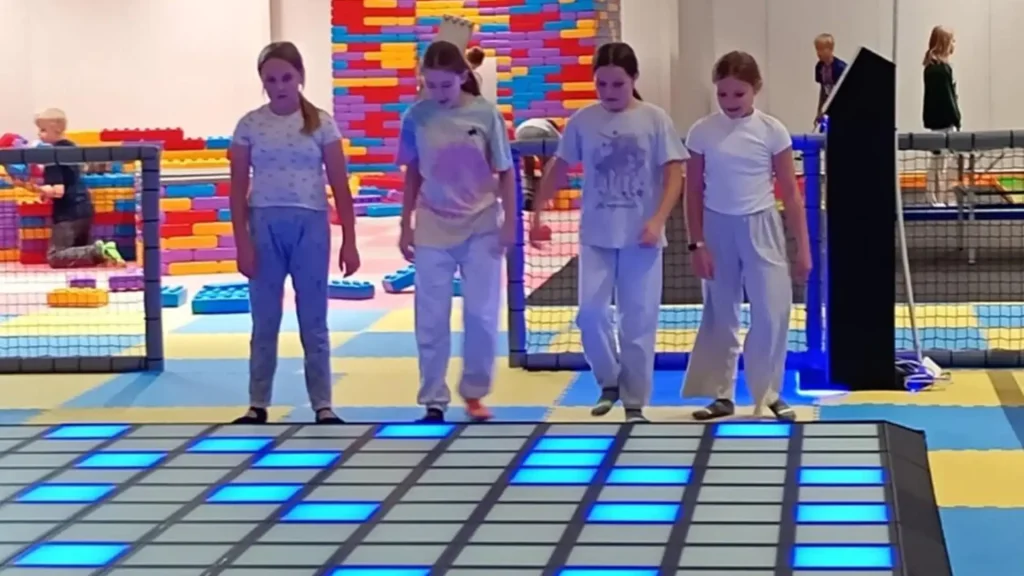
This is probably a good fit for an interactive game floor for indoor playgrounds if:
- Your soft play area works well for toddlers and preschoolers but older kids (roughly 6+) disengage quickly
- You regularly have families with a wide age spread in one visit
- You have a defined space — even a modest one — that isn’t inside your main soft-play structure
- You want an attraction that can be reconfigured (new game modes, themes) without a full renovation
- You monetize through time-based admission, memberships, or party packages rather than per-attraction tickets
Hold off on requesting a quote if:
- Your venue is toddler/preschool-only by design — the age-retention problem this solves doesn’t apply to you
- You don’t have a way to physically separate it from toddler traffic
- Your traffic flow is already congested and you don’t have a clear place to route people to it
- You haven’t decided what specific problem you want it to solve (see the next section — this matters more than it sounds)
Choose the Job Before You Choose an Interactive Game Floor for Indoor Playgrounds
The single biggest planning mistake is skipping straight to size and price before deciding what the zone is actually for. A few common goals, each of which points to a different configuration:
| Goal | What It Usually Means for Configuration |
|---|---|
| Retain older kids who’ve outgrown soft play | Positioned as a distinct “big kid” zone, game modes tuned for ages 6+ |
| Fill the gap while families wait for a party room or table | Smaller footprint near the entrance or party waiting area, shorter game rounds |
| Add a weather-independent draw for slower seasons | Positioned prominently, potentially themed to seasonal promotions |
| Create a standalone paid attraction rather than a bundled amenity | Different sizing and layout considerations than a bundled zone — closer to an FEC-style installation |
Deciding this upfront changes the conversation with a supplier from “how big is a floor” to “here’s the problem I’m solving — what configuration fits it.”
Where an Interactive Game Floor for Indoor Playgrounds Works Best
Read: Interactive Game Floor for Trampoline Parks covers a related but distinct venue type, if you’re evaluating both formats.
Three layouts come up most often:
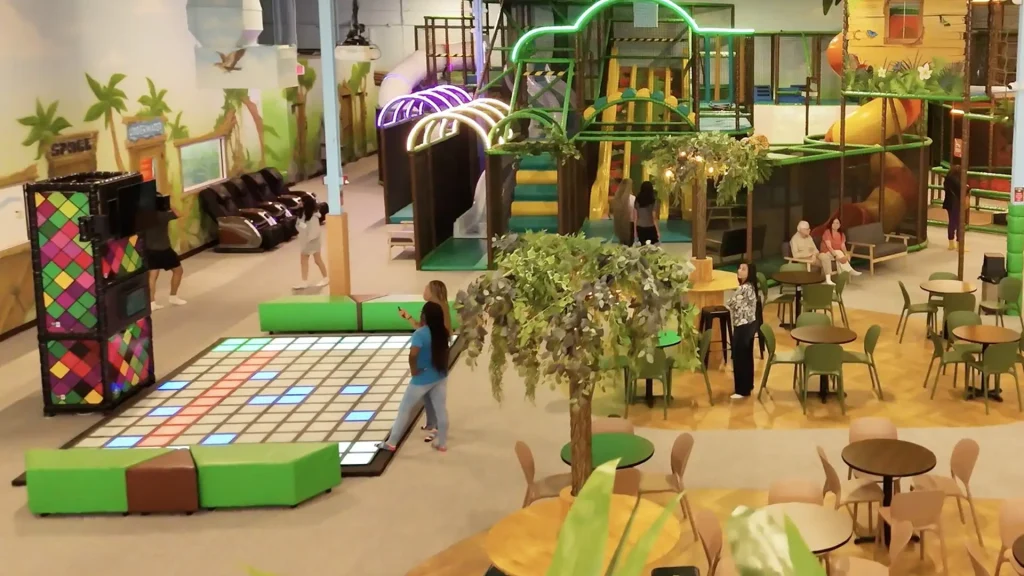
Adjacent to soft play, not inside it. Keeps the interactive zone visible to supervising parents nearby without mixing equipment types — different sensor/surface tolerances, different safety review categories, and easier sightlines for staff.
Near the entrance or party waiting area. High visibility, useful for guests waiting on a party group or check-in — but this placement generally needs shorter game rounds so it doesn’t create a bottleneck.
A designated “big kid” zone, separate from toddler areas. Reduces the pacing mismatch between a toddler wandering near a fast-paced game and an 8-year-old trying to actually compete.
Because tiles are 30×30cm and total quantity scales to the space available, an interactive game floor for indoor playgrounds can be sized for a compact zone alongside existing soft play or a larger dedicated area — for full specifications and configuration options, see the Interactive Game Floor product page.
Risk to plan around: The layout mistake operators run into most isn’t wrong sizing — it’s placing the zone somewhere that made sense on an empty floor plan but turns out to be a natural crossing point for toddler foot traffic once the venue is actually operating. Walking the space at a busy time, not just measuring it empty, catches this before installation rather than after.
Age, Supervision, and Sensory Settings
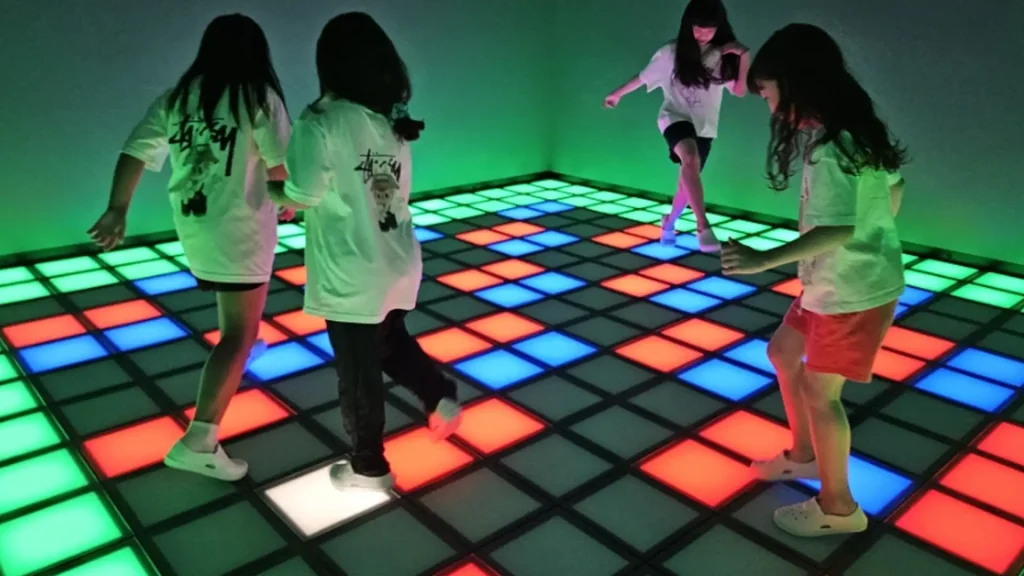
Indoor playground audiences typically skew younger overall than a standalone FEC or trampoline park, which affects a few configuration decisions:
- Game difficulty and pacing should generally be configurable across a wider age range than a single-purpose attraction venue would need — confirm the actual range with your supplier
- Supervision model changes by placement — an unsupervised lobby-adjacent zone needs different game modes than a staffed big-kid zone
- Lower-stimulation or “calm” modes are an increasingly common request, particularly from venues wanting to serve sensory-sensitive kids without dedicating a separate room to it
If a venue needs a lower-stimulation option, ask suppliers specifically whether brightness, flash-rate, audio, and game pacing can be configured independently of each other. An “easy” difficulty setting alone doesn’t establish a genuinely lower-stimulation mode — a “calm” mode that still flashes rapidly or plays loud audio cues doesn’t achieve the actual goal, so it’s worth confirming the specific controls and their limits before presenting a zone to parents as sensory-friendly.
Technical and Safety Questions to Ask Before Buying an Interactive Game Floor for Indoor Playgrounds
Because most indoor playground audiences skew younger, safety documentation carries more procurement weight here than in many other venue types. A supplier should be able to answer these clearly:
| Question | Why It Matters |
|---|---|
| What’s the surface’s anti-slip performance in a barefoot or sock-only environment? | Many soft-play venues operate under this standard already, and it’s a different test condition than general commercial-use durability |
| Can game modes be configured for a younger average age than a typical FEC? | Indoor playground audiences often skew younger than standalone attraction venues |
| How does the equipment fit into your existing safety review process? | Even non-soft-play equipment gets scrutinized under a young-skewing venue’s safety standards |
| Can the zone be sized to sit next to, rather than inside, existing soft play structures? | Keeping equipment types separate simplifies supervision and safety review |
| What’s the actual process if a tile or sensor needs replacing? | Downtime on a visible attraction affects the whole venue’s traffic flow, not just one zone |
Worth knowing directly: ASTM F1918-21 and EN 1176-10:2023 apply specifically to soft-contained and enclosed play equipment — not to interactive floor systems as a category. Ask the supplier which product-specific test reports, safety documentation, and local compliance information they can provide for the actual equipment, rather than assuming either standard applies or doesn’t without checking. Operators evaluating any equipment for a young-skewing venue should still expect these standards to come up in procurement conversations about the venue as a whole, and a supplier who understands them is generally easier to work with during review.
Three Real Installations of an Interactive Game Floor for Indoor Playgrounds
Fun For All — Huntington Beach, California. The operator’s own site lists an “Interactive Super Grid” — described as a “super interactive grid floor game” with 10+ challenge modes — as a named attraction alongside soft play, a toddler zone, a ball pit, and a trampoline area. This is a real operator’s own description of their venue, not a hypothetical use case.
Action Arena — Germany. Combines soft play with an LED interactive grid floor and projection-based games, according to the equipment supplier’s project documentation. This is supplier-sourced evidence, not an independent case study, so it’s worth weighing differently than the Fun For All example — but it confirms the same underlying pairing in a real commercial venue.
Diversión Toledo — Toledo, Spain. A small, family-run indoor playground whose own Instagram account shows an LED grid-style interactive floor as one of several attractions alongside ball pits and slides. It’s a useful reminder that this format doesn’t require a large FEC-style build-out — it can be one modest attraction within a small venue.
Three examples don’t establish an interactive game floor for indoor playgrounds as standard practice across the industry — it isn’t, based on what’s publicly documented. They do establish that the pairing works in practice, across different venue scales and markets, for operators who’ve actually tried it.
What to Send for an Interactive Game Floor for Indoor Playgrounds Layout Recommendation
A generic size recommendation based on square footage alone tends to miss what actually determines whether an interactive game floor for indoor playgrounds gets used well. Sharing the following leads to a more useful recommendation:
- Floor plan and clear ceiling height for the target area
- Target age range and typical group composition (families, school groups, birthday parties)
- What’s already in the venue (soft play layout, party rooms, other attractions)
- Typical foot traffic patterns and peak times
- Whether the zone should be supervised or self-directed
- Your country and rough installation timeline
Read the OEM Interactive Game Floor guide if you’re planning a standardized rollout across multiple locations rather than a single venue.
Frequently Asked Questions
Is an interactive game floor for indoor playgrounds appropriate for toddlers?
Not usually as the primary use case — it’s generally positioned for kids roughly 6 and up who’ve outgrown soft play, though difficulty and game modes can be configured across a range. Discuss your specific target age with a supplier rather than assuming a one-size-fits-all setup.
Should it go inside or next to our existing soft play structure?
Next to, generally — it keeps equipment types and their respective safety and supervision considerations separate while remaining visible to parents nearby.
Does the floor need to meet the same certifications as our soft play equipment?
ASTM F1918 and EN 1176 apply specifically to soft-contained and enclosed play equipment. Ask your supplier which product-specific test reports and compliance documentation apply to the actual equipment rather than assuming either standard applies by default. Expect safety documentation questions to come up anyway during procurement review for a young-skewing venue.
Can it work as a quiet or sensory-friendly zone?
Ask suppliers specifically whether brightness, flash-rate, audio, and game pacing can be configured independently — an “easy” difficulty setting alone doesn’t establish a genuinely lower-stimulation mode. Confirm the available controls and their limits before presenting a zone to parents as sensory-friendly.
What size do we need?
There’s no fixed minimum — tile count scales to whatever space you have, from a compact zone to a larger dedicated area. Share your actual floor plan for an accurate recommendation rather than starting from a generic package.
Considering an interactive game floor for indoor playgrounds? Send us your floor plan, ceiling height, and target age mix. We’ll return a preliminary zone recommendation and the technical questions worth resolving before you request a formal quote. Start here