
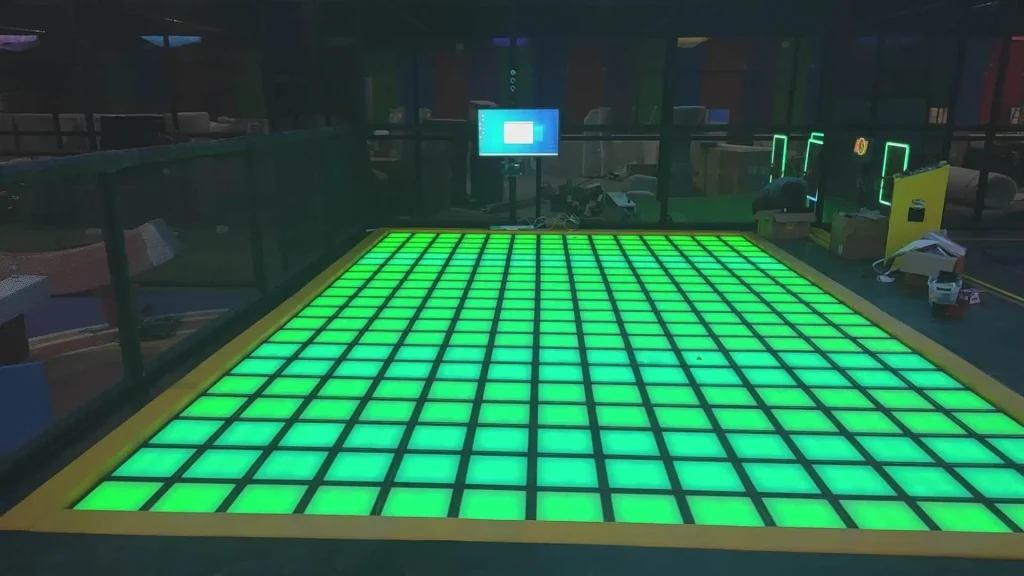
Interactive Game Floor for Trampoline Parks: Layout, ROI & Installation Guide (2026)
Trampoline parks were built around one core activity—and for years, that was enough. It isn’t anymore.
Parents get tired of watching. Younger siblings can’t always jump on the big trampolines. Adults visiting for a birthday party or corporate event don’t always want to bounce for an hour straight.
An interactive game floor solves a problem that’s specific to this venue type—not a generic “add more attractions” problem, but a real gap in who a trampoline-only park can actually serve.
For anyone new to the category, an interactive game floor is a modular LED tile system with under-tile sensors that turns physical movement into gameplay. Players step, dodge, or race across the tiles, and the system responds in real time with lights, scoring, and multiplayer game modes. It’s the same core technology covered in our complete Interactive Game Floor guide—this article focuses specifically on how it fits into a trampoline park’s layout and business model.
Why an Interactive Game Floor for Trampoline Parks Makes Sense
The trend isn’t limited to any one operator. Industry market research on the trampoline park sector consistently points to the same pattern: parks that once competed purely on trampoline square footage are now competing on variety. Climbing walls, obstacle courses, and interactive digital attractions are increasingly standard rather than optional.
Market research on the sector—including Trampoline Park Market analysis—repeatedly cites diversified attractions as a driver of the industry’s growth, not a side effect of it. The same research notes that indoor facilities now dominate the sector, largely because they can offer year-round variety regardless of weather—which is exactly the kind of facility layout an interactive game floor fits into well.
For an individual venue, the practical reasons are simpler than a market report:
Not every visitor can or wants to jump. Younger kids below height/weight minimums, parents supervising, and older adults at group events all need something to do that isn’t standing on the sidelines.
Trampoline sessions are physically intense. A cooldown activity between jump sessions extends total visit time without requiring more bouncing.
Group bookings need more than one activity. Birthday parties and corporate events are easier to sell as packages when there’s a second attraction to build an itinerary around.
How an Interactive Game Floor for Trampoline Parks Differs From What’s Already in the Building
A trampoline park’s core attraction is built around impact—jump height, fall protection, foam pits, structural engineering to handle constant vertical force. An interactive game floor works on a completely different mechanical principle: players move across a flat, ground-level surface, and sensors under the tiles track movement rather than absorbing impact.
That distinction matters for two practical reasons:
1. Space efficiency. A game floor doesn’t need the ceiling height, netting, or structural reinforcement a trampoline court requires. It can go into corners, transition areas, or repurposed space that isn’t large or tall enough to be useful as trampoline square footage.
2. Supervision load. Because there’s no fall height involved, staff supervision requirements are generally lighter than a trampoline court—a relevant factor for parks already stretching staff across multiple zones.
Layout Placement for an Interactive Game Floor in a Trampoline Park
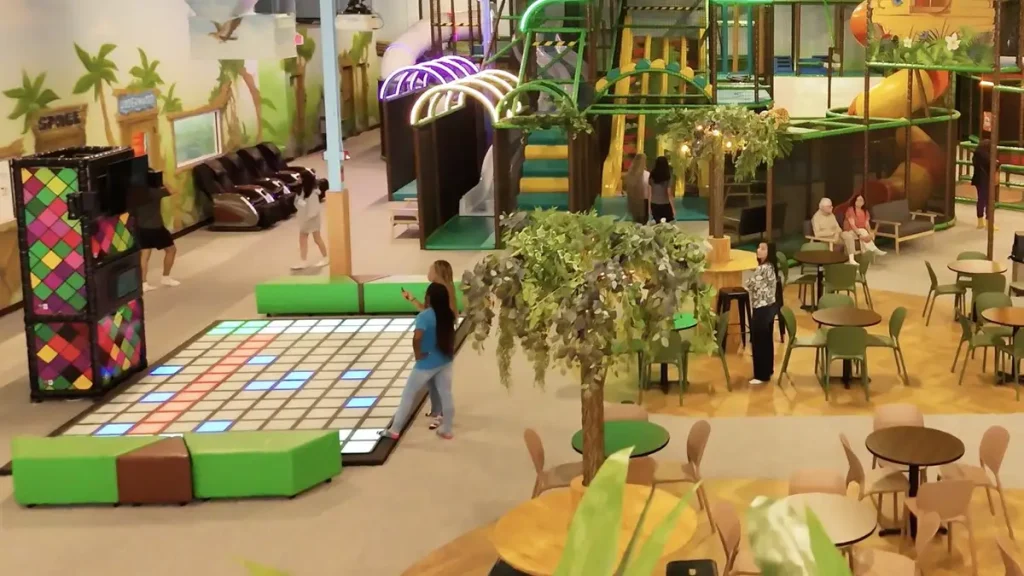
A few placements come up most often when we’re asked to recommend a layout for this venue type:
| Placement | Best For |
|---|---|
| Near the entrance or check-in area | Visible to arriving groups; useful as a warm-up activity before jump sessions begin |
| Adjacent to party rooms | Gives birthday groups a second activity without needing to walk across the building |
| In a designated rest/cooldown zone | Positioned as the “catch your breath” attraction between trampoline sessions rather than competing with them for the same energy level |
Because tiles are 30×30cm and total quantity scales to the space available, the floor can be sized to fit almost any leftover or transitional area in an existing building—it doesn’t require redesigning the whole facility around it.
Thinking About ROI in a Trampoline Park Context
The ROI logic here is different from a standalone FEC, where the floor might be the primary ticketed attraction. In a trampoline park, it’s more often bundled into an existing wristband or session price rather than sold separately—which shifts the ROI question from “how much does this attraction earn on its own” to “does this attraction increase total visit length, group booking conversion, and repeat visits.”
The same underlying formula still applies, just with different inputs:
Revenue Impact = (Increase in Average Visit Length × Session Price) + (Increase in Group Booking Conversion Rate × Average Group Booking Value)
Rather than treating the floor as a separate profit center, most trampoline park operators we work with model it as a retention and conversion tool—its value shows up in longer visits and higher group-booking close rates, not in a separate ticket line.
For a fuller breakdown of how to think about active-gaming ROI generally:
→ Read: Active Gaming Room ROI — How FEC Operators Maximize Returns
Interactive Game Floor Cost for Trampoline Parks
Cost for an interactive game floor for trampoline parks scales with tile quantity, not a fixed package—which means the right way to think about budget is by installation size rather than a single price point:
| Installation Size | Typical Use Case |
|---|---|
| Small | A compact transition zone or corner area; typically the entry point for parks adding their first secondary attraction |
| Medium | A dedicated cooldown zone or party-room-adjacent area; sized for regular group traffic rather than occasional use |
| Larger custom project | Multi-zone layouts for parks planning several secondary attractions together, or chains standardizing a layout across multiple locations |
Rather than working from a generic price list, cost is quoted against your actual floor plan—tile count, customization level, and installation complexity all factor in before a number makes sense.
What We Consider When Designing for This Venue Type
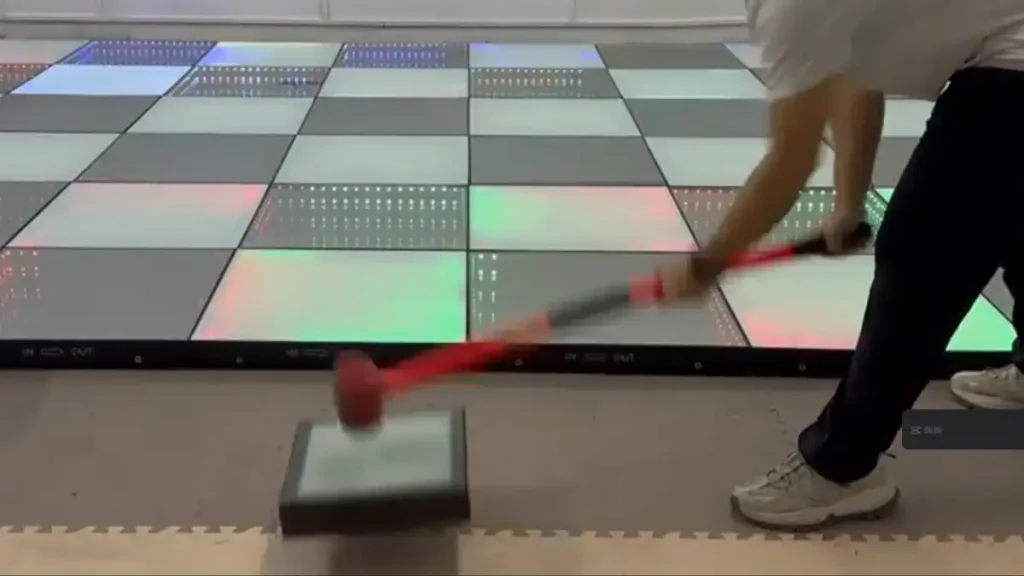
Designing an interactive game floor for trampoline parks means accounting for a specific kind of wear: high foot traffic, sock-only surfaces in many venues, and near-continuous operating hours during peak season. From a hardware standpoint, that means:
Surface durability matters more here than in a lower-traffic FEC setting—the floor needs to hold up under sock traffic and constant use without the anti-slip coating degrading faster than expected.
Sensor calibration needs to stay stable under near-continuous operation, not just intermittent use, since trampoline parks often run longer daily hours than a standalone attraction venue.
Cleaning compatibility matters—many trampoline parks already have cleaning protocols in place for sock-only surfaces, so the floor’s surface material needs to tolerate whatever sanitizing routine the venue already uses, rather than requiring a separate process.
How It Compares to Other Trampoline Park Add-Ons
Interactive game floors aren’t the only secondary attraction trampoline parks consider. The most common alternative is a climbing wall, and the two aren’t competing options so much as different answers to different problems.
| Attraction | Intensity Level | Best For | Space Required |
|---|---|---|---|
| Interactive Game Floor | Low to medium | Cooldown, younger kids, parents, group play | Flexible—fits odd spaces |
| Climbing Wall | High | Older kids, teenagers, intensity-seekers | Vertical—needs wall space |
| Obstacle Course | Medium to high | Larger parks with space to spare | High—significant floor footprint |
A climbing wall adds a vertical, physically demanding challenge that appeals to older kids and teenagers looking for something more intense than the trampoline courts themselves—it’s an intensity add-on. An interactive game floor does the opposite: it’s a lower-intensity, ground-level attraction that works as a cooldown or an activity for visitors who can’t or don’t want to jump.
Parks with the space for both often use them to bracket the visit—floor near the entrance as a warm-up, climbing wall deeper in the venue as a bigger physical challenge for groups looking for more.
→ Read the full Interactive Climbing Wall guide
Obstacle courses are the third common option, but they typically require more floor space and higher supervision than either a game floor or a climbing wall, which is why they tend to appear in larger parks rather than as a first secondary attraction.
Common Mistakes When Adding a Secondary Attraction to a Trampoline Park
A few patterns show up repeatedly when trampoline park operators plan their first interactive game floor installation:
Treating it as a standalone profit center from day one. As covered above, the ROI case for a trampoline park is usually about visit length and group-booking conversion, not a separate ticket line. Operators who expect it to generate its own revenue stream immediately are measuring it against the wrong benchmark.
Underestimating cleaning and surface compatibility requirements. Trampoline parks already run sock-only cleaning protocols in many cases—it’s worth confirming any new surface is compatible with the venue’s existing sanitizing routine before ordering, rather than discovering a mismatch after installation.
Placing it too far from existing traffic flow. A secondary attraction tucked into an unused back corner gets far less use than one positioned somewhere visitors naturally pass—near the entrance, party rooms, or the transition between trampoline sessions.
Sizing it based on available space alone, without considering supervision. A larger floor covering more of an open area can look like a better use of space, but if it stretches staff coverage thinner than the venue can support, a smaller, well-supervised installation is usually the better choice.
FAQ: Interactive Game Floors for Trampoline Parks
Will this compete with our existing attractions or complement them?
In most layouts, it complements rather than competes—it’s rarely positioned as a replacement for trampoline courts, but as an addition that serves visitors the trampoline courts can’t (younger kids, parents, cooldown periods).
Do we need dedicated staff to supervise it?
Generally lighter supervision than a trampoline court, since there’s no fall-height risk. But this depends on group size and your venue’s existing staffing model—worth confirming against local requirements for your specific layout.
Can it fit into leftover space, or does it need a dedicated room?
Because tile quantity scales to the space rather than requiring a fixed footprint, it can often go into odd-shaped or smaller areas that wouldn’t be usable as additional trampoline square footage.
Should it be sold as a separate ticket or bundled into admission?
Most trampoline parks bundle it into existing admission rather than ticketing it separately—the value case is usually about extending visit length and improving group-booking conversion, which works better as an included feature than a paywalled add-on.
Does it need its own power or structural setup separate from the rest of the building?
It needs standard commercial power, but no special structural reinforcement—unlike a trampoline court, which requires specific structural engineering for impact and fall protection.
How much does an interactive game floor cost for a trampoline park installation?
Cost depends on tile quantity and customization level, which depend on your available space—for a quote based on your actual layout, see our full cost and ROI guide or request a quotation directly.
How much space do we need to set aside?
There’s no fixed minimum—tile count scales to whatever area you have available, from a small transition zone to a larger dedicated space.
Can the game modes be customized for a trampoline park audience?
Yes—game libraries can be adjusted for different age groups and session lengths, which is useful for venues serving both young children and adult group bookings.
Do you provide installation support for trampoline park projects?
Yes—layout recommendations and installation guidance are part of the standard process; see our installation guide for what that typically involves.
Why Trampoline Park Operators Work With Us Directly
A few specifics worth knowing about an interactive game floor for trampoline parks, since they directly affect how well it fits into a trampoline park’s existing operation:
30×30cm modular tiles — quantity scales to your space rather than being sold as a fixed package, which matters for the odd-shaped or leftover areas common in trampoline park buildings.
Multiplayer support — built for group play, which matches how trampoline park visitors typically move through the venue in groups rather than alone.
Custom game library — game modes can be adjusted to fit different age groups and session lengths, useful for a venue serving both young kids and adult group bookings.
Factory-direct and OEM support — relevant for larger trampoline park chains planning branded, multi-location rollouts rather than a single installation.
Learn more about the full product spec on our Interactive Game Floor product page.
Getting a Layout Recommendation
Because the right size and placement for an interactive game floor for trampoline parks depends on your specific building—leftover space, ceiling height in different zones, existing traffic flow, and whether you’re planning to bundle it into admission or a party package—a generic quote based on square footage alone tends to miss the details that actually determine whether the installation gets used.
Sharing your full floor plan, not just the space you’re considering for the floor, usually leads to a more useful layout recommendation than starting from a fixed package.
Quick Summary: Is an Interactive Game Floor Right for Your Trampoline Park?
| Factor | Consideration |
|---|---|
| Visitor segments | Do you have younger kids, parents, or adults who don’t want to jump? |
| Space availability | Do you have odd-shaped or leftover areas that can’t fit more trampolines? |
| Visit duration | Are you looking to extend average stay without adding more jump time? |
| Group bookings | Do you want to strengthen birthday party and corporate event packages? |
| Staffing | Can you accommodate lighter-supervision attractions alongside trampoline courts? |
If you answered yes to two or more, an interactive game floor is likely a strong fit.
Ready to plan an interactive game floor for your trampoline park?
Send us your floor plan and we’ll recommend:
- Suitable floor size
- Game configuration
- Installation layout
- Estimated investment
👉 Get a free layout proposal →
Bring an Interactive Game Floor to Your Trampoline Park
Our commercial-grade Interactive Game Floor is built for high-traffic trampoline parks and FECs durable tiles, turnkey installation, and game content that keeps guests coming back.
View Interactive Game Floor Get a Free Quote Chat on WhatsApp