
Active Gaming Room vs Activate Games Franchise: What FEC Operators Should Know (2026)
An active gaming room is one of the most commercially discussed entertainment formats in the FEC industry right now. Activate Games built a global brand around it. Investors across multiple markets are trying to understand whether to join that brand — or build independently.
The conversation usually starts the same way. An operator researches Activate, finds the concept compelling, then discovers the entry requirements: minimum venue size of 930㎡ or more, capital requirements starting at CAD $10 million in Canada, fixed supplier relationships, fixed game content, and ongoing royalty obligations. For most operators outside North America’s primary markets — and for many within them — those requirements do not match the commercial real estate that is actually available.
The question is not whether the active gaming room model works commercially. Activate’s global expansion has answered that. The question is whether you need to be inside Activate’s franchise system to build a commercially viable active gaming room.
The answer is no — but understanding what the franchise gives you, and what an independent active gaming room requires you to build yourself, is the right starting point for any investment decision in this category.
What the Activate Games Franchise Actually Includes
Before comparing paths, it is worth being specific about what the Activate franchise model actually delivers — because some operators overestimate it and others underestimate it.
Venue and space requirements
Activate’s real estate page specifies venues between 10,000 and 14,000 square feet — approximately 930 to 1,300㎡ — with a minimum ceiling height of 12 feet (3.6 meters). Locations need enough space for 8 to 12 game rooms, a lobby, two restrooms, and a storage area. The Sterling, Virginia location spans 9,212 square feet with 11 interactive game rooms and more than 800 challenges. The Helsinki, Finland location is 929㎡ with 10 game rooms and over 700 challenge levels.
These are large commercial units by most markets’ standards. Finding a 1,000㎡ unit with 3.6 meter ceilings in a mall or high street location is a significant real estate constraint.
Capital requirements
In Canada, Activate franchise investors need access to a minimum of CAD $10 million depending on location, in available cash or proven financing. This reflects the scale of the build-out: large facilities, custom-built gaming rooms, advanced technology systems, leasehold improvements, and significant working capital for the early operational period. FranchiseSeek
This is not a small FEC addition. It is a standalone entertainment venue investment at the scale of a mid-size cinema or bowling alley.
What the franchise provides
The franchise system delivers Activate’s branded RFID wristband technology, its proprietary scoring and progression platform, access to its full game content library (currently expanding past 50 game room types), ongoing content updates, brand recognition in markets where Activate has visibility, and operational training and support.
For investors in markets where Activate already has strong consumer awareness — primarily Canada and expanding US cities — the brand recognition has real commercial value at opening. New locations in established markets can leverage Activate’s existing social media presence and word-of-mouth rather than building an audience from scratch.
What the franchise restricts
Suppliers are fixed. Game content is controlled by Activate. Pricing must align with franchise standards. Operational decisions require franchise approval. Ongoing royalty fees reduce margin. And in markets where Activate has limited or no existing consumer awareness — most of Asia, the Middle East, Eastern Europe, Southeast Asia, and Latin America — the brand premium is significantly reduced.
What an Independent Active Gaming Room Looks Like in Practice
An independent active gaming room uses the same room-rotation operating model as Activate, but without the franchise system. Operators source equipment directly from manufacturers, build their own brand, and design a game mix suited to their specific market and space.
Space flexibility
An independent active gaming room can operate effectively in 200 to 500㎡ after accounting for reception, corridors, and restrooms. A 200 to 280㎡ venue supports four challenge rooms covering four distinct player states. A 300 to 400㎡ venue supports five to six rooms. A 400 to 500㎡ venue reaches seven to eight rooms — approaching the game type coverage of a small Activate location at roughly half the real estate footprint.
This matters practically. A 250㎡ commercial unit is available in most shopping centres globally. A 1,000㎡ unit with high ceilings in the same centres is rare, expensive, or both.
Capital requirements
Without a franchise fee, without mandated supplier pricing, and at a smaller scale, the total investment for an independent active gaming room is substantially lower than a franchise build-out. The exact figure depends on market, fit-out standards, and game mix — but operators building a 300 to 400㎡ venue with five to six rooms are working in a completely different investment bracket than the CAD $10 million minimum that Activate Canada requires.
Brand building
The trade-off is that independent operators build their brand from zero. There is no Activate recognition to borrow. This is a meaningful challenge in the first six to twelve months, and it underscores why social media visibility matters: an interactive game floor with strong visual appeal generates organic short-form video content that can substitute for brand recognition in building initial awareness.
Expansion path
Independent active gaming rooms can expand room by room as venue performance justifies the investment. Pre-running electrical and structural infrastructure during the initial build makes adding a fifth or sixth room a relatively simple equipment addition rather than a renovation project. This staged expansion approach is not available within a franchise system that requires a full build-out at opening.
Side-by-Side: Franchise vs Independent Active Gaming Room
| Activate Franchise | Independent Active Gaming Room | |
|---|---|---|
| Minimum venue size | 930㎡+ | 200㎡ workable |
| Capital requirement | CAD $10M+ (Canada) | Significantly lower |
| Franchise / royalty fees | Yes — ongoing | None |
| Brand recognition | Strong in North America | Build from zero |
| Supplier flexibility | Fixed | Manufacturer direct |
| Game content control | Activate system | Fully customisable |
| Pricing flexibility | Franchise standards | Complete autonomy |
| Local market customisation | Limited | High |
| Content update path | Via Activate | Via manufacturer |
| Expansion flexibility | Full build-out required | Room by room |
| Best for | North American markets, high capital investors | Global markets, operators wanting control |
What Game Types Does an Independent Active Gaming Room Need?
The commercial strength of the active gaming room model — whether franchise or independent — comes from covering multiple player states within a single session. A group of four players with different strengths should each find a room where they perform well and a room where they genuinely struggle.
Here is how the core game types map to player states, and why each earns its place in a well-planned active gaming room:
| Game Type | Player Skill | Commercial Role |
|---|---|---|
| Interactive Game Floor | Full-body movement | Anchor attraction — highest visual impact |
| Laser Maze | Precision and patience | Tempo variation — slows the session rhythm |
| Push Button Wall | Reaction speed and memory | High replay value — short cycles, specific failure |
| Hide Room | Strategy and timing | Unique player state — no other room covers it |
| Hoops Game | Sports accuracy | Group competition — strong for corporate bookings |
| Climbing Wall | Vertical movement | Visual differentiation — strong social content |
| Ball Pipe Wall | Team coordination | Corporate and party anchor — physical team mechanic |
Interactive Game Floor — the anchor room
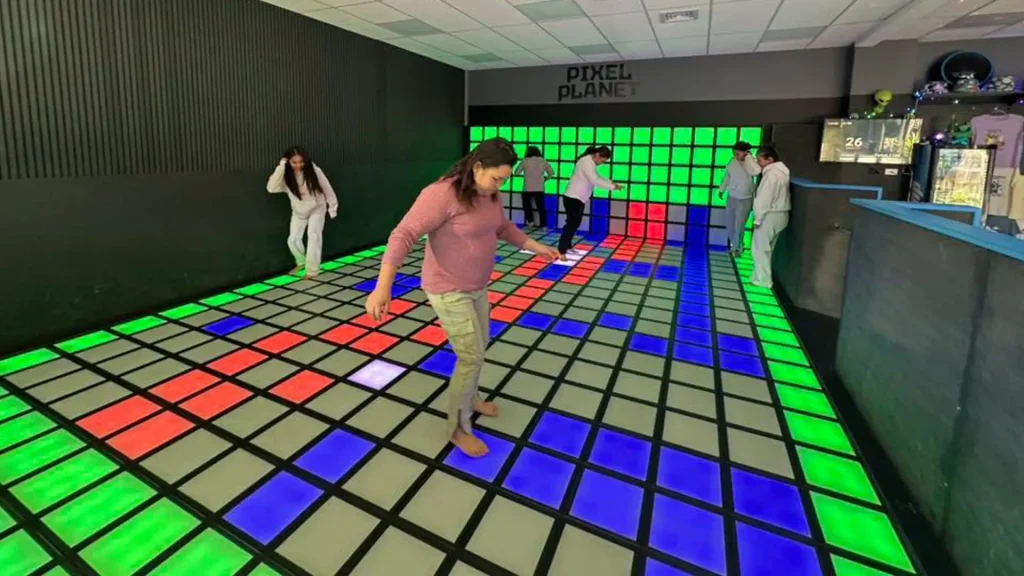
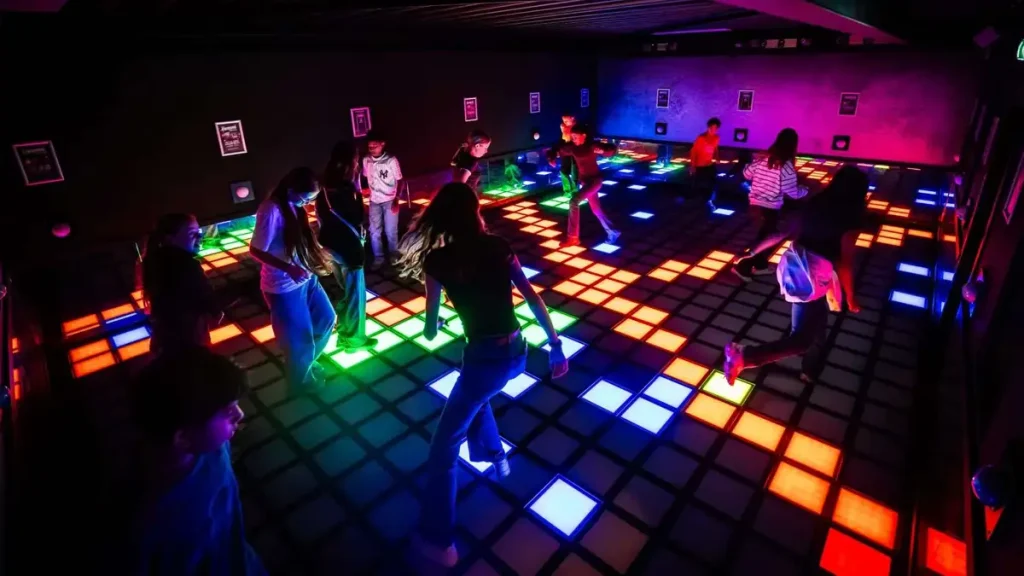
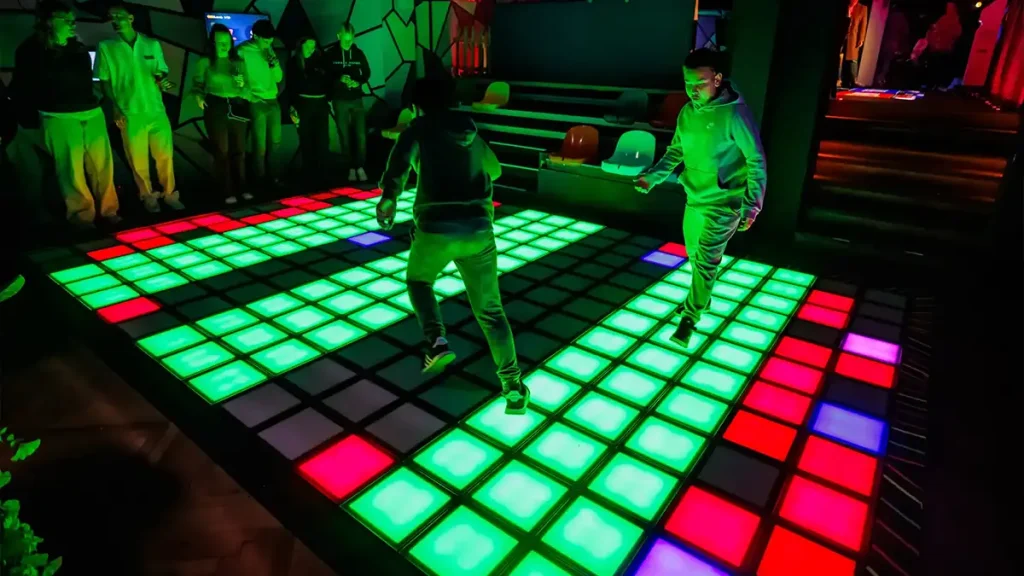
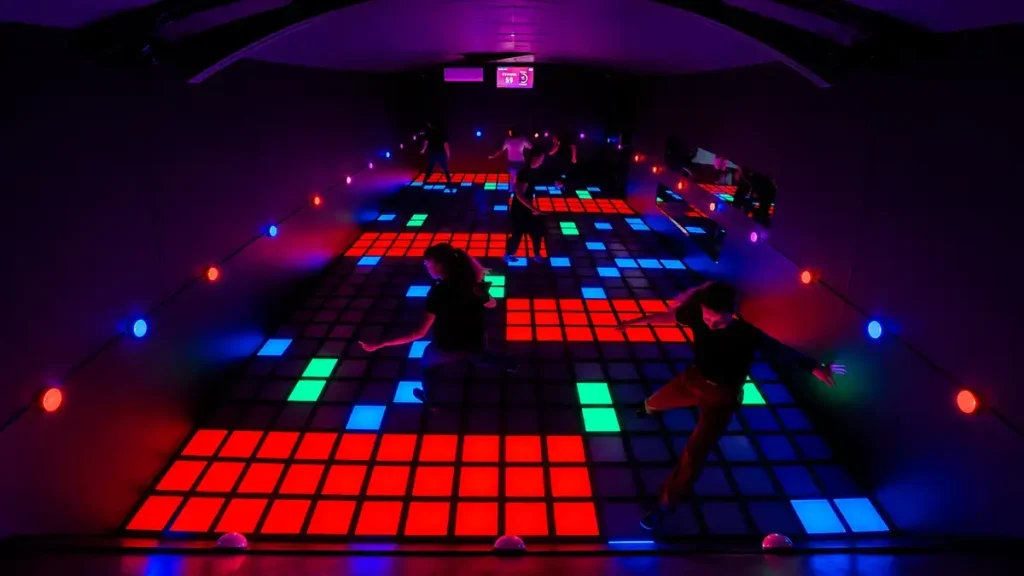
The most visually impactful attraction in any active gaming room. Players move across a reactive LED tile surface responding to patterns, challenges, and team objectives. This room generates more organic social media content than any other room type and should be positioned where it is visible from outside the venue. Every active gaming room starts here.
Commercial Laser Maze Game — the precision room
Slows the session rhythm between high-energy rooms. Players who dominate the game floor often find the laser maze unexpectedly difficult — that contrast creates a specific motivation to return and improve. A compact footprint makes it easy to include even in smaller venues.
Push Button Game Wall — the high-replay room
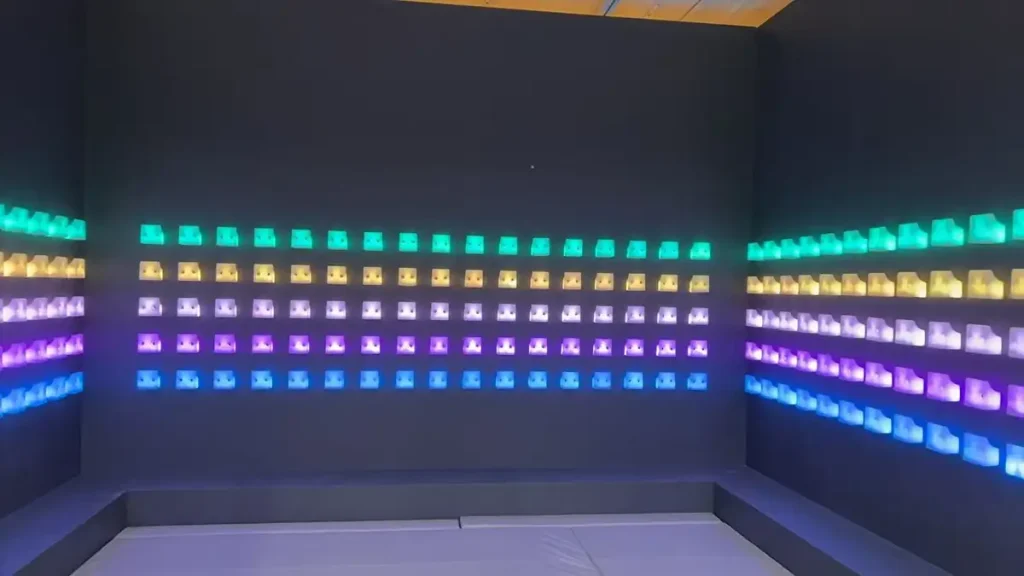
Short 60 to 120 second sessions, visible scoring, and team coordination under pressure. The most consistently replayed room type in active gaming venues we have worked with — because the failure is always specific and the improvement always feels achievable.
Evil Eyes Hide Game — the strategy room
The only room in an active gaming room where moving slowly is an advantage. Players who lead in every other room often struggle here. That reversal is what makes it memorable and drives the specific replay motivation: returning to master the room where you performed worst.
Interactive Hoops Game — the sports competition room
Color-shifting LED backboards combine shooting accuracy with real-time color decision-making. Introduces a sports-competitive dynamic that appeals to a different player type than the floor or push wall. Strong for corporate bookings where a clear scoring outcome matters.
Interactive Climbing Wall — the vertical challenge room
Adds physical and visual variety that no floor or wall-mounted game can replicate. Touch-activated holds in LED patterns create a challenge that works across age ranges without requiring athletic climbing experience.
Interactive Ball Pipe Wall — the team coordination room
The only active gaming room attraction that requires a genuine physical exchange between players. One player identifies the correct pipe, another catches and inserts the ball, within a tight time window. The most team-dependent challenge in the mix — and the one corporate groups consistently rate as their strongest team-building experience.
These seven game types cover the full range of player states that makes an active gaming room commercially durable. They can be deployed in a 200 to 500㎡ venue and scaled up room by room as the business justifies expansion.
For detailed layout planning across these room types, see our interactive gaming room layout guide.
Which Path Is Right for Your Active Gaming Room Project?
Neither path is universally better. The right answer depends on three variables: your market, your capital, and your operational goals.
Choose the Activate franchise if:
You are in a North American market where Activate already has consumer recognition. You have access to the capital required for a full franchise build-out. You can secure a 930㎡+ commercial unit with appropriate ceiling height. You want to operate within a proven system rather than build operational processes from scratch. And you are comfortable with the ongoing royalty structure and supplier constraints that come with franchise operation.
Choose an independent active gaming room if:
Your available venue space is between 200 and 500㎡. You are operating in a market where Activate has limited or no brand presence — most of Asia, Southeast Asia, the Middle East, Eastern Europe, Oceania, and Latin America. You want complete control over pricing, suppliers, branding, and game content. You want to validate the market with a lower initial investment before committing to a larger build. Or you are planning to build your own brand in a market where the active gaming room concept is new but not yet dominated by Activate.
In projects we have worked on with operators across multiple markets, the independent active gaming room path consistently makes more commercial sense for venues outside North America’s primary cities. The Activate brand premium has real value where Activate is known. In markets where the brand is unfamiliar, an independent operator can build equivalent game quality, equivalent player experience, and equivalent replay mechanics — without the franchise fee, royalty structure, or minimum scale requirements.
The core question is not “franchise or independent.” It is whether your active gaming room covers enough player states, is laid out to maximize session flow, and has the visual anchor in the right position. Those decisions determine commercial performance more reliably than which system the equipment comes from.
For operators at the earlier stage of planning the full experience, our interactive gaming room games guide and how to build an interactive gaming room cover the full planning sequence from concept to opening.
Planning an Active Gaming Room Project?
Whether you are evaluating an Activate franchise or building an independent active gaming room, the first step is understanding how different game types work together as a complete experience — not which individual game to buy first.
Our team works with FEC operators and active gaming room investors across multiple markets. We can help review:
✓ Recommended room mix based on your venue size and audience
✓ Active gaming room layout and player flow design
✓ Space planning for 200–500㎡ venues
✓ Interactive game floor integration as the anchor attraction
✓ Challenge room combinations and sequencing
✓ OEM branding options for independent active gaming rooms
✓ Factory-direct equipment supply
Send us your floor plan for a free concept review.
Contact us on WhatsApp
View our Interactive Game Floor product page
Explore our Interactive Gaming Room Layout Guide
Active Gaming Room FAQ
What is the difference between an Activate Games franchise and an independent active gaming room?
An Activate Games franchise gives operators access to Activate’s brand, technology platform, game content library, and operational system — in exchange for a franchise fee, ongoing royalties, fixed supplier relationships, and minimum venue size requirements starting at 930㎡. An independent active gaming room uses the same room-rotation model and session-based format, but without the franchise system. Operators source equipment directly, control their own brand and pricing, and can build at venues from 200㎡ upward.
How much does it cost to build an active gaming room?
Costs vary significantly by market, venue size, and game mix. An Activate Games franchise in Canada requires a minimum of CAD $10 million in available capital. An independent active gaming room at 200 to 400㎡ operates in a substantially lower investment bracket — without franchise fees or royalties — and can be expanded room by room as performance justifies the investment.
How much space do you need for an active gaming room?
An effective active gaming room covering four core game types can operate in approximately 200 to 280㎡ after allocating space for reception, corridors, and restrooms. A five to six room active gaming room typically needs 300 to 400㎡. Seven to eight rooms fit comfortably in 400 to 500㎡. Full Activate franchise venues require 930㎡ or more.
Can you build an Activate-style active gaming room without buying a franchise?
Yes. The room-rotation model, timed session format, difficulty progression, and multi-challenge room mix are operating format decisions that any venue can adopt. What is proprietary to Activate is its brand, RFID platform, and specific game content. Independent operators build equivalent experiences using direct-sourced equipment, their own branding, and a game mix tailored to their local market.
Which markets are best suited for independent active gaming rooms?
Independent active gaming rooms perform particularly well in markets where Activate has limited or no existing brand presence — which includes most of Asia, Southeast Asia, the Middle East, Eastern Europe, Oceania, and Latin America. In these markets, there is no brand premium for the franchise, and independent operators can build the full active gaming room experience without the minimum scale and capital requirements that franchise agreements impose.
What game types does an active gaming room need to succeed commercially?
The minimum viable active gaming room covers four distinct player states: full-body movement (interactive game floor), reaction speed (push button wall), precision control (laser maze), and strategy or team coordination (hide room or ball pipe wall). Adding sports competition (hoops game) and vertical challenge (climbing wall) extends the mix to six player states — covering the full audience range from children to corporate groups and delivering the session variety that drives repeat visits.