
Interactive Hoops Game: Why Basketball Challenge Rooms Work in Active Gaming Venues (2026)
Someone shoots the wrong color with three seconds left on the clock. The team groans. The score that was almost a personal best disappears. Before the display has finished updating, someone is already asking for another round.
That moment — specific, competitive, immediately repeatable — is why an interactive hoops game performs differently from most other active gaming attractions. It is not a traditional basketball machine. It is a software-driven challenge room where shooting accuracy is only part of the game. Color recognition, timed decision-making, and team coordination determine the result as much as whether the ball goes through the hoop.
This guide covers how an interactive hoops game works inside a commercial active gaming venue, why the basketball format creates a specific kind of engagement that other room types do not replicate, and what operators need to evaluate before adding one to their project.
What Is an Interactive Hoops Game?
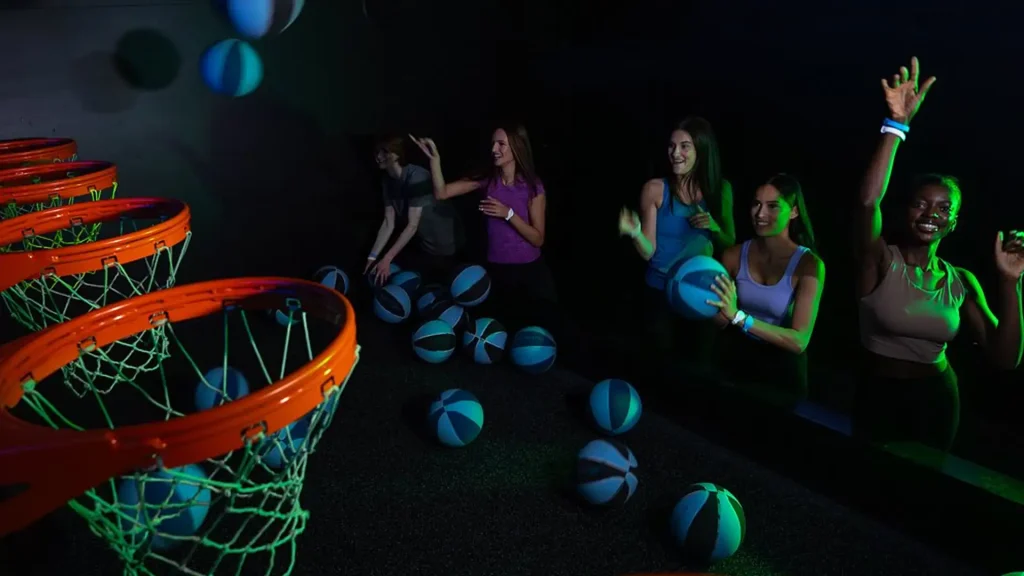
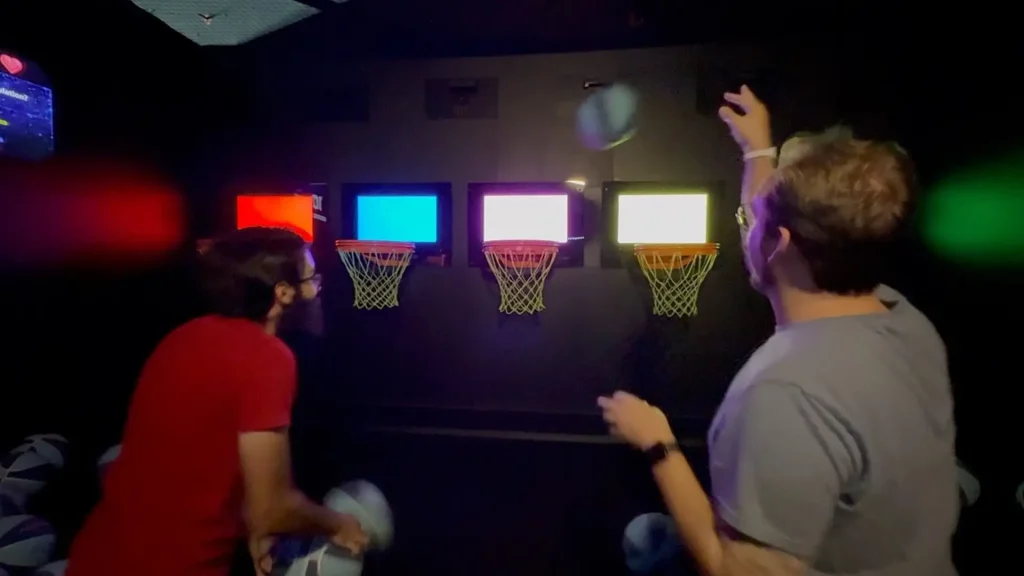
An interactive hoops game is a basketball challenge room where LED-lit backboards change color according to software-driven instructions. Players must shoot at the correct color target within a time limit, combining physical shooting accuracy with real-time color recognition and memory challenges.
The distinction from a conventional arcade basketball machine matters commercially. A coin-operated basketball machine measures how many balls a player can sink in a fixed time. An interactive hoops game adds a second layer: players must shoot at specific targets in a specific order, respond to color changes mid-session, and adapt their strategy as the game difficulty increases. Missing the right hoop costs as much as missing the shot entirely.
The game combines dynamic quick-hit challenges and precision shooting challenges, testing players’ shooting skills, memory, and quick reaction. In competition mode, each player can choose a color as their shooting color, and whichever color scores the most points within the time limit wins. Made-in-china
The minimum recommended floor area for a commercial interactive hoops game is approximately 3×5 meters. The system includes five basic game modes, and administrators can create unlimited additional games via the backend. That software flexibility is part of what makes the interactive hoops game commercially sustainable beyond the first few weeks of operation. PlayActivate
Why the Interactive Hoops Game Creates Replay Value
Basketball is one of the few physical skills that almost everyone has tried and almost no one feels they have fully mastered. That gap between familiarity and genuine competence is the foundation of the interactive hoops game’s replay value.
First-time players understand the concept immediately. You shoot at the hoop. The hoop changes color. You adjust. That accessibility means groups do not need a briefing before they can contribute. Within thirty seconds, everyone is playing.
What changes between the first round and the fifth is the layer of decision-making that sits on top of the physical skill. A player who can consistently sink shots still has to identify the right target, prioritize between two active colors, and communicate with teammates about who covers which backboard. Those decisions become the source of replay motivation rather than the shooting itself.
The failure, when it comes, is always specific. Someone shot the wrong color. Someone hesitated on a target switch. Someone took a difficult angle when an easier target was available on the other side. That specificity is what creates the immediate desire to try again — not because the session was bad, but because the improvement is visible.
In venues we have worked with, the interactive hoops game tends to generate particularly strong replay behavior among groups that include at least one player who is genuinely confident at basketball. That player’s confidence often does not translate as directly as expected into a high score on the first session, which creates a competitive motivation that extends well beyond a single visit.
How the Interactive Hoops Game Fits the Active Gaming Room Model
An interactive hoops game is not a standalone purchase. It earns its place as one room inside a complete active gaming venue where players rotate through different challenge types during a timed session.
The room-based model that defines modern active gaming venues works because different rooms demand genuinely different skills. The interactive game floor asks for full-body movement across a large surface. The laser maze asks for slow, controlled precision through a fixed space. The push button game wall asks for upper-body reaction speed and team coordination. The evil eyes hide game asks for patience and strategic movement.
The interactive hoops game adds the one skill set this mix does not otherwise cover: targeted physical accuracy combined with real-time cognitive decision-making. Players who move well on the floor game, react fast on the push wall, and navigate precisely through the laser maze may still find the basketball challenge room difficult — because the bottleneck here is not physical speed or spatial awareness but shooting accuracy under color-switching pressure.
That distinction matters commercially. A venue that covers genuinely different skill demands across its rooms creates a session where different players within the same group each find something they are specifically good at. The interactive hoops game gives athletic groups with basketball backgrounds a room where their skill is tested in a new way, rather than simply replicated.
The hoops challenge combines sports gaming with interactive LED target technology, where players shoot basketballs toward illuminated targets while competing in reaction-based challenges and multiplayer scoring battles. walmart
The footprint requirement of 3×5 meters makes the basketball challenge room one of the more compact options within a multi-room active gaming layout. It fits naturally alongside a laser maze or climbing wall challenge without requiring the venue’s largest available zone.
For full venue planning guidance, see our how to build an interactive gaming room guide.
How the Interactive Hoops Game Performs Across Booking Types
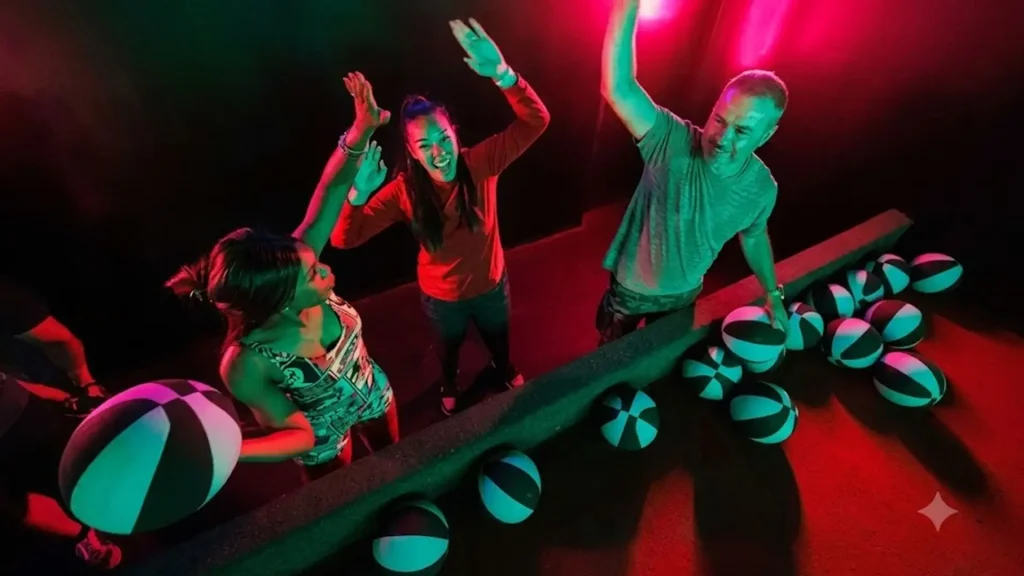
Birthday parties. The basketball format is one of the most universally understood competitive games across age groups. In a birthday group with mixed ages, the interactive hoops game creates natural team competition without requiring any rules explanation. Who scored more becomes the immediate question, and the color challenge layer means the result is not predetermined by whoever is the strongest shooter. Groups replay quickly because the format produces a clear winner and a clear rematch motivation.
Corporate team-building. The competition mode — where each team member defends a color — creates a direct head-to-head format that produces a concrete, score-based result. Unlike some active gaming room types where team performance is collaborative and outcomes are ambiguous, the interactive hoops game produces a winner. That clarity makes it particularly effective for corporate groups where individuals want a specific competitive context rather than purely cooperative gameplay.
In projects we have worked with, corporate bookings that include a basketball challenge room consistently report stronger engagement scores than sessions without one — specifically because the sports-competitive format feels distinct from both office environments and typical team-building activities that rely on abstract exercises.
School and youth groups. Basketball is part of physical education curricula in most markets. The interactive hoops game takes that familiar activity and adds a challenge layer that students have not encountered before. Lower difficulty settings allow younger groups to participate without frustration, while the competitive scoring format keeps older students engaged without requiring elite athletic ability.
Walk-in visitors and regular players. The interactive hoops game holds returning visitors well because the skill progression has two independent tracks: shooting accuracy and color-decision speed. A player can improve one without improving the other, which creates dual goals for returning visits. Leaderboard visibility amplifies this — a posted high score in a basketball challenge room has particular competitive appeal because basketball performance feels like something people should be able to improve with practice.
What Makes an Interactive Hoops Game Perform Well Over Time
Software depth determines long-term engagement.
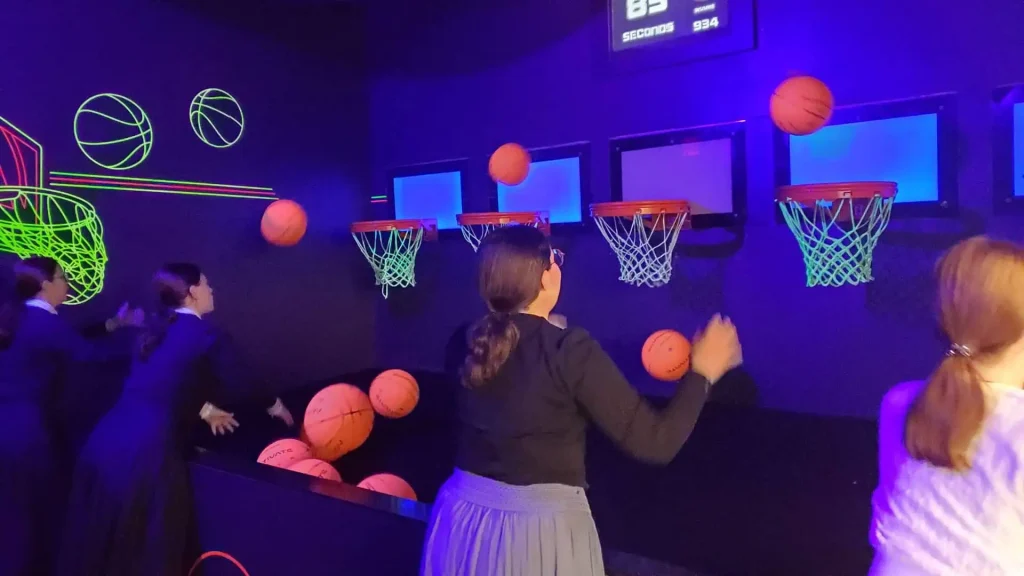
The physical hardware — the hoops, the LED backboards, the sensors — changes very little after installation. What keeps players returning is the software: the number of game modes available, how difficulty scales within each mode, and whether new challenges can be added after installation. A basketball challenge room with five game modes and an open backend that allows new games to be created will sustain engagement significantly longer than one with fixed content.
Competition mode design is where the commercial quality shows.
The color assignment mechanic in multiplayer mode sounds simple, but the quality of its implementation varies considerably between systems. The best competition formats create genuine last-second drama — situations where a three-point deficit can be erased in the final ten seconds by hitting a scoring run on the right color. That tension is not accidental. It is the result of deliberate game design decisions around scoring intervals, color change timing, and difficulty curves. Operators should see a live software demonstration before purchasing, specifically to evaluate whether the competition format creates this kind of finish.
Venue visibility carries more weight here than in most room types.
A player shooting a basketball at a color-lit hoop is one of the most visually readable activities in an active gaming venue. Passersby understand immediately what is happening and whether the player succeeded. If the interactive hoops game room has any sightline to a main corridor, lobby, or the exterior of the venue, it generates foot traffic more naturally than most other room types. Planning the room placement with visibility in mind is worth the extra thought at the design stage.
Staff briefing is minimal but specific.
Unlike the hide game, where players need a full explanation of the stealth mechanic, the interactive hoops game requires only a brief orientation on the color challenge rules. Most groups understand “shoot at the right color” within seconds. The useful briefing focuses on mode selection and difficulty level, not on how the game works.
Common Planning Mistakes
Treating it as a premium arcade basketball machine. The interactive hoops game and a commercial arcade basketball machine occupy completely different positions in a venue. An arcade machine generates revenue through coin or card credits per session. An interactive hoops game is a challenge room that contributes to a timed active gaming session. Buying a high-end arcade basketball unit and placing it inside an active gaming room will create a disconnected experience — the game logic, the session structure, and the social format are all different from what the room model requires.
Evaluating hardware without seeing the software. Two interactive hoops game systems can look nearly identical in product photos and differ substantially in commercial performance. The backboard, the hoops, the sensor system — these are the visible components. The software — the game modes, the difficulty progression, the competition format, the backend management tools — is what actually determines whether players come back. Operators who make the purchase decision based on hardware specifications alone consistently underestimate the software variable.
Placing the room where it cannot be seen. An active gaming room where players are clearly visible shooting at color-lit targets is one of the most effective passive marketing tools a venue has. Tucking the basketball challenge room into a back corner because the floor space is convenient wastes that effect. If any room type should be positioned with sightlines to high-traffic areas, it is the interactive hoops game.
Ready to Add an Interactive Hoops Game to Your Venue?
An interactive hoops game is not just a basketball attraction.
It is a competitive room system that turns simple shooting into a repeatable, score-driven experience.
What makes it commercially valuable is not the hardware — but the behavior it creates:
players immediately want to replay,
groups naturally compete,
and every round produces a clear winner.
This is why basketball challenge rooms consistently become one of the most replayed attractions inside modern active gaming venues.
If you are planning a new FEC or upgrading an existing venue, we can help you design the full setup.
Before recommending a configuration, we typically review:
- Your room size and available layout
- Target audience (kids / teens / corporate / mixed groups)
- Existing attraction mix (floor games, laser maze, push wall, etc.)
- Expected throughput and session structure
- Branding and venue positioning
What we provide
- Interactive Hoops Game system design
- Full room layout planning for FEC projects
- Game mode configuration based on your audience
- Integration with other active gaming rooms
- Installation guidance and timeline support
Next step
View Interactive Hoops Game system details
Contact us on WhatsApp for a project review
Or send your floor plan for a free layout suggestion
Still planning your full venue?
Our interactive gaming room guide explains how different challenge rooms work together to increase session time, group engagement, and overall ROI.
Interactive Hoops Game FAQ
How is an interactive hoops game different from a regular basketball arcade machine?
A conventional arcade basketball machine measures how many balls a player sinks in a fixed time. An interactive hoops game adds a color challenge layer: players must shoot at specific LED-lit targets that change color according to software instructions. Missing the right target costs as much as missing the shot. The game tests color recognition and decision-making alongside shooting accuracy, which is why it generates stronger replay behavior than a standard timed shooting format.
What room size does an interactive hoops game need?
The minimum recommended floor area is approximately 3×5 meters for comfortable multiplayer gameplay. The compact footprint makes the basketball challenge room one of the easier rooms to incorporate into a multi-room active gaming layout without requiring a dedicated large zone.
Can the interactive hoops game work for players who are not good at basketball?
Yes. The color challenge mechanic means that shooting accuracy is one component among several. A player with strong pattern recognition and fast color decision-making can perform well even without athletic basketball experience. This is part of what makes the interactive hoops game work across mixed-ability groups, including corporate teams and mixed-age birthday parties.
How many players can use an interactive hoops game room at the same time?
Most commercial interactive hoops game rooms support two to four simultaneous players in competition mode, with each player assigned a color to defend. Larger groups can rotate through in team sessions, with the scoreboard tracking results across rounds.
What game modes does a commercial interactive hoops game support?
Commercial systems typically include color-target challenge modes, timed precision rounds, multiplayer competition formats, and cooperative team modes. The number of available modes and whether new content can be added after installation varies between manufacturers — this is one of the most important questions to ask before purchasing.
How does an interactive hoops game fit into a multi-room active gaming venue?
As one challenge module in a complete room rotation. Players move between the interactive hoops game and other challenge types — floor game, laser maze, push wall, hide room — throughout their session. The basketball challenge room contributes the specific skill set of targeted physical accuracy combined with real-time color decision-making, which no other room type in a standard active gaming mix covers.