
Interactive Game Floor for Gyms and Fitness Centers: The Active Entertainment Opportunity (2026)
Why Gyms Are Looking Beyond Traditional Exercise Equipment
Gym membership retention has always come down to one hard problem: people sign up motivated, and motivation fades. It’s not a minor issue — the Health & Fitness Association’s 2025 Benchmarking Report puts the industry-average annual member retention rate at 66.4%, meaning roughly one in three members leaves within a year across the industry. Fitness centers, sports clubs, and youth training facilities have spent years layering on classes, trainers, and apps to fight that drop-off. An interactive game floor for gyms and fitness centers is a newer entry into that same fight — not a replacement for traditional equipment, but a different way to make movement feel less like a chore.
A note on where this technology stands today: interactive floor technology is still concentrated mostly in FECs and family entertainment venues, not gyms specifically — this guide isn’t claiming gyms have widely adopted interactive LED floors already. What follows is a case for why the underlying concept — gamified, sensor-based physical activity — has real research and market support, and why fitness facilities are a logical next application.
What Is a Gamified Fitness Experience?
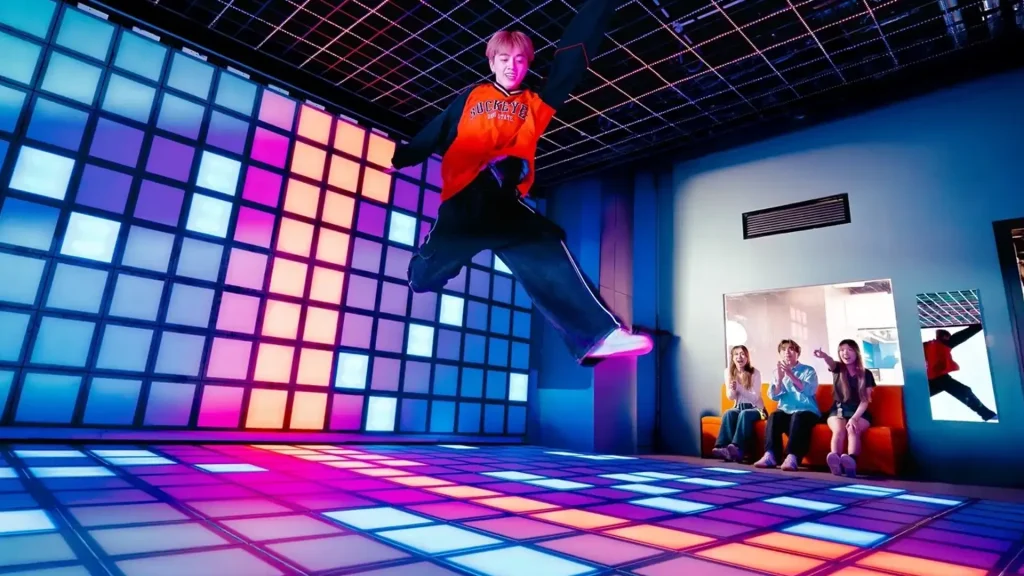
Gamification means applying game mechanics — scoring, competition, real-time feedback, progression — to an activity that isn’t inherently a game. Applied to exercise, this usually means turning a workout into something with a score, a challenge, or a multiplayer element, rather than a repetitive set of reps.
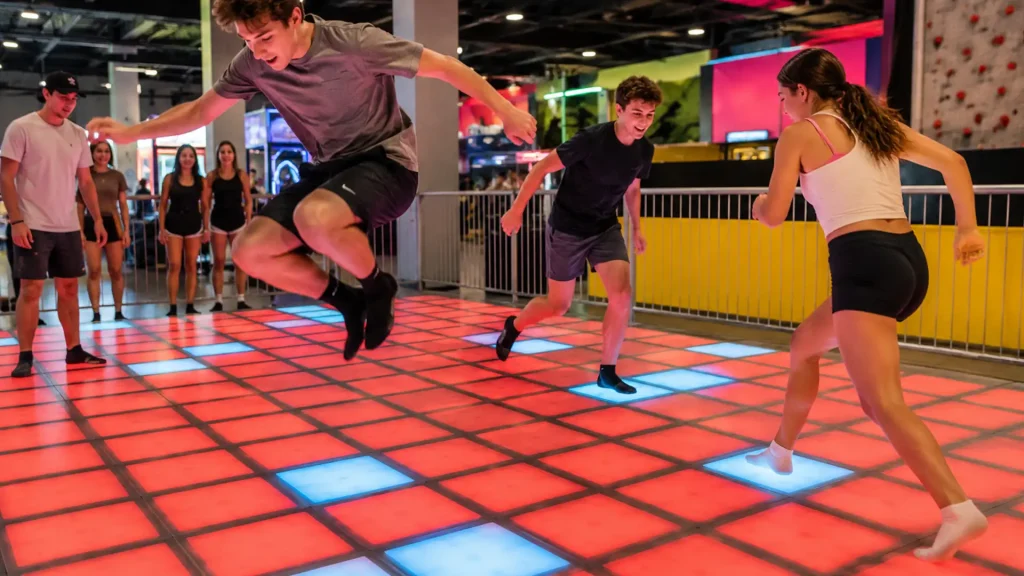
An interactive game floor applies this directly and physically: sensors under LED tiles track movement in real time, turning stepping, dodging, and reacting into a scored, competitive activity. Unlike a fitness app that gamifies a treadmill run through a screen, the game floor makes the physical space itself the game.
What Research Says About Gamification and Exercise
This is worth grounding in actual research rather than assuming the connection is obvious. A systematic review published via PMC examining mHealth-based gamification interventions found that gamification can increase physical activity participation — though the review is careful to note the results were mixed across studies and the improvements were often modest rather than dramatic, which is a more honest picture than marketing claims usually present.
A separate field experiment on gamification of physical activity found something specifically relevant here: gamification didn’t necessarily change how motivated people felt, but it did produce a measurable increase in physical activity (step counts) compared to non-gamified tracking. In other words, the behavioral effect showed up even without a strong psychological effect — people moved more because of the game mechanic, whether or not they consciously felt “more motivated” by it.
The honest takeaway: gamification is not a guaranteed fix for engagement, but the research base supports it as a real, measurable lever — not just a marketing concept. Research supports the broader concept of gamified physical activity; the interactive game floor represents one commercial implementation of that concept, not something these specific studies tested.
Evidence of Growing Demand for an Interactive Game Floor for Gyms and Fitness Centers
Rather than pointing to a specific gym that has installed an interactive floor — public examples are still limited — it’s more useful to look at whether the underlying interactive gaming concept has real commercial traction. Three layers of evidence, each doing a different job:
Layer 1 — Market Adoption
Activate, the active gaming format built around the same core idea (physical, sensor-based, multiplayer game rooms), has expanded from a single Winnipeg location to more than 65 locations worldwide as of early 2026, with a stated goal of reaching 100 locations across 12 countries by 2027 and more than 2.7 million players to date. That’s not a single operator’s claim about one venue — it’s continued, verifiable expansion across multiple countries and real estate markets over several years, which is a much stronger signal than a single case study would be.
Layer 2 — Consumer Validation
Independent interactive-floor venues — not affiliated with any single brand — have also established themselves in multiple markets with sustained, public consumer reviews over time. Venues like Pixel Planet in Kraków, Poland, and Pixel Arena in the Lisbon area of Portugal operate as standalone attractions with real, ongoing TripAdvisor review histories from family groups, team-building bookings, and repeat visitors. The continued operation of these venues, together with sustained public review activity, provides a useful signal of ongoing consumer interest in interactive floor-based entertainment — not proof of gym-specific success, but real evidence the underlying format works commercially with real customers.
Layer 3 — Application Fit
The third layer is where we can speak directly: as a manufacturer, we can explain why the same modular, sensor-based technology suits an interactive game floor for gyms and fitness centers specifically — group-scale multiplayer play, short session formats that fit between classes, and hardware built for continuous public use. The growing number of operators and venues in Layers 1 and 2 suggests the concept has moved beyond a niche demonstration product into a commercially established entertainment format — which makes the application question for gyms a reasonable one to explore, even without a direct gym case study yet.
Where Interactive Game Floors Fit in a Fitness Facility
A few applications come up most often across gyms, sports clubs, and fitness-adjacent venues:
| Application | How It’s Used |
|---|---|
| Group Training | Multiplayer challenges add a competitive, social element to group fitness sessions |
| Youth Fitness | Game-based movement appeals to kids and teens who may not respond to traditional gym equipment |
| Family Fitness | Parents and kids can participate together at different intensity levels on the same system |
| Sports Clubs | Reaction and agility-based game modes double as informal skill training for team sports |
| Corporate Wellness | Employer-sponsored fitness programs increasingly look for engaging, low-barrier group activities |
For the corporate wellness angle specifically, this overlaps with how event and team-building companies think about interactive attractions:
Read: Interactive Game Floor for Corporate Events & Team Building
Interactive Game Floor for Gyms and Fitness Centers vs. Traditional Fitness Equipment
This is not a replacement question — it’s a complement question.
| Traditional Equipment | Interactive Game Floor |
|---|---|
| Individual exercise | Multiplayer, social |
| Repetitive movement patterns | Game-based, varied challenges |
| Fixed workout structure | Dynamic, scored challenges |
| Equipment-focused | Experience-focused |
| Primarily fitness-oriented | Fitness plus entertainment |
| Familiar, low novelty over time | More novel, higher initial engagement |
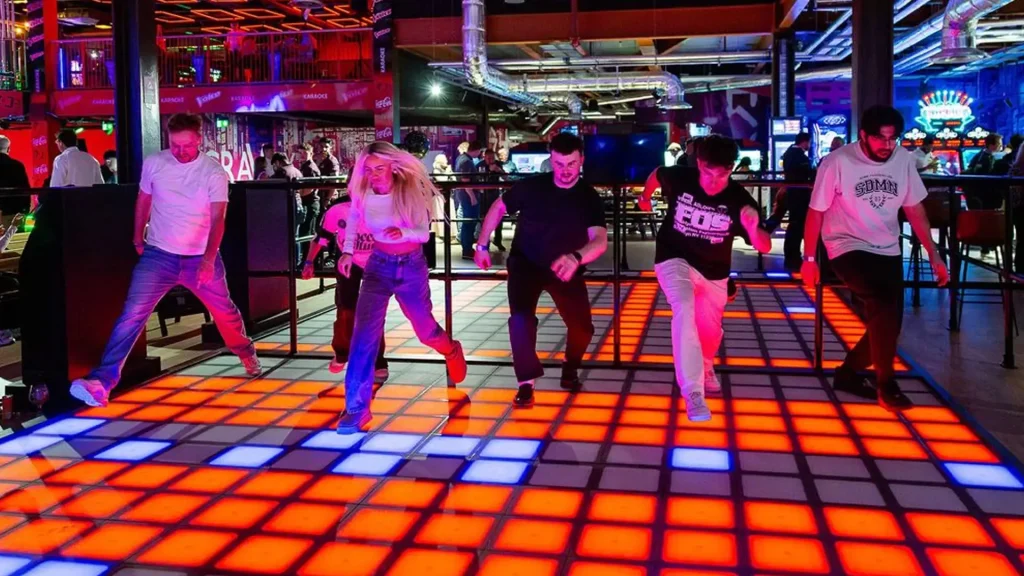
An interactive game floor doesn’t replace treadmills, weights, or classes — it complements them by giving members a low-barrier, social, game-based option alongside traditional training, which is particularly useful for warm-ups, youth programs, or members who find conventional equipment intimidating or repetitive.
Business Value for Gym Operators
As with every non-ticketed venue type in this series, we won’t publish a promised revenue number — member engagement value doesn’t translate directly into a dollar figure the way a ticketed FEC attraction does. Instead, as a practical way to think about engagement value, operators can consider the relationship conceptually:
Engagement Value = Session Frequency × Participation Rate × Repeat UsageThis isn’t an industry-standard formula — it’s a way of framing the logic: a facility that gives members another reason to show up regularly, participate actively, and keep coming back has a real (if indirect) impact on retention — which is the metric gym operators actually care about most, more than any single attraction’s standalone revenue.
How to Evaluate an Interactive Game Floor for Gyms and Fitness Centers
| Question | Why It Matters |
|---|---|
| Can it handle continuous public use across long operating hours? | Gyms typically operate far longer hours than a ticketed attraction |
| Does it support both low-intensity and high-intensity game modes? | Facilities serve members across a wide range of fitness levels and ages |
| Can it be positioned for group classes as well as open/casual use? | Different scheduling models need different game mode flexibility |
| How simple is cleaning given sweat and heavy use? | Fitness environments have different hygiene demands than a family FEC |
| Can branding and game content be customized to the facility? | Sports clubs and gym chains often want the experience to match their brand identity |
Class Formats and Scheduling Considerations
A few practical points worth planning around before installation:
- Short game rounds fit between scheduled classes better than long-format sessions. A 60–90 second challenge round is easier to slot into open gym time or a warm-up window than a longer structured game.
- Difficulty scaling matters more here than in an FEC. Fitness facilities serve members across a wide range of ability levels — game modes that can scale from beginner to advanced keep the attraction relevant across a diverse membership base, not just for a single demographic.
- Instructor-led vs. self-serve use changes game mode selection. A staff-led group class can run more complex, competitive formats; unsupervised open-gym use generally works better with simpler, lower-risk game modes.
Why Work With a Direct Manufacturer
Victor Activate Games has manufactured interactive game floors and LED grid game systems for 12 years, based in Guangzhou, China, with OEM and ODM support built into standard production. Our systems are CE and RoHS certified. For gym chains or sports club groups planning a standardized rollout across multiple facilities rather than a single installation, this is typically closer to an OEM relationship than a single-venue purchase.
Read the OEM Interactive Game Floor guide if you’re evaluating a multi-facility rollout.
Getting a Recommendation for Your Facility
Because the right configuration for an interactive game floor for gyms and fitness centers depends on facility size, member demographics, and whether it’s positioned for group classes or open casual use, a generic size recommendation tends to miss what actually matters for your specific program. Sharing your facility layout, target member segments, and existing class schedule leads to a more useful recommendation than starting from a fixed package.
Frequently Asked Questions
Is there research supporting gamification as a way to increase exercise participation?
Yes — systematic reviews of gamification interventions show real, if often modest, increases in physical activity participation. The effect is measurable but shouldn’t be oversold as a guaranteed engagement solution.
Have gyms actually adopted an interactive game floor for gyms and fitness centers?
Public examples of gyms specifically installing this technology are still limited — the stronger evidence right now is the broader interactive gaming market’s expansion (venues like Activate and independent pixel-floor attractions) and the research base on gamified exercise, which together support the application logic even without a direct gym case study yet.
Does an interactive game floor replace traditional gym equipment?
No — it’s positioned as a complement, particularly useful for group training, youth programs, warm-ups, and members who find conventional equipment repetitive or intimidating.
Is this suitable for sports clubs, not just gyms?
Yes — reaction and agility-based game modes are often used informally as skill training in sports clubs and youth training centers, beyond general fitness gyms.
How is business value measured if it’s not a ticketed attraction?
Primarily through member engagement, session frequency, and retention — indirect signals rather than direct attraction revenue, similar to how hotels and malls evaluate the same product.
Considering an interactive game floor for gyms and fitness centers, sports clubs, or youth training facilities? Send us your facility size and program goals for a recommendation