
Interactive Game Floor for Hotels and Resorts: Guest Experience Guide (2026)
Many successful family resorts are shifting focus from accommodation alone toward complete on-property experiences. Great Wolf Lodge and Kalahari Resorts built entire business models around this shift, pairing lodging with indoor waterparks and family entertainment amenities so guests spend their whole stay on property instead of going out to find things to do.
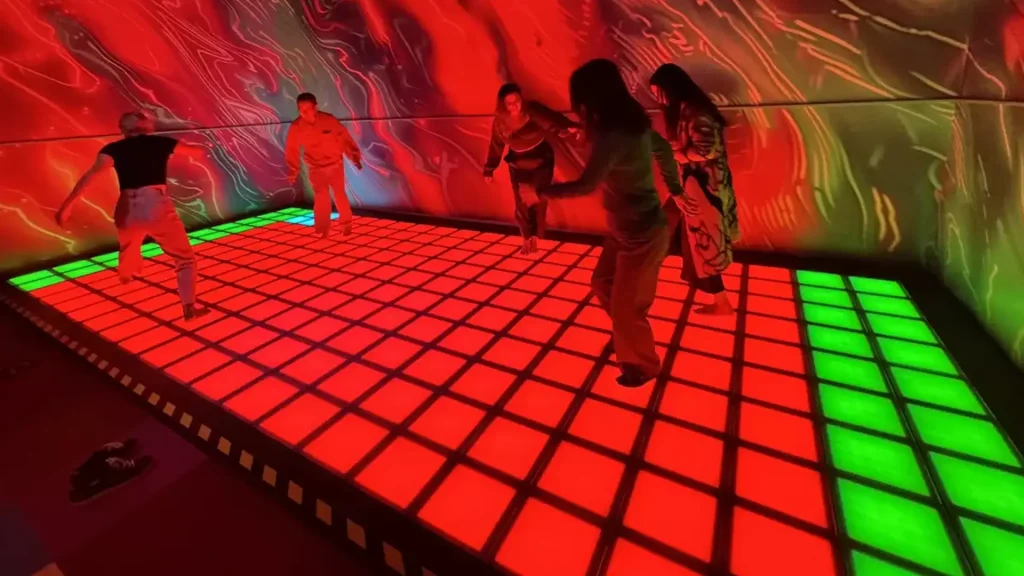
One example of this broader trend is the rise of interactive LED game floors — modular, sensor-based entertainment systems that let guests play competitive, family-friendly games directly within hotel spaces like a lobby, kids’ club, or event hall. An interactive game floor for hotels and resorts represents an emerging way for properties to tap into the same experiential trend as a Great Wolf Lodge or Kalahari, at a much smaller scale and lower cost than building a waterpark wing.
The business case here doesn’t look like an FEC’s, though — worth understanding before assuming the same ROI logic applies.
A note on where this technology stands today: Interactive floor technology is currently concentrated mostly in FECs, family entertainment venues, and malls — public examples of hotels specifically installing interactive LED floors are still limited. What’s well established is the broader hospitality trend below: hotels investing in on-property entertainment. The opportunity for hotels is applying proven interactive entertainment concepts, which is the case this guide makes.
Why Properties Are Adding an Interactive Game Floor for Hotels and Resorts
According to Hotel Online’s coverage of family-focused resort trends, the resorts succeeding with families are the ones curating amenities that bring adventure and engagement onsite rather than relying on guests to find entertainment elsewhere — Great Wolf Lodge’s MagiQuest interactive game is cited as one of its signature draws precisely because it gives families a reason to stay on property rather than leaving to find things to do nearby.
For an individual hotel or resort, the practical reasons line up with that pattern:
- Guest reviews and online reputation — An engaging on-property activity for kids and families is a common theme in positive reviews, and review scores increasingly affect ranking and conversion on booking platforms.
- Keeping guests on property increases ancillary spend — A family that stays in-house for entertainment is more likely to eat at the hotel restaurant and use other paid amenities than one that leaves to find activities elsewhere.
- It differentiates a property in a crowded market — With guest experience increasingly a deciding factor between similarly priced properties, a distinctive on-site attraction is a concrete point of difference a listing photo can actually show.
- Multigenerational travel is growing — Family trips increasingly include grandparents alongside parents and kids, which puts pressure on properties to offer activities that don’t require the same physical intensity as a waterslide. A lower-intensity, ground-level attraction fits that gap well.
Real Examples of Hotels Investing in On-Property Entertainment
Great Wolf Lodge built its entire brand around this idea — pairing accommodation with an indoor waterpark and MagiQuest, an interactive wand-based quest game played throughout the property. It’s one of the clearest examples of a hotel treating entertainment as core to the guest experience rather than an afterthought.
Universal’s Cabana Bay Beach Resort takes a smaller-footprint approach worth noting for properties that can’t build a waterpark wing: Game-O-Rama, a dedicated arcade space on the second floor of the hotel lobby, gives families an on-property activity without requiring the scale of a full resort buildout.
Neither example uses an interactive LED game floor specifically — this is worth being direct about, since interactive floor technology today is still concentrated mostly in FECs and family entertainment venues rather than hotels. What these examples demonstrate is the underlying pattern: hotels are increasingly building dedicated, in-house entertainment spaces rather than treating activities as something guests find elsewhere. An interactive game floor is a natural next step for properties following that same logic — smaller footprint than a waterpark, more space-efficient than a full arcade, and easier to theme to a specific property’s brand.
How the Business Case Differs From an FEC
This is the part worth getting right before assuming an FEC’s ROI logic transfers directly. A Family Entertainment Center sells the attraction itself as the product — it’s ticketed, and its revenue is measured directly. A hotel or resort almost never does that with a lobby or kids-club attraction; it’s typically included in the room rate or resort fee, not sold separately.
Instead, the value of an interactive game floor for hotels and resorts tends to show up as:
| Value Driver | How It Shows Up |
|---|---|
| Guest review scores | Family-friendly amenities are frequently mentioned in reviews, which affects ranking on booking platforms |
| Direct booking conversion | A distinctive on-site amenity gives marketing and listing photos something concrete to show, supporting conversion over similarly priced competitors |
| Ancillary spend | Guests who stay on property for entertainment tend to spend more on food, beverage, and other paid amenities |
| Repeat bookings | A memorable amenity for kids is a common reason families choose to return to the same property |
None of these show up as a line item the way ticket revenue would — which is exactly why this needs a different ROI conversation than an FEC.
Layout Placement for an Interactive Game Floor for Hotels and Resorts
A few placements come up most often for this venue type:
| Placement | Best For |
|---|---|
| Lobby or check-in area | Immediate first impression, gives waiting families something to do during check-in |
| Kids’ club or dedicated family zone | Supervised, structured play as part of an existing kids’ program |
| Poolside or indoor water park adjacent area | Dry-zone activity alternative to swimming, useful for weather or time-of-day gaps |
| Event or ballroom space | Flexible use for family-oriented conferences, weddings, or seasonal programming |
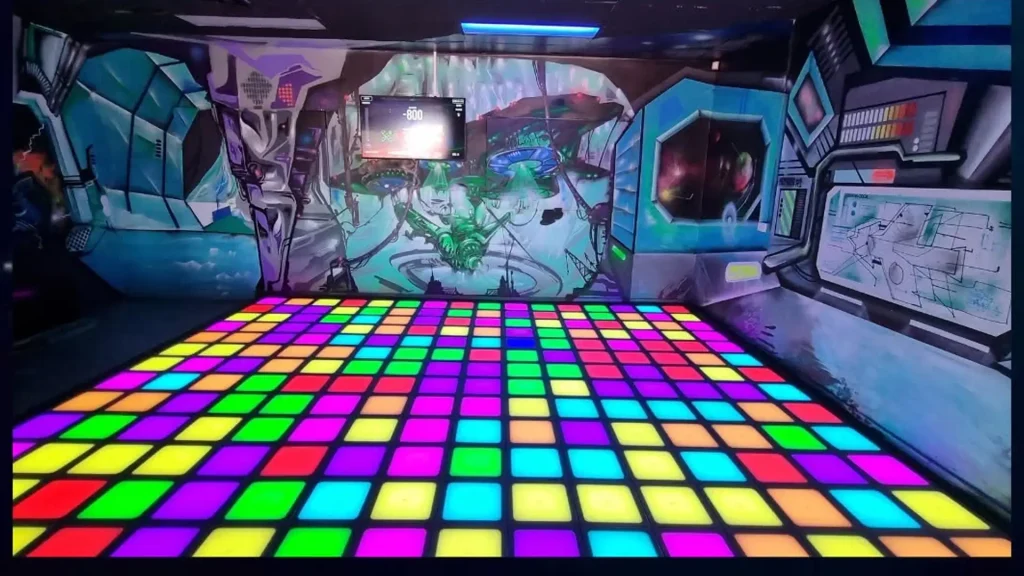
Because tiles are 30×30cm and total quantity scales to the space available, an interactive game floor can be sized for a compact lobby corner or a larger dedicated kids’ club room — the same underlying product adapts to very different footprints depending on where the property has space.
Suitable Hotel Installation Areas
| Area | Purpose |
|---|---|
| Kids’ Club | Family engagement, supervised structured play |
| Resort Activity Zone | Daytime entertainment alongside pool or outdoor programming |
| Lobby Activation Area | First-impression guest interaction during check-in and arrival |
| Event Hall | Group activities for family-oriented conferences or weddings |
| Holiday Events | Seasonal campaigns tied to specific dates or promotions |
What We Consider When Designing for Hospitality Environments
Hotels and resorts put different demands on the hardware than a standalone FEC:
- Guest-facing visibility and brand fit — The installation is often the first or last thing a guest sees, and it needs to look intentional and high-quality rather than like an add-on, since it reflects on the overall property brand.
- Supervision models differ by placement — A kids’ club installation with staff supervision has different requirements than an unsupervised lobby placement, which affects game mode selection and safety considerations.
- Humidity and pool-adjacent placement — If positioned near an indoor water park or pool deck, moisture resistance and surface material need to account for a more humid environment than a standard indoor room.
- Operating hours are often longer — Hotel common areas frequently run near-continuous hours, which affects component durability expectations compared to an attraction with defined open/close times.
Common Mistakes When Adding an Interactive Attraction to a Hotel or Resort
Treating it as a standalone revenue generator. As covered above, this is almost never how hotel installations are monetized — evaluating it against direct ticket revenue sets the wrong expectation from the start.
Underestimating brand fit. An attraction that looks generic or mismatched with the property’s design language can undercut the polished impression a hotel is trying to create, even if the attraction itself works well.
Placing it somewhere unsupervised without considering game mode. A lobby installation running unsupervised needs different game modes and safety considerations than a staffed kids’ club setup.
Not accounting for humidity if placed near a pool or water park. Moisture-resistant materials and surface ratings need to be confirmed upfront for pool-adjacent placements, not assumed to be standard across all installation types.
Assuming every property needs the same placement. A boutique city hotel with limited lobby space has different needs than a large resort with a dedicated kids’ club — copying another property’s layout without accounting for your own traffic flow and demographics often leads to an underused installation.
What Hotel Operators Should Evaluate Before Choosing an Interactive Game Floor
| Question | Why It Matters |
|---|---|
| Lobby or kids’ club placement? | Different operating models — unsupervised visibility vs. supervised structured play |
| Does it need to run near-continuous hours? | Hotel common areas often operate far longer than a ticketed FEC attraction |
| Is it durable enough for continuous public use? | Hospitality spaces see high, unpredictable foot traffic without controlled access |
| How simple is ongoing cleaning and maintenance? | Public hospitality spaces need reliability without dedicated technical staff on-site |
| What safety considerations apply for unsupervised areas? | Lobby and public-area placements need different safety design than staffed kids’ club settings |
| Can branding be customized to the property? | Hotel groups and resort chains typically want the installation to match property theme and brand identity |
| Is remote technical support available? | Hotels rarely have in-house technicians for specialized attraction equipment |
| How are spare parts sourced if a component fails? | Downtime on a guest-facing amenity reflects directly on guest experience |
| Is multi-language support available? | Relevant for international properties and resorts with a diverse guest base |
Hospitality-Specific Advantages
Beyond the general product characteristics covered elsewhere, a few advantages matter specifically for hotel and resort buyers:
- No major building footprint required. Space is the most expensive resource in a hotel — this format doesn’t require the structural investment a waterpark or dedicated arcade wing would.
- Makes use of underused space. Lobby corners, kids’ zones, and event halls that sit empty outside of specific hours can become an active guest touchpoint without a full renovation.
- Supports seasonal and thematic programming. Holiday themes, resort-specific events, and family programming can be layered onto the same hardware through software updates, giving properties a way to refresh the guest experience without new capital investment each season.
Why Hotel Groups Choose Modular Interactive Game Floors
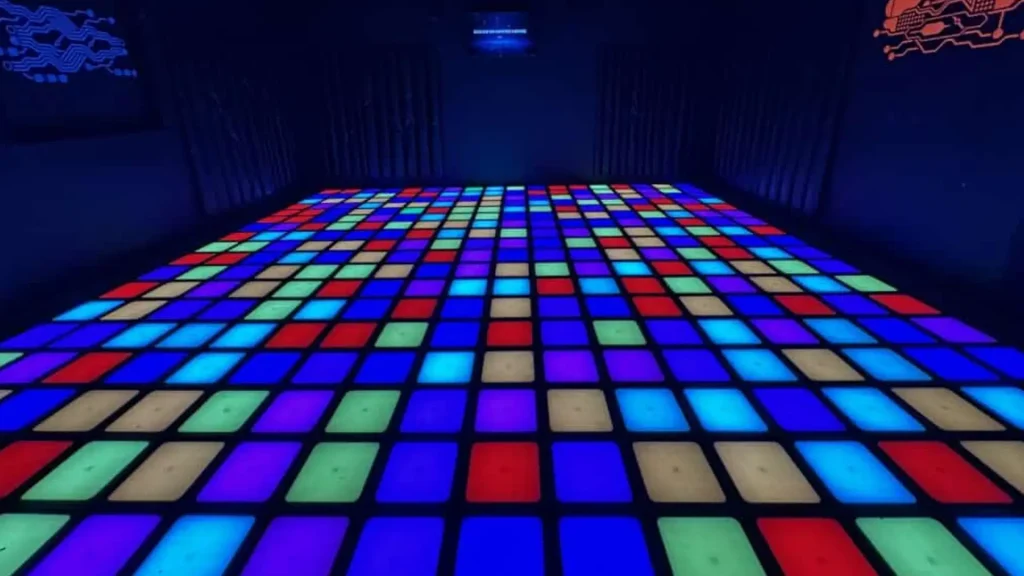
From a manufacturing standpoint, a few characteristics explain why this format suits hospitality environments specifically:
- Modular sizing fits varied property layouts — the same core product works for a compact boutique hotel lobby or a large resort kids’ club, without a different hardware design for each property type.
- OEM branding for hotel groups and resort chains — multi-property brands standardizing an amenity across locations can apply consistent branding through OEM customization, similar to how a mall chain would approach a multi-location rollout.
- Factory-direct customization for game themes — game modes and visual branding can be tailored to match a resort’s specific theme or family programming rather than limited to generic content.
Read the OEM Interactive Game Floor guide if you’re a hotel group or resort chain planning a standardized rollout across multiple properties rather than a single-location installation.
How This Compares to Other Venue Types
The value-driver logic here is closer to a shopping mall’s than an FEC’s — neither is ticketing the attraction directly, and both are measuring value through indirect signals rather than a per-session price.
Read: Interactive Game Floor for Shopping Malls for a fuller look at how non-ticketed venue types evaluate ROI differently from FECs.
Getting a Layout Recommendation
Because the right placement for an interactive game floor for hotels and resorts depends on supervision model, brand fit, and proximity to water features, a generic quote based on square footage alone tends to miss the details that actually determine whether the installation works for your property. Sharing your property type, target placement (lobby, kids’ club, poolside), and existing family programming leads to a more useful layout recommendation than starting from a fixed package.
Frequently Asked Questions
Is an interactive game floor a good fit for a hotel or resort? Yes — an interactive game floor for hotels and resorts is a common fit for family-oriented properties looking to differentiate on guest experience, but it’s worth planning it as a guest-satisfaction and booking-conversion investment rather than a standalone revenue attraction, since most hotels don’t ticket it separately.
Where does it typically go in a hotel — lobby, kids’ club, or poolside? All three are common, and the right choice depends on supervision model and existing traffic flow. Lobby placements maximize visibility; kids’ club placements allow supervised structured play; poolside placements work as a dry-zone alternative activity.
Does it need special materials if placed near a pool or water park? Yes — humidity and moisture exposure near pool-adjacent areas require different surface material considerations than a standard indoor placement, worth confirming before finalizing a layout.
How is ROI measured for a hotel installation if it’s not ticketed? Primarily through guest review scores, booking conversion, ancillary spend, and repeat bookings — indirect signals rather than direct attraction revenue, similar to how a shopping mall evaluates the same product.
Can hotel chains standardize the same installation across multiple properties? Yes — this is typically approached as an OEM/branded rollout rather than a series of separate single-property purchases, allowing consistent branding and game content across locations.
Planning an interactive game floor for hotels and resorts or a specific property? Send us your space and property details for a layout recommendation