
Interactive Game Floor for Shopping Malls: Layout, Foot Traffic & Business Case (2026)
Malls aren’t competing with each other anymore — they’re competing with staying home and ordering online. The malls that are actually growing right now have figured out the same thing: a purely transactional visit doesn’t get repeated, but an experience does. An interactive game floor for shopping malls is one of the most accessible ways to add that experiential layer without the cost and commitment of a full anchor-tenant buildout.
The business case here is genuinely different from an FEC, though — worth understanding before assuming the same logic applies.
Why Retail Properties Are Adding an Interactive Game Floor for Shopping Malls
The shift toward experiential retail isn’t a niche trend. According to Placer.ai’s 2025 mall performance data, 37.6% of indoor mall visits lasted more than 75 minutes — a higher share than open-air centers or outlet malls — with rising dwell times tied directly to experiential appeal. That pattern matters beyond the attraction itself: a property drawing longer visits generally sees spillover benefit across its whole tenant mix, not just the store or attraction that drew the visit in the first place.
For an individual mall or retail space, the practical reasons line up with that data:
- Dwell time drives spend. A visitor who stays longer generally spends more across multiple stores, not just the one they came for.
- Foot traffic is a leasing asset. Malls with demonstrated foot-traffic draws have an easier time filling vacant units and negotiating lease terms with new tenants.
- Social content drives walk-ins on its own. A visually striking, shareable attraction generates organic social exposure that a static storefront display doesn’t.
How the Business Case Differs From an FEC
This is the part worth getting right before assuming an FEC’s ROI logic transfers directly. A Family Entertainment Center typically prices the attraction as a standalone, ticketed product — the floor earns its keep on its own. A mall or retail environment usually can’t do that in the same way; foot traffic through common areas isn’t ticketed, and most mall operators aren’t in the business of running paid attractions directly.
Instead, the value of an interactive game floor for shopping malls tends to show up in one of a few different forms:
| Model | Description |
|---|---|
| Brand activation | A retailer or the mall itself uses the floor as a temporary or seasonal draw, valued for the foot traffic and social content it generates rather than direct ticket revenue |
| Anchor-adjacent draw | Positioned near a family-oriented tenant mix to extend visit length and support cross-shopping |
| Leasable attraction space | Some malls lease the space to a third-party operator who runs it as its own small business, which shifts the ROI question back to a more FEC-like model for that operator specifically |
Which model applies changes the whole ROI conversation, so it’s worth being clear on which one you’re actually planning before requesting a quote.
Layout Placement in a Mall Environment
A few placements come up most often when planning an interactive game floor for shopping malls:
| Placement | Best For |
|---|---|
| Atrium or central common area | Maximum visibility, works well for both permanent installations and seasonal activations |
| Vacant or transitional retail unit | Repurposing empty storefronts into a temporary draw while the space is between tenants |
| Adjacent to family-oriented anchor tenants | Extends visit length for the demographic most likely to have time and reason to stay longer |
| Pop-up or event zone | Temporary installs tied to a specific campaign, holiday season, or brand activation |
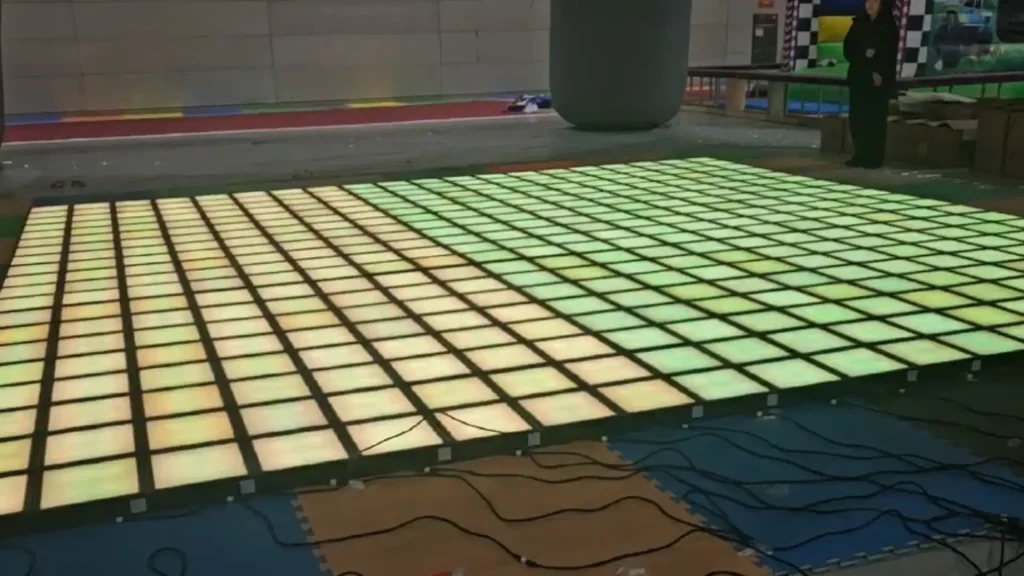
Because tiles are 30×30cm and total quantity scales to the space available, an interactive game floor can be sized for a compact vacant unit or a full atrium centerpiece — the same underlying product works at very different scales depending on what real estate is actually available.
Thinking About ROI for a Mall or Retail Installation
Because the revenue model varies by which of the three forms above applies, the ROI formula needs different inputs than a ticketed FEC attraction:
Value Impact = (Increase in Average Dwell Time × Estimated Cross-Store Spend)
             + (Foot Traffic Increase × Leasing/Marketing Value)
             + (Social Content Reach × Estimated Marketing Equivalent Value)
For a fuller breakdown of active-gaming ROI logic that applies across venue types:
Read: Active Gaming Room ROI — How FEC Operators Maximize Returns
In many retail attraction projects, buyers are usually evaluating the installation against dwell time, foot traffic, and marketing value rather than trying to make the attraction profitable on its own — which is a fundamentally different calculation than a ticketed FEC attraction and shouldn’t be forced into the same model.
What We Consider When Designing for Retail Environments
Designing an interactive game floor for shopping malls means accounting for demands a dedicated FEC room doesn’t have:
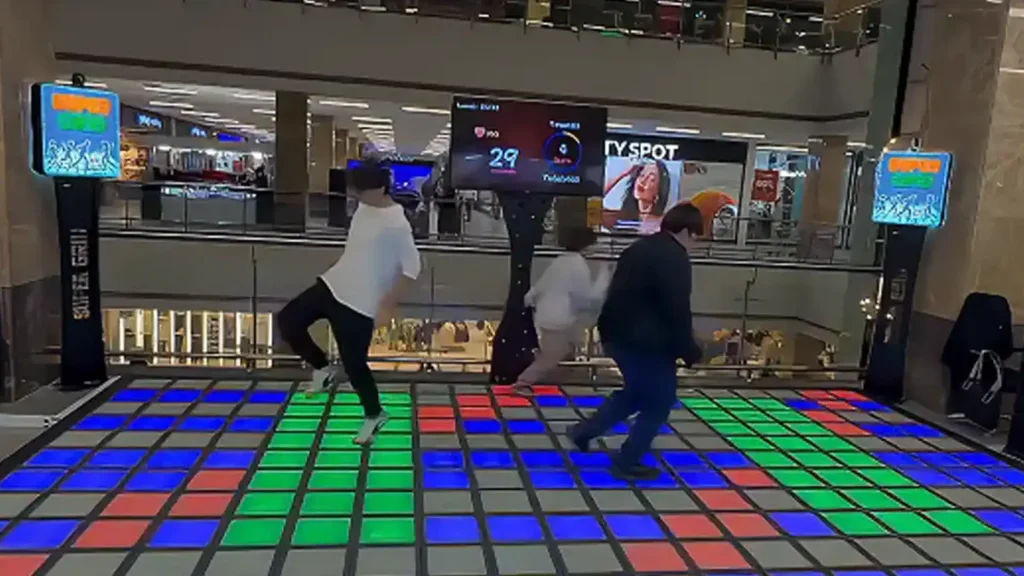
- High visibility from multiple angles matters more here — unlike a dedicated attraction room, a mall installation is often viewed from balconies, escalators, and multiple approach angles, which affects how the LED grid floor is configured and lit for maximum visual impact
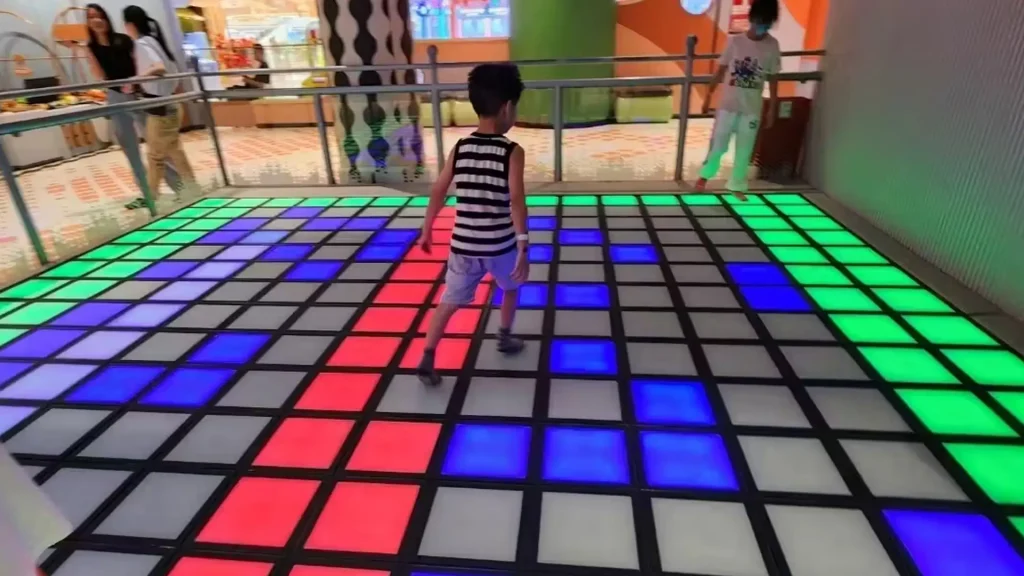
- Mixed foot traffic, not just barefoot or sock traffic — mall visitors wear street shoes, which changes surface durability and anti-slip requirements compared to a sock-only FEC or trampoline park setting
- Temporary and permanent configurations need different mounting approaches — a seasonal pop-up installation has different setup/teardown requirements than a permanent atrium centerpiece, and the two shouldn’t be quoted the same way
- Mall safety and insurance requirements vary by property — confirm what your specific mall’s risk management team requires before finalizing a layout, since this varies more by property than by product
How This Differs From Other Venue Types
It’s worth contrasting this against how the same product gets evaluated elsewhere, since the differences aren’t always obvious from the product page alone:
| Venue Type | Value Driver |
|---|---|
| Trampoline park | Typically bundles the floor into an existing admission price, measuring value through visit length and group-booking conversion rather than a standalone ticket |
| FEC | Prices it as a standalone ticketed attraction with direct revenue per session |
| Shopping mall | Usually can’t be ticketed at all — its value shows up in dwell time, foot traffic, and marketing exposure instead, which is a fundamentally different ROI conversation from either of the other two |
None of these models is more correct than another — they reflect real differences in how each venue type generates revenue, and the right way to plan an installation depends on knowing which model actually applies to your property before requesting a quote.
Why Mall Operators Choose Modular Interactive Game Floors
From a manufacturing standpoint, a few product characteristics explain why this format fits retail environments better than many alternative attractions:
- Modular sizing — because tiles are 30×30cm and quantity scales to the space, the same core product works for a compact vacant unit, a full atrium centerpiece, or anything in between, without redesigning the hardware for each property
- Installation flexibility — the same system can be configured for a permanent atrium installation or a temporary pop-up tied to a season or campaign, using the same underlying hardware
- OEM branding for chain rollouts — mall groups and retail chains standardizing an attraction across multiple properties can apply consistent branding through OEM customization rather than sourcing a new solution for each location
- Factory-direct customization — layout, game modes, and branding can be adjusted at the production stage rather than limited to whatever a reseller happens to have in stock
What Mall Operators Should Ask Before Installing an Interactive Game Floor
| Question | Why It Matters |
|---|---|
| Can the system handle street-shoe foot traffic? | Mall environments differ from sock-only FEC or trampoline park settings |
| Is the installation permanent or temporary? | Affects mounting approach, lead time, and quoting |
| How easy is ongoing maintenance in a public space? | Malls need reliability without dedicated on-site technical staff |
| Can the size be customized to an irregular footprint? | Mall spaces (atriums, vacant units) rarely match a standard room shape |
| Does the supplier provide a layout design based on your actual space? | A generic size recommendation often doesn’t account for sightlines and traffic flow specific to your property |
Common Mistakes When Adding an Interactive Attraction to a Mall
Pricing the attraction like a standalone FEC business. As covered above, most mall installations aren’t meant to generate direct ticket revenue — evaluating them against that standard sets the wrong expectation from the start.
Underestimating visibility requirements. A layout that looks good from ground level but disappears from balcony sightlines misses much of the foot-traffic value a central mall location is supposed to provide.
Treating a seasonal pop-up like a permanent installation. Mounting, calibration, and takedown planning are different for a temporary activation than a fixed centerpiece — confirm which one you’re actually planning for before ordering.
Not confirming property-specific compliance requirements early. Mall risk management and insurance requirements vary significantly by property; discovering a mismatch after installation is a more expensive problem to fix than confirming it during the layout planning stage.
Assuming one mall’s success predicts another’s. A layout and business model that performs well in one property doesn’t automatically transfer to a different mall with a different tenant mix, demographic, and foot traffic pattern — each installation is worth evaluating against its own property’s data rather than a generic benchmark.
For Mall Chains and Multi-Location Rollouts
Some mall operators and retail chains planning a standardized attraction across multiple properties are effectively sourcing the same way an OEM distributor would — consistent branding, repeatable installation, and a factory relationship built for volume rather than a single order.
Read the OEM Interactive Game Floor guide if you’re planning a branded, multi-property rollout rather than a single mall installation — the sourcing considerations are closer to a distributor relationship than a single-venue purchase.
Getting a Layout Recommendation for a Mall or Retail Installation
Because the right configuration for an interactive game floor for shopping malls depends heavily on which business model applies — brand activation, anchor-adjacent draw, or leased attraction space — a generic quote based on square footage alone tends to miss the details that actually determine whether the installation delivers on its purpose. Sharing your property type, target location within the mall, and whether the installation is temporary or permanent leads to a far more useful layout recommendation than starting from a fixed package.
Frequently Asked Questions
Is an interactive game floor a good fit for a shopping mall? Yes — an interactive game floor for shopping malls is a common choice for properties investing in experiential retail to drive dwell time and foot traffic, but it’s worth being clear upfront on which business model applies (brand activation, anchor-adjacent draw, or leased attraction space), since that determines how ROI is measured.
Can it be installed as a temporary or seasonal attraction? Yes — mounting and setup can be configured for temporary installs tied to a season or campaign, though this should be planned and quoted differently than a permanent installation.
How is ROI measured differently for a mall versus an FEC? An FEC typically measures ROI through direct ticket revenue. A mall installation is usually evaluated through dwell time, foot traffic, and marketing value instead, since most mall operators aren’t running the attraction as a standalone ticketed business.
Does it need to be a large, atrium-scale installation to be effective? No — because tile quantity scales to the space, it can work in a compact vacant unit or a full atrium centerpiece, depending on what real estate and budget are available.
What durability considerations apply in a mall setting that don’t apply elsewhere? Mall foot traffic includes street shoes rather than sock-only traffic common in trampoline parks or dedicated FEC rooms, which affects surface and anti-slip requirements.
Planning an interactive game floor for shopping malls or a retail space? Send us your space dimensions and installation goals for a layout recommendation