

How to Choose an Active Gaming Room Supplier: Factory Direct vs Local (2026)
In almost every project discussion, the conversation begins with equipment specifications. Tile count, sensor type, game modes, controller capacity. A few weeks later, it usually shifts to installation schedules, software update paths, replacement part lead times, and what happens when something stops working on a Saturday afternoon during peak hours.
That is the moment most operators realize they were not just choosing equipment. They were choosing an active gaming room supplier — and those are different decisions that require different evaluation criteria.
This guide covers what experienced operators actually verify before committing to a supplier, how factory direct sourcing compares to local distribution in practice, and the questions worth asking before any purchase order is signed.
What Experienced Operators Expect From an Active Gaming Room Supplier
Operators who come to us after a difficult first purchase usually say the same thing: the equipment arrived, but the project did not go smoothly. Installation took longer than expected. Software questions went unanswered for days. A replacement part took six weeks.
None of those problems were visible in the product catalog.
A capable active gaming room supplier delivers more than hardware. The complete picture includes layout planning and 2D floor recommendations based on the specific venue dimensions, installation guidance either remote or on-site, software configuration and game mode setup, post-installation technical support with a defined response time, spare parts availability and a clear replacement process, and OEM or custom branding support if the project requires it.
One mistake we see repeatedly is operators evaluating suppliers entirely on unit price and product photos. Both matter, but neither tells you what the experience of working with that supplier will actually be like when the project is in progress. The evaluation has to go deeper than the catalog.
Factory Direct vs Local Distributor — What the Difference Actually Means
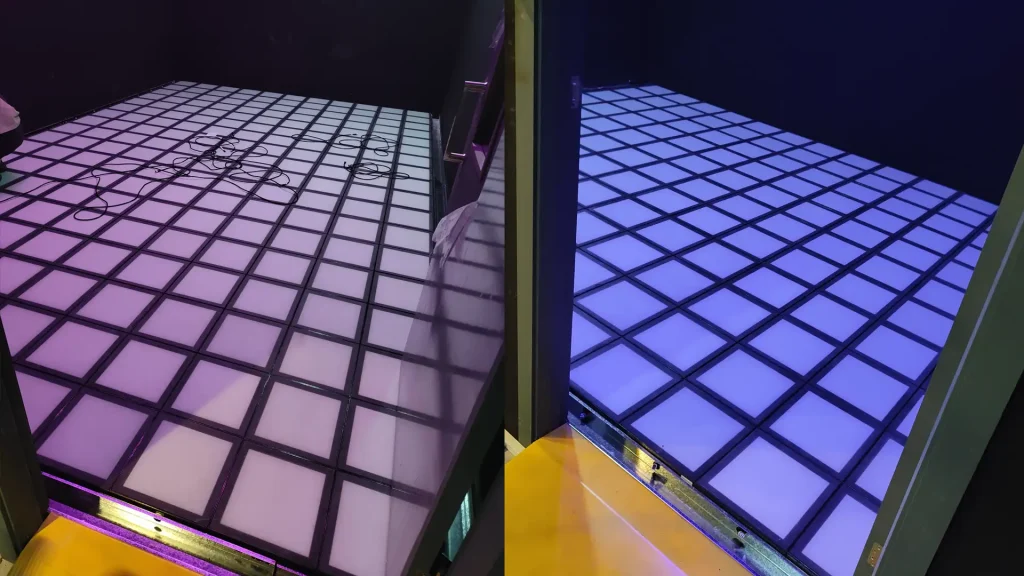
An operator in Eastern Europe recently asked us why two quotations for apparently similar interactive game floor systems differed by nearly 30 percent. The hardware specifications looked almost identical. The difference was not the product.
One quotation came directly from a manufacturer. The other passed through a regional distributor. When installation guidance, software customization, spare parts logistics, and long-term support were factored in, the gap became considerably larger than the initial quotation suggested.
Factory direct sourcing from an active gaming room supplier means working with the entity that actually builds the equipment. Pricing reflects production cost without intermediary margin. Customization requests go directly to the engineers who can make the changes. Technical questions reach people who understand the system at the component level, not just the feature level. And when something needs to be replaced, the factory knows exactly which part is involved and where it comes from.
Local distributors offer a different set of advantages. For operators who need on-site installation support in a specific country, a local partner can coordinate that more efficiently than a factory operating across time zones. For first-time buyers who want someone nearby to hold accountable, the local relationship has genuine value. For projects with tight timelines that depend on local stock availability, a distributor who holds inventory changes the delivery equation.
When factory direct makes more sense:
Larger projects where total cost savings on equipment justify the additional coordination effort. Projects requiring OEM branding, interface customization, or game content modification. Operators planning multiple venues or ongoing expansion who want a direct manufacturing relationship. Projects where the technical complexity benefits from direct engineer access.
When a local distributor may be the better choice:
First-time projects where local installation support is a priority. Operators with limited cross-border purchasing experience. Projects in markets where the factory has no local presence and on-site commissioning is a genuine requirement.
The decision is not about which model is better in principle. It is about which model matches the specific project requirements, the operator’s experience level, and the support needs that will emerge after the equipment arrives.
Before You Compare Prices, Verify These Five Things
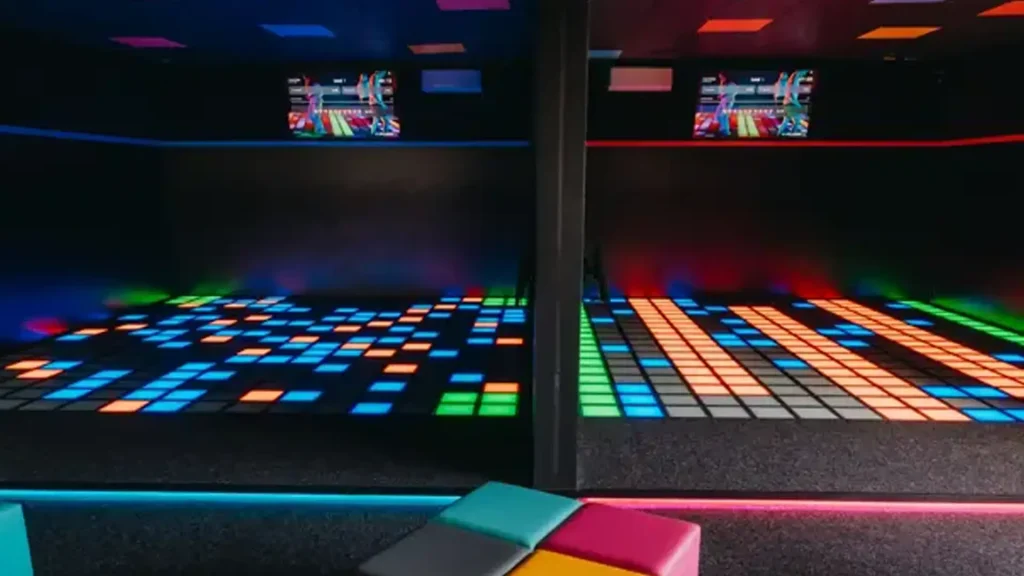
Operators who come to us after making a difficult first purchase rarely say they chose the wrong product. They usually say they chose a supplier without verifying the right things before ordering.
Ask for a live factory walk-through — not a video.
Not a promotional video. Not a slide deck. A real-time video call where you can direct the camera. Watch how LED tiles are assembled. Ask to see where controllers are tested. Ask to see finished products running. A factory with real production capacity will walk you through this without hesitation. A trading company presenting itself as a factory will have reasons why this week is difficult.
Request a live software demonstration.
The software is what determines whether players come back after the first visit. Ask to see game mode switching in real time. Ask to see the difficulty adjustment interface. Ask to see the backend management system. Ask specifically whether new games can be added after installation and who develops the content updates. A supplier whose software depth is shallow will not want to demonstrate it live.
Ask for completed project photos — not renderings.
Any company can generate a rendering. What you need to see is installation photos from actual venues: the room during setup, the system running, ideally with players in frame. Ask for the country or city where the project is located. Suppliers with a real project history share this readily. Suppliers without one redirect to renderings or product shots.
Verify spare parts availability and replacement lead times.
In a high-traffic active gaming venue, individual components will eventually need replacement. Ask specifically: how quickly can a single replacement LED tile be shipped? Is there stock held outside the factory? What is the process if a controller fails during peak hours? The answers to these questions reveal more about a supplier’s operational readiness than any specification sheet.
Confirm the after-sales support structure.
Technical support quality matters as much as product quality for long-term venue operation. Ask what the committed response time is for technical issues. Ask whether support is provided directly by engineers or routed through a customer service layer. Ask what happens if a software issue affects gameplay during a busy period. A supplier with genuine after-sales infrastructure answers these questions with specifics.
Red Flags That Appear Before the Contract Is Signed
One of the earliest warning signs appears in the first exchange.
You ask for completed project photos. The supplier sends beautiful renderings. Nothing else. No installation photos. No venue environment. No operators. No players. That absence is usually a signal that the project portfolio exists only in design software.
Another point that is often overlooked: a supplier who cannot explain their software in a live call is unlikely to support it effectively after delivery. We have seen operators receive systems where the software had significant limitations that were not visible in the promotional material — limited game modes, no difficulty adjustment, no content update path. These issues only became apparent during the live demonstration that should have happened before the order was placed.
A third pattern that appears repeatedly: quotations that are unusually low and then increase significantly when installation, customization, and shipping are added. A reliable active gaming room supplier provides a complete project cost picture from the first quotation, not a base price that expands at each stage of the conversation.
One mistake we see repeatedly in supplier evaluation is treating the initial response speed as a signal of reliability. A supplier who replies instantly with a low price and a catalog link is not necessarily more capable than one who asks several questions about the project before quoting. The questions are usually a better signal.
Questions Worth Asking Before Any Order Is Placed
Copy these into your next supplier meeting.
About the software:
How many game modes are included in the standard package? Can new games be added after installation, and who develops the content? Who owns the software — is it licensed or proprietary? How often is it updated, and is there a cost for updates?
About the product:
What is the load rating per tile? What sensor technology is used, and why? If a single tile fails, can it be replaced without taking the system offline? What is the standard warranty period and what does it cover?
About the project:
Do you provide 2D layout planning based on our floor dimensions? Is installation guidance included, and is it remote or on-site? What is the commissioning process and who supervises it?
About after-sales:
What is your committed response time for technical issues? Do you hold spare parts stock outside the factory? What is the replacement shipping lead time to our country? What happens if a software issue occurs during operating hours?
About customization:
What OEM options are available — interface language, logo, startup screen, game themes? What is the minimum order quantity for customized items? What is the lead time for custom configurations?
In projects we have worked with, operators who ask these questions before ordering consistently have smoother projects than those who ask them after. The answers do not just provide information — they reveal how the supplier thinks about the project relationship.
Why the Supplier Relationship Matters Beyond the First Order

An active gaming room is not a one-time purchase. A venue that opens successfully will eventually want to expand its room count, update its game content, replace wear components, or customize its brand presentation for a second location.
The supplier relationship that was established during the first order determines how smoothly all of those subsequent needs are handled.
In projects we have worked with, operators who established a direct factory relationship from the beginning consistently describe better outcomes in the second and third year of operation than those who purchased through a distributor and then needed direct factory access for customization or expansion. The initial cost saving from a distributor arrangement sometimes becomes a coordination cost later when the operator needs something the distributor cannot provide.
This is not an argument against distributors. It is an argument for understanding, before ordering, what the project will need in years two and three — and choosing an active gaming room supplier whose structure can support that.
For operators still in the planning stage, our interactive gaming room layout guide and active gaming room ROI guide cover the project decisions that happen before supplier selection becomes the primary question.
Before Comparing Quotations, Make Sure You Are Comparing the Same Project
Two suppliers can offer equipment that looks similar on paper while providing completely different levels of planning support, software depth, installation guidance, and long-term service. A quotation that does not include those elements is not a comparable quotation — it is an incomplete one.
Before comparing numbers, it is worth making sure every quotation covers the same scope: hardware, software, layout planning, installation guidance, commissioning, training, warranty terms, and after-sales support structure.
If you already have a floor plan, send it to us. We will review:
✓ Whether your room mix fits your target audience and revenue model
✓ Whether the equipment specification matches your expected player throughput
✓ Whether the layout supports efficient player rotation during peak hours
✓ Whether factory customization is necessary for your project
✓ Which questions you should be asking other suppliers before placing any order
There is no obligation. Sometimes a second technical opinion before purchasing prevents expensive changes after installation.
→ Contact us on WhatsApp
→ View our Interactive Game Floor product page
→ Read our Interactive Gaming Room Layout Guide
→ Compare Activate Games vs Independent Active Gaming Room
Active Gaming Room Supplier FAQ
What is the difference between a factory direct active gaming room supplier and a local distributor?
A factory direct active gaming room supplier manufactures the equipment and manages the project relationship without an intermediary. Pricing reflects production cost, customization requests go directly to the engineering team, and technical support comes from people who built the system. A local distributor resells equipment from a manufacturer, typically with faster local logistics and on-site support, but with less flexibility for customization and a higher base cost. The right choice depends on the project’s customization requirements, location, and long-term support needs.
How do I verify that an active gaming room supplier is a real manufacturer?
Request a live video factory walk-through — not a pre-recorded video. Ask to see the LED tile assembly line, the controller testing area, and finished products running in a test environment. Ask where specific components are sourced and how production is scheduled. A genuine manufacturer answers these questions with specifics and welcomes the walk-through. A trading company presenting itself as a manufacturer will typically find reasons to avoid or delay it.
What should be included in a complete active gaming room supplier package?
At minimum: hardware delivery, software configuration, 2D layout planning based on venue dimensions, installation guidance, commissioning support, technical training, warranty coverage with defined terms, spare parts availability, and a defined after-sales support structure. A quotation that covers only the hardware cost is not a complete project quotation.
Can factory direct active gaming room suppliers provide OEM and custom branding?
Yes. Factory direct suppliers typically offer OEM support including interface language customization, logo and startup screen integration, game theme and color scheme modification, and custom scoring interface design. The scope and minimum order requirements vary by supplier. Confirm the specific customization options and lead times before ordering, particularly if branding consistency across multiple venues is a requirement.
How long does delivery take when ordering from a factory direct active gaming room supplier?
Standard production and shipping timelines vary by order size and destination, but typical factory-to-venue timelines range from four to eight weeks for standard configurations. Custom or OEM orders add production time depending on the scope of modification. Operators should confirm the production schedule, shipping method, and customs clearance requirements for their specific country before finalizing the delivery timeline in the project plan.
What after-sales support should an active gaming room supplier provide?
Committed technical response time for software and hardware issues, spare parts availability with defined shipping lead times, remote diagnostics capability, a clear replacement process for individual components, and access to software updates. Ask specifically whether support is provided directly by engineers or routed through a customer service layer — the distinction matters when a technical issue affects venue operation during peak hours.