
Pixel Floor Game vs Arcade vs VR: Which One Should You Invest In?
Most venue owners don’t get to install every attraction they like. Floor space is limited, budgets are tighter than vendor quotes suggest, and every square meter has to earn its keep. At some point the decision comes down to picking one or two formats and committing real capital to them — and a pixel floor game, a row of arcade cabinets, and a VR station all end up on the same shortlist.
Every supplier will tell you their format is the smarter bet. The honest comparison depends on numbers most sales conversations skip over: cost per session, floor space per paying player, ongoing maintenance load, and how long the novelty actually lasts once the ribbon-cutting is over. This guide walks through those numbers directly, using a pixel floor game as the reference point since it’s the attraction most operators are currently adding to an existing lineup rather than replacing outright.
If you haven’t yet confirmed what a pixel floor game actually is and how the gameplay works, our complete pixel floor game guide covers the mechanics, game modes, and commercial fundamentals — worth a read first if the category is new to you.
Why the Pixel Floor Game Comparison Question Comes Up So Often
A pixel floor game sits in an odd spot in the buying process. It’s not cheap enough to add on impulse, and it’s not expensive enough to need board approval the way a full VR arena might. That puts it right in the middle of a comparison conversation with the two formats operators already know how to budget for: arcade cabinets and VR.
Operators bringing a pixel floor game into an existing venue usually aren’t asking “is this a good attraction.” They already believe it is — they saw the social media clips, or a competitor down the street installed one first. The real question is where it fits relative to what they already have, and whether it’s worth the floor space that would otherwise go to another arcade row or a second VR bay.
Pixel Floor Game vs Traditional Arcade

Space and Throughput
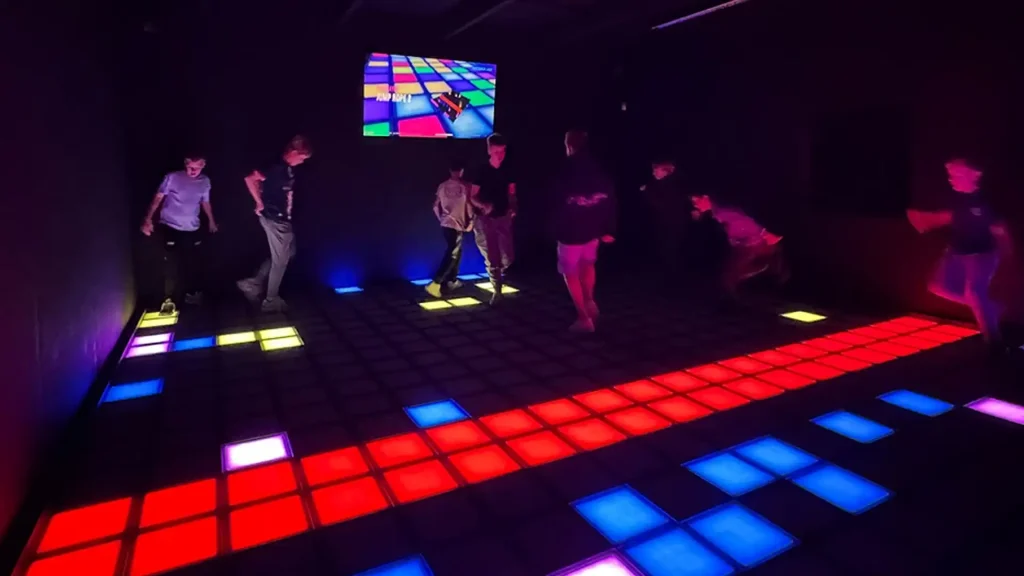
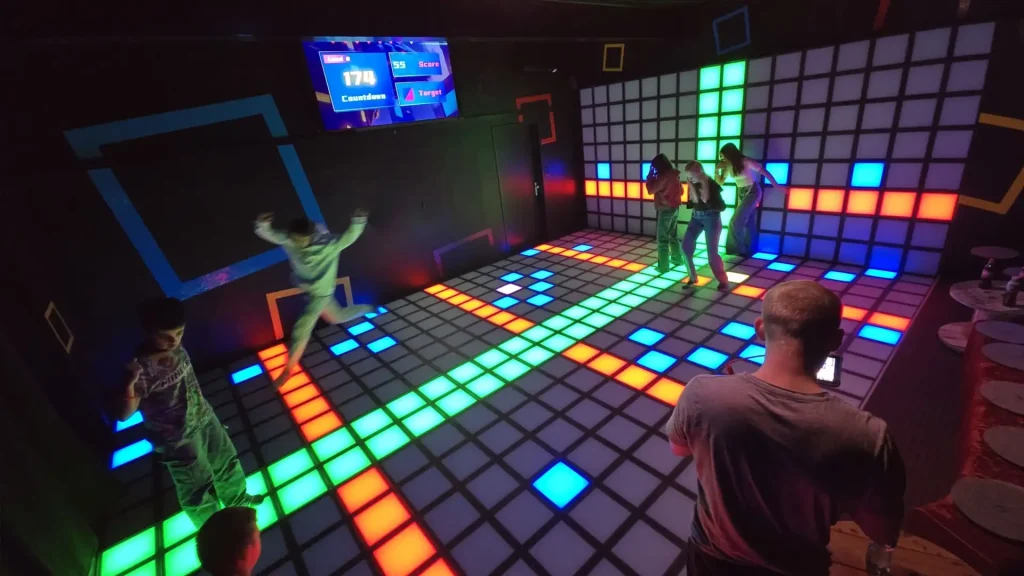
A single arcade cabinet occupies roughly 1 to 1.5 square meters and serves one player, occasionally two, per session. A pixel floor game system of comparable footprint — around 3m x 3m — can run three to five players at once, and individual rounds typically last 60 to 180 seconds. That’s shorter than most arcade play cycles, which means more paying players rotate through the same floor space in a given hour.
For venues that charge per session or per person, revenue per square meter is the number that actually decides whether an attraction is pulling its weight, and a pixel floor game consistently outperforms single-player cabinets on that metric.
Player Interaction
| Factor | Pixel Floor Game | Traditional Arcade |
|---|---|---|
| Interaction type | Full-body movement | Button or joystick input |
| Simultaneous players | 3–5+ | Usually 1 |
| Spectator appeal | High — visible from outside the play area | Low — screen-facing |
| Social media content | Generated by players without prompting | Rare, screens don’t film well |
| Main point of failure | Individual tile sensors | Cabinet electronics, worn joysticks |
Maintenance and Lifecycle
Arcade cabinets depend on internal boards, screens, and mechanical buttons that wear down with heavy daily use, and replacement parts are often specific to that one manufacturer’s cabinet — sourcing them can take weeks. A commercial-grade pixel floor game is built around modular tiles, so a single damaged tile can usually be swapped out without shutting the rest of the floor down. In a venue running long daily hours, that difference matters more than it sounds on paper.
Where Arcade Still Wins
Arcade cabinets remain the better call for venues that need a wide variety of game titles packed into a small footprint, or where the audience genuinely leans toward solo play — redemption-ticket arcades and mall kiosks, for example. If your model runs on ticket redemption rather than group social play, cabinets are still the more proven format, and a pixel floor game should complement that lineup rather than replace it.
Pixel Floor Game vs VR Gaming

Setup Time and Hygiene
VR needs a headset per player, a calibration step before every session, and — the part that matters most in a commercial venue — headset sanitation between users. A pixel floor game needs none of that. Someone steps onto the tiles and the round starts; there’s no equipment to fit, wipe down, or replace between groups. Multiply the setup time saved by every session in a full operating day and it adds up to real throughput.
Group Experience
Even multiplayer VR is largely a solo experience, because each player is visually isolated inside their own headset. A pixel floor game is the opposite by design — it’s a shared physical space where players see each other, react to each other, and where anyone standing nearby can watch and get pulled in. Group bookings — birthday parties, corporate outings, school trips — tend to convert better around an attraction the whole group can experience together rather than one that isolates each player individually.
Equipment Cost and Depreciation
| Factor | Pixel Floor Game | VR Station |
|---|---|---|
| Per-player equipment | None | Headset + controllers |
| Sanitation required | No | Yes, between every session |
| Setup time per session | Immediate | 2–5 minutes calibration |
| Equipment lifespan | Tiles rated for years of commercial use | Headsets typically cycled every 2–3 years |
| Group visibility | Full — spectators watch and queue up | Low — players isolated per headset |
Where VR Still Wins
VR delivers a level of visual immersion — full 3D environments, narrative content — that a physical floor simply can’t match. For a venue building a premium, ticketed VR experience as a distinct draw rather than a high-throughput group attraction, VR still earns a clear place in the lineup. Industry data backs this up: location-based VR entertainment centers are currently one of the fastest-growing attraction categories worldwide, expanding faster than most other FEC segments, according to Mordor Intelligence’s family entertainment center market research. The category is growing because it fills a specific niche — not because it outperforms group attractions like a pixel floor game on throughput.
Total Cost of Ownership: Pixel Floor Game vs Arcade vs VR
Sales conversations tend to fixate on the number at the top of the quote. What actually determines whether an attraction earns its floor space is total cost of ownership across two or three years of daily operation.
Initial investment. Arcade cabinets usually have the lowest per-unit cost, but the cost scales linearly — more titles mean more cabinets, which means more spend. VR stations require an ongoing per-headset investment on top of the initial hardware. A pixel floor game scales by tile count and room size, and typically sits in the mid-to-upper range of initial investment among the three formats.
Ongoing maintenance. Arcade cabinets carry parts and repair costs tied to a specific manufacturer’s cabinet design. VR stations carry headset replacement and content licensing costs that recur year over year. A commercial-grade pixel floor game generally carries the lowest ongoing maintenance cost per session once installed, since replacing an individual tile is inexpensive relative to replacing a cabinet board or a VR headset.
Revenue per square meter. This is usually where the comparison resolves in practice. Multiplayer, group-format attractions — a pixel floor game chief among them — generate more revenue per square meter per hour than single-player cabinets, simply because more paying players occupy the same footprint at the same time. This lines up with a broader shift the industry has been tracking: at IAAPA Expo 2025, operators repeatedly emphasized evaluating attractions on lifecycle ROI rather than novelty alone, according to Valo Motion’s summary of the show’s key trends — a framework that favors high-throughput formats like a pixel floor game over attractions that look impressive but serve one player at a time.
Which Attraction Fits Your Venue
There’s no single right answer here — the correct choice depends on your venue type and the audience walking through the door.
Shopping mall attraction or trampoline park with high walk-in traffic. A pixel floor game’s visibility and instant playability convert passersby into paying customers without needing a sales pitch, and that matters more in this venue type than almost anywhere else.
Redemption-ticket arcade with a solo-play audience. Traditional arcade cabinets remain the proven model here. A pixel floor game complements this format rather than replacing it, giving groups something to do together between rounds at individual machines.
Premium ticketed experience venue. VR earns its place as a distinct, higher-priced experience alongside — not instead of — higher-throughput group attractions like a pixel floor game.
Multi-room active gaming venue. The strongest-performing venues we’ve worked with rarely pick just one format. They anchor the space with a pixel floor game near the entrance for visibility and throughput, then use arcade cabinets or VR as secondary rooms deeper inside the venue where players who’ve already committed to visiting are looking for a second or third activity.
For a full breakdown of how a pixel floor game fits into a complete multi-attraction layout, see our interactive gaming room layout guide.

FAQ: Pixel Floor Game vs Arcade vs VR
Is a pixel floor game a better investment than VR for a small venue? For venues under 100 square meters prioritizing group throughput and walk-in conversion, a pixel floor game generally delivers stronger revenue per square meter than a VR station, which serves fewer players per hour and carries higher ongoing per-player equipment costs.
Does a pixel floor game require more maintenance than arcade cabinets? Generally less. Commercial-grade pixel floor tiles are designed for individual replacement without shutting down the full system, which typically results in lower ongoing maintenance cost than arcade cabinets that depend on manufacturer-specific parts.
Can a venue run a pixel floor game, arcade cabinets, and VR together? Yes, and multi-room venues that combine formats rather than choosing only one tend to see stronger group booking performance, since different attractions appeal to different players within the same group.
What’s the typical payback period for a commercial pixel floor game? Payback depends on room size, ticket pricing, and daily footfall, but the short session length — 60 to 180 seconds — combined with multiplayer throughput generally produces faster payback than single-player attraction formats at a comparable investment level.
Why is a pixel floor game more social-media-friendly than arcade cabinets or VR? A pixel floor game is visible from outside the play area, so both players and bystanders can watch and film in real time. Arcade cabinets face the screen away from onlookers, and VR isolates each player inside a headset — neither format produces the same kind of shareable, spectator-visible content a pixel floor game generates on its own.
Compare Interactive Floor Solutions Side by Side
Whether you lean toward our standard Interactive Game Floor or the Pixel Floor Game, both are commercial-built for venues that want reliable, high-ROI attractions.
View Interactive Game Floor View Pixel Floor Game Get a Free Quote Chat on WhatsApp