
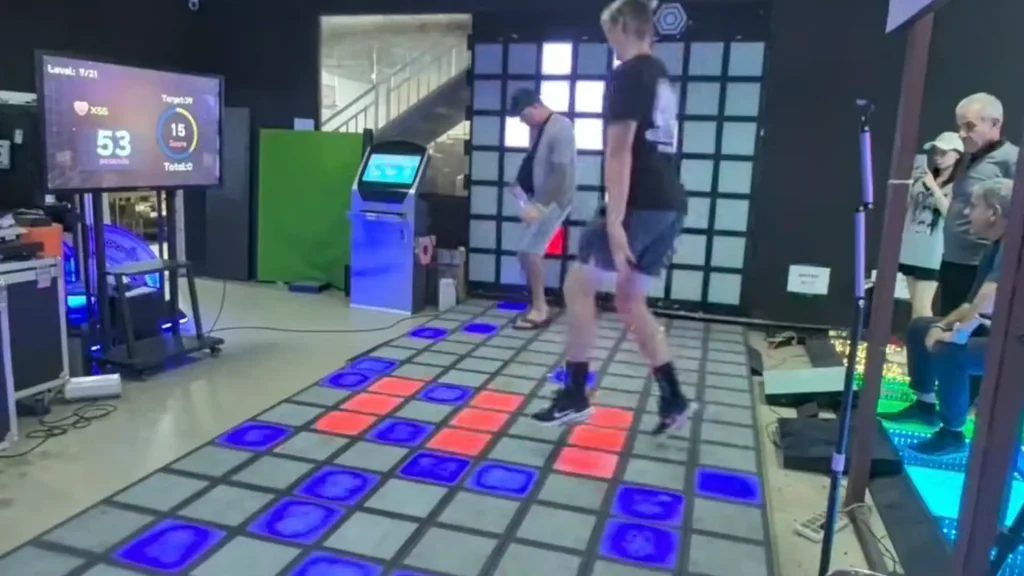
Interactive Games Supplier Checklist: 13 Things to Verify
Most product pages look the same. Every interactive games supplier shows glowing floors, laser mazes and button walls, usually filmed in a dark showroom where everything looks premium. The photos cannot tell you how the frame is welded, what happens when a sensor fails in month eight, or whether the person quoting you has ever stood on a production floor.
The difference between a smooth project and an expensive one is what you verify before the deposit — not after the container arrives. This checklist covers the 13 things experienced buyers confirm before placing an order with an interactive games manufacturer. None of them require you to fly to the factory. Buyers in most countries never visit in person, and a serious supplier is used to proving itself remotely.
Check 1: Company Legitimacy and Export History
Start with the basics, because the person answering your email may be a trading company rather than the interactive games manufacturer you think you are dealing with.
Ask for and check:
- Business license and registered scope
- How many years the company has manufactured interactive game equipment specifically
- Export experience in your market, including shipping documentation and customs handling
- Whether the quotation comes from the factory or a middleman
A trading company is not automatically wrong — but you should know which one you are talking to, because it changes the price, the communication chain and who is responsible when something needs replacing.
Check 2: Housing, Glass and How the Sensing Actually Works
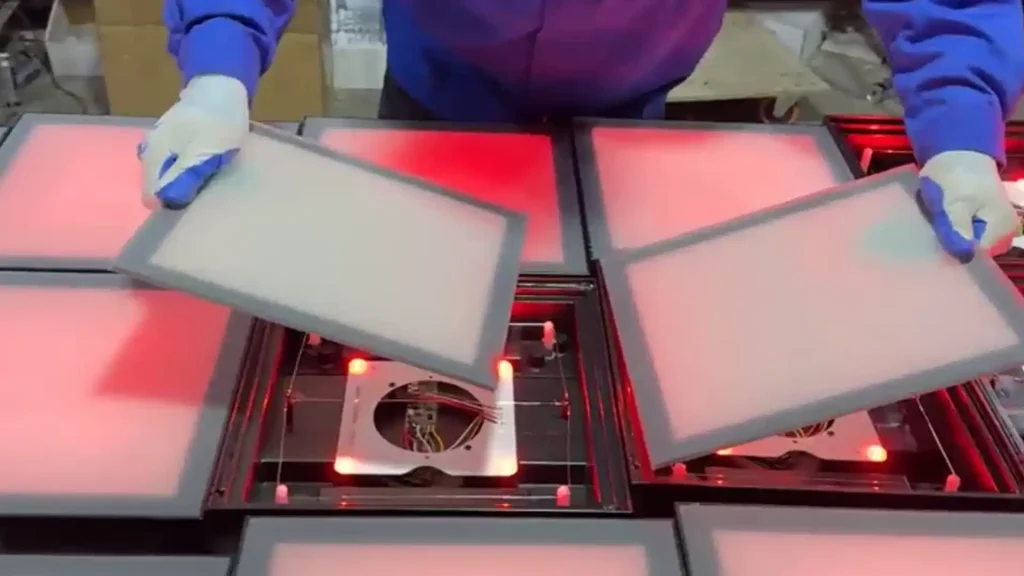
Two suppliers can use the same product name — “interactive game floor” — while building completely different hardware. Ask for the construction spec, not the marketing term.
Buyers often shortlist by material first, so it helps to know what you will run into: enclosures and surfaces in this category are commonly described as stainless steel, PVC, fiberglass or LLDPE plastic, and each has a different cost, weight and service life. Material names are a reasonable starting point — but they are only a starting point. Two suppliers can both say “stainless” and still deliver very different products, so ask what each part is made of, why that material was chosen, and what service life the supplier expects from it.
For reference, this is how we build ours — followed by what to ask any other manufacturer:
- Housing: what is the enclosure made of, and is it moulded in-house or bought in? Our Interactive Game Floor uses an ABS plastic-steel enclosure — rigid enough for public use, light enough to keep freight reasonable.
- Surface: what glass thickness and rating is used, and what happens if you need something else? Ours is 8 mm tempered glass as standard. If your project needs a different specification — thickness, finish, anti-slip rating or lamination — tell the supplier before production starts: glass is ordered against the build slot, so a late change delays the whole order.
- Sensing: how does the system detect players, and how is a failed cell replaced? Our modules use capacitive sensing, with a light board inside each module carrying the game interaction. Ask how the sensing layer is protected from moisture and dust, and whether a failure means replacing the whole module or only the board.
- Wiring: what conductor and connector type? Ours uses copper conductors, not aluminium-clad substitutes.
- Installation: how do modules connect, and is first assembly supported remotely? Ours uses quick-connect plugs, so a room can be assembled without specialist labour.
Then apply the same test to every supplier you are comparing: ask them to point at each of these five items in a photo of the actual product. A manufacturer that builds its own hardware can do it in ten seconds. The same test separates a real interactive games factory from a trading company that only forwards enquiries.
Check 3: What Ships in a Complete System — Controllers, Sub-Controllers and Licence Keys
A quotation that only says “interactive game floor, N modules” is incomplete. A working room needs control hardware and software authorisation on top of the floor:
- Game content: how many games ship with the system, and what happens when you want more later
- All-in-one control unit (一体机): the main machine running sessions, scoring and game switching — confirm whether it is included or quoted separately
- Sub-controllers (分控机): typically one per zone or room section; ask how many your layout needs and whether additions later are plug-and-play
- Game machines: where an individual attraction runs its own control hardware, confirm which ones do
- Licence keys (密钥): how content and software are authorised — perpetual or term-based, tied to a machine or transferable, and what happens when a controller is replaced
Two questions prevent most of the trouble: is the licence tied to the hardware serial number, and can games be added after installation without sending equipment back. Both are cheap to arrange before shipping and expensive to fix afterwards.
Check 4: OEM and ODM Scope
“OEM/ODM” appears on every interactive games supplier page, but it means very different things. Pin down the actual scope:
- Branding (OEM): your logo, colors and packaging on a proven system. Fastest and lowest risk.
- Game content customization: custom game modes, difficulty levels, scoring rules, languages and sounds. Ask to see examples of custom modes already shipped.
- Hardware changes (ODM): room dimensions, module sizes, sensor layouts, integration with your ticketing or wristband system.
Ask what each level does to lead time and price, and request photos of customized systems delivered to real buyers — not renders.
Check 5: Durability and Duty Cycle
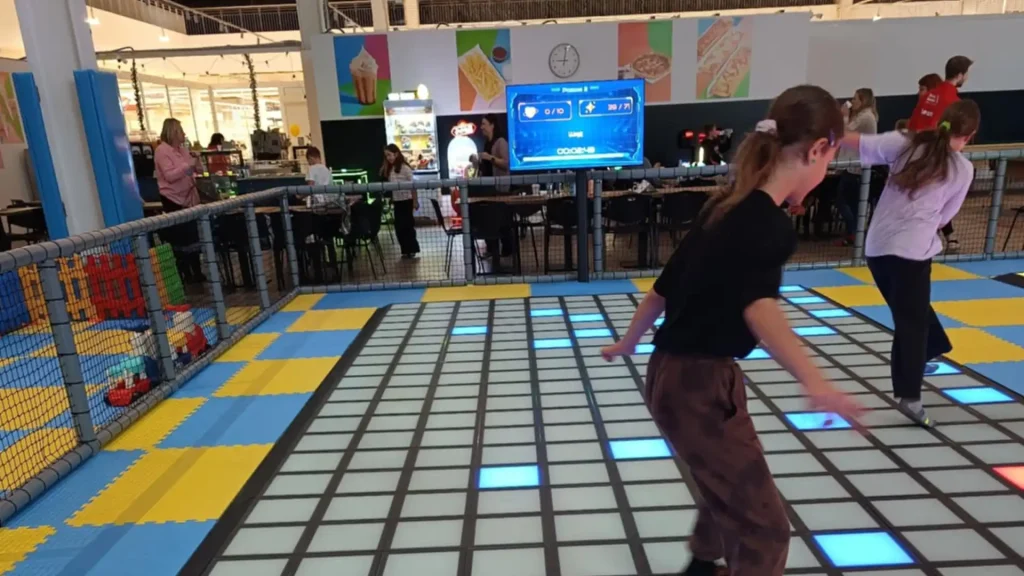
Commercial attractions run for 8–12 hours a day. A system designed for a demo room will not survive an FEC — so ask what makes a unit durable under continuous public use, not just whether it works on day one.
Verify:
- Rated duty cycle and daily operating hours
- Sensor lifespan and what typically fails first
- Floor load rating and surface anti-slip performance
- How the system handles spilled drinks, dust and humidity
- Mean time between failures, if the manufacturer tracks it
The most reliable answer is a concrete one: which components fail most often, and how they are replaced. A supplier who says “nothing ever breaks” is telling you they have never operated one of their rooms.
Check 6: Lead Time — How Long Will Your Exact Configuration Take?
Confirm three numbers in writing:
- Production lead time after deposit. For our own production planning, a standard order is typically around 15 days, while a single Interactive Game Floor in a suitable standard configuration can be prepared in as little as 3 days. These are supplier-specific figures, not industry-wide benchmarks. When comparing factories, ask each supplier to confirm the production date for your exact configuration in writing.
- Order quantity: whether single-room starter sets are accepted, and how pricing changes at 3, 5 or 10 rooms
- Peak season effect: lead times before holidays and trade-show season often stretch; ask for this year’s worst case, not the best case
Be suspicious of any supplier quoting both the fastest lead time and heavy customization — those two rarely co-exist.
Check 7: Price Structure and Quotation Scope
The cheapest quote and the real cost are rarely the same number. Before comparing prices, make every interactive games supplier quote the same scope:
- What is included: control units, sub-controllers, licence keys, game content and a spare parts kit (see Check 3)
- What is excluded: shipping, installation, room buildout, decoration, customs
- Payment terms and what stage triggers production
- Whether the quoted figure is a factory price or includes a trading company’s commission
For how budget ranges scale with room size, see our interactive game floor price guide.
Check 8: Certifications and Test Reports
Request the certificates for the standards that apply to your market, not a folder of everything the factory ever obtained:
- CE marking (EU) or UKCA marking (Great Britain), or the applicable mark for your region
- Electrical safety test reports for the control cabinet and power supplies
- Fire ratings for surface materials where your venue requires them
- Which certificates cover the complete system and which cover only components
A component-level certificate that cannot be applied to the shipped system will not satisfy a venue inspection, so ask precisely what each document covers.
Check 9: Warranty — What Happens When Something Fails?
Warranties in this category are usually quoted in years — 1, 2, 3, sometimes 10 or 20 — and buyers naturally compare on that number first. Duration alone is the weakest part of the comparison, though. Compare warranty terms on three axes, because “1 year warranty” can mean very different things:
- Duration and tiering: what is covered in year one versus years two and three
- Scope: full replacement, or spare parts plus repair guidance
- Process: how a claim is filed, how a replacement is shipped, and who pays freight
To make the difference concrete, the following is an example of how one supplier can structure its warranty terms. Use it as a comparison model rather than assuming every manufacturer offers the same coverage.
| Period | What is covered | Who pays freight |
| Within 1 year | Quality defects: the grid floor is replaced free of charge with a new one | Seller |
| Year 2 – year 3 | Quality defects: spare parts are supplied free of charge, together with a repair video and guidance | Seller |
Two details matter more than the duration itself. First, whether freight is covered — a “free” part that costs you more in shipping than the part itself is not really free. Second, whether the second tier includes repair guidance, because most downtime is lost waiting for a technician to work out what to do, not waiting for a parcel.
Check 10: Spare Parts — How Fast Can a Failed Component Be Replaced?
This is where attraction operators lose the most money, because a closed attraction earns nothing. Ask:
- What spare parts kit ships with the order, and what it covers
- Spare part pricing after the warranty ends
- Response time for technical questions, and in what language, on what channel
- Whether remote diagnostics are available
- How long discontinued parts remain available
Ask for one real example: a part that failed at a customer venue, and how long the fix took end to end.
Check 11: Shipping, Packing and Installation Support
Interactive game equipment mixes electronics, glass, acrylic and steel in one container, so packing matters as much as production.
Confirm with the interactive games supplier:
- Export-grade packing: wooden crates, foam, moisture protection, module-level separation
- Container loading plan and who optimizes it
- Shipping terms offered (EXW, FOB, CIF, DDP)
- Installation: remote video guidance, or a supervisor on site, and what each costs
- Site requirements checklist before the equipment ships: power, flooring levelness, ceiling height, network
Check 12: Verifying the Factory Remotely — The Video Audit
Most overseas buyers never visit the factory, and they do not need to. A structured video call can verify almost everything a walk-through would — and any interactive games supplier that builds its own hardware should be comfortable doing it on camera:
- Ask for a live video walkthrough of the production area, not a recorded tour
- Ask the host to show the specific production step for your order: frame welding, module assembly, aging test
- Request a live demo of the actual game system, with the host playing it, not a promotional clip
- Check the nameplate and the label on the equipment during the call and match it to the quotation
- Ask to speak to the engineer who would support you after sales, not only the salesperson
Thirty minutes on a live call tells you more than thirty pages of catalog.
Check 13: Pre-Shipment Inspection and Photo Documentation
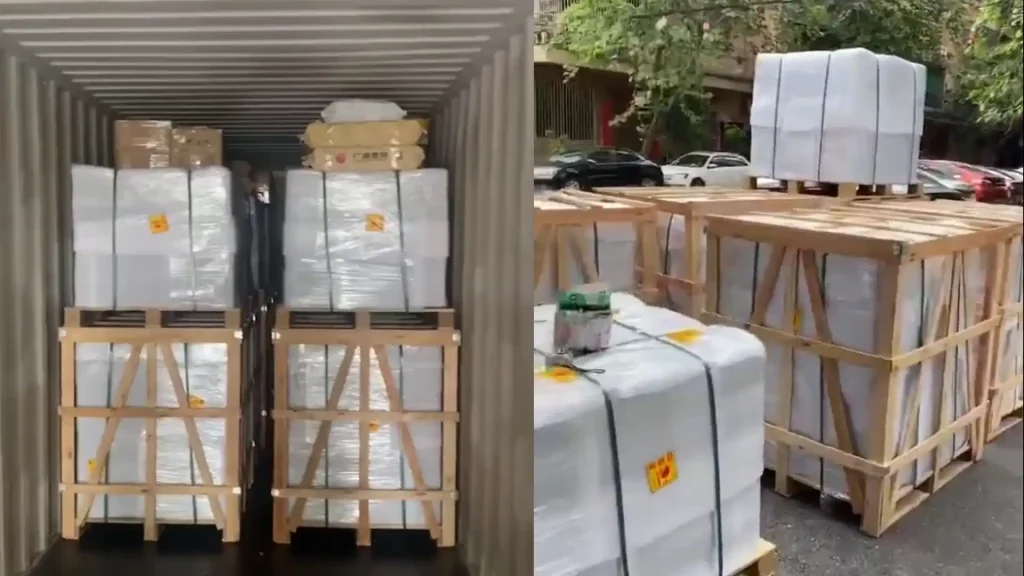
The last checkpoint happens after production and before the container closes. Make it contractual:
- Full photo and video documentation of the finished system before packing: each module powered on, game modes running, serial numbers visible
- Packing photos of every crate, labeled and mapped to the packing list
- Optional third-party inspection: an independent inspector (SGS, QIMA, TÜV Rheinland or a local freelance inspector) checks the goods at the factory for an additional inspection fee. For larger orders, that cost is usually small relative to the value of the equipment being purchased
- Agree in advance what happens if the inspection finds defects: repair, replace, or deduct
A factory that photographs and documents every shipment before it leaves is a factory that expects its records to be checked. Ask for samples of previous inspection documentation when you negotiate — how the supplier responds to that request is itself a signal.
A Real Project Reference: What One 231 m² Room Included
Checklists are easier to apply to a real project. One of our completed projects in Jordan planned a commercial gaming room of approximately 231 m² around an Interactive Game Floor and a wider interactive gaming mix.
These are exactly the numbers an interactive games supplier should be able to give you before you sign anything. The useful detail for buyers is not the number itself but the ratio: playable zones, entrances, circulation, reception, staff access, electrical points and emergency routes all had to fit inside that footprint. The buyer confirmed module size (30 cm × 30 cm), supervision model and room mix before ordering — exactly the checks in this list.
The full planning process, including the layout patterns and support-space ratios, is documented in our 231 m² Jordan project case study.
Red Flags: When to Walk Away
Walk away — or at least slow down — when an interactive games supplier:
- Quotes a price far below every other quote and cannot explain the difference
- Sends only renders and showroom videos, never live footage
- Refuses a live video factory walkthrough
- Cannot name which parts are produced in-house
- Has no process for pre-shipment documentation
- Answers technical questions only through a salesperson, never an engineer
None of these alone is proof of a bad supplier. Two or three together usually are.
Plan Your Room With a Manufacturer, Not a Catalog
If you are comparing interactive games suppliers for an active gaming or interactive floor project, send us your room size and target opening date. We will return an equipment list, production lead time and a factory-direct budget range within one business day — including the pre-shipment photo documentation we prepare for every order.
FAQ
How do I verify an interactive games supplier without visiting China?
Use a structured video audit: a live walkthrough of the production floor, a live demo of your actual system, nameplate checks during the call, and a conversation with the after-sales engineer. Add pre-shipment photo documentation and, for larger orders, an independent third-party inspection at the factory.
What materials should commercial interactive game equipment use?
Ask every supplier for its own construction specification rather than assuming a category standard. For example, our Interactive Game Floor uses an ABS plastic-steel enclosure, 8 mm tempered glass, capacitive sensing, a light board and copper wiring; another manufacturer may build the same product differently. What matters is that the interactive games supplier states its specification in writing. Confirm the glass thickness and rating, ask what happens when a single cell fails, and check that wiring is copper rather than aluminium-clad. If you need a different glass specification, request it before production starts.
What is the difference between OEM and ODM for interactive games?
OEM applies your branding to a proven system. ODM changes the product itself: room dimensions, module layouts, sensor configurations, custom game modes and integration with your operating system. Customization increases lead time and price, so confirm the scope in writing.
What certifications do I need to import interactive game equipment?
It depends on your market: CE for the EU, UKCA for the UK, and local electrical safety standards elsewhere. Ask what each certificate covers — a component-level certificate does not always apply to the complete shipped system.
How does pre-shipment inspection work?
After production, the supplier documents the finished system: every module powered on, game modes running, serial numbers recorded, and every crate photographed against the packing list. For larger orders, an independent inspector can perform the check at the factory before shipping.
What does the warranty actually cover, and who pays shipping?
Ask the supplier to state coverage in tiers and to name who pays freight on replacement parts. As one example of how a supplier may structure this: within the first year, quality defects are covered by a free replacement of the affected grid floor, with the seller covering freight; in years two and three, spare parts are supplied free of charge with a repair video and guidance, with the seller still covering freight. Freight terms are the part most buyers forget to confirm — and the part most likely to turn a “free” replacement into a real cost.
How long does production take for interactive game equipment?
Confirm the figure for your exact configuration rather than accepting a general number. For our production planning, a standard order is typically around 15 days, while a single Interactive Game Floor in a suitable standard configuration can be prepared in as little as 3 days. Custom layouts and game content can extend the schedule, so ask each supplier for a written production date based on your exact configuration.
What does a typical interactive game floor project cost?
Budget scales with room size, module quantity, game content and the room mix around the floor. See our interactive game floor price guide for how quotation scope is structured, and send your floor plan for a project-specific range.