
Commercial Laser Maze Game: Complete Guide for FECs and Entertainment Venues (2026)
A commercial laser maze game is one of the most consistently profitable secondary attractions in the FEC industry — not because it looks spectacular, but because players keep coming back to beat their own time. When a mall operator in Southeast Asia added a commercial laser maze game next to their interactive game floor, the laser maze room ended up generating more repeat visits per square meter than almost any other part of the venue. The rules were simple, the scores were visible, and the competition between friends kept players returning week after week.
This guide covers how a commercial laser maze game works, what it costs, how much space it needs, and how FEC operators can use it inside a wider room strategy.
What Is a Commercial Laser Maze Game?
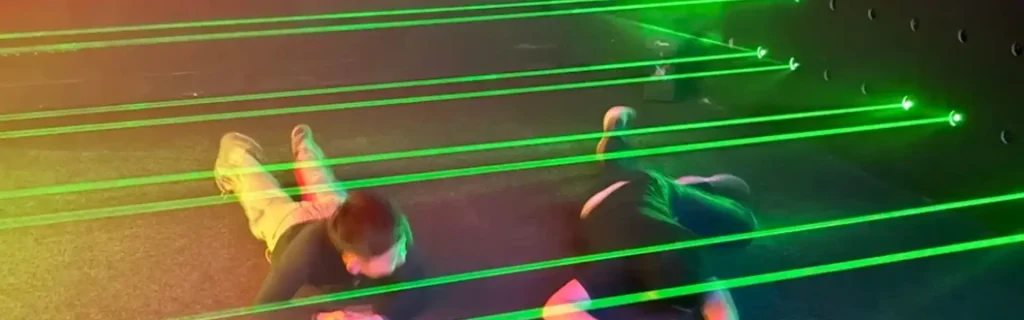
A commercial laser maze game is an indoor attraction where players move through a room of laser beams — ducking, stepping over, turning sideways — without breaking any beam. The system tracks time, counts penalties when a beam is triggered, and displays a final score.
The concept is immediately understood by almost anyone who sees it. That clarity is part of what makes it commercially strong.
Unlike a VR experience that needs headset fitting and calibration, or an escape room that requires staff to reset props between groups, a commercial laser maze game resets in under 30 seconds. A player completes the run, the score appears, and the next player can start almost immediately.
A commercial-grade system differs from a DIY setup in the ways that matter most for public operation: consistent beam detection, durable hardware, multi-difficulty software, visible scoring, and a control panel that staff can manage without technical training.
What a complete commercial laser maze game typically includes:
- laser emitter and receiver system across floor, wall, and ceiling zones
- timer with visible countdown display
- penalty detection and composite scoring
- difficulty level control (easy, medium, hard, team mode)
- single-player and team competition modes
- sound and lighting effects
- staff remote reset and control panel
- start and finish confirmation points
- leaderboard display inside or outside the room
Why FEC Operators Choose a Commercial Laser Maze Game
High Replay Value Through Competitive Scoring
Most FEC attractions have a natural replay ceiling. Once a visitor completes an escape room or watches a show, there is limited reason to do it again in the same visit. A commercial laser maze game does not have the same ceiling.
Players who finish the easy level want to try medium. Players who beat a friend’s time want to go again faster. Visitors who see their name near the top of the leaderboard have a specific social reason to defend their position on the next visit.
This score-driven replay dynamic is one of the primary reasons operators who add a commercial laser maze game report strong repeat visit numbers from the same customer base.
Fast Throughput in a Small Footprint
A commercial laser maze game running 3-minute sessions can serve 15–20 players per hour in single-player mode. For venues operating in leased mall or retail space where every square meter carries a rental cost, this throughput-to-footprint ratio is difficult to match with larger attractions.
Many operators find that corners, side rooms, or narrow areas that are difficult to monetize with bigger attractions become profitable commercial laser maze game rooms.
Works Across Age Groups
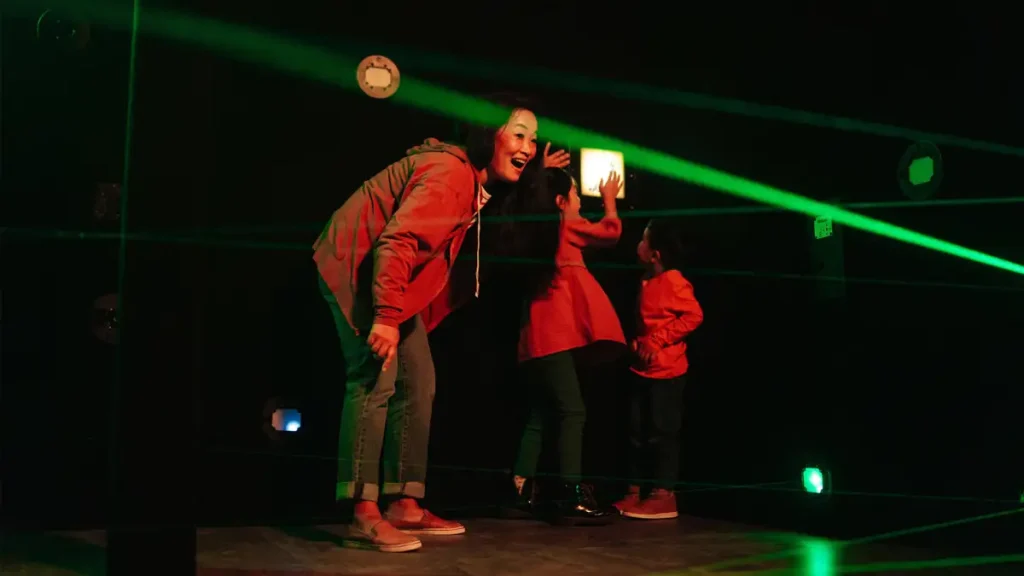
Children understand “avoid the lasers” immediately. Teenagers enjoy the timed competitive element. Parents can play alongside their children on equal terms. Corporate groups can use it as a light team challenge.
The commercial laser maze game is one of the few FEC attractions where a 10-year-old and a 40-year-old are genuinely competing on the same terms. That cross-age appeal is commercially useful because it widens the paying audience beyond any single demographic.
How a Commercial Laser Maze Game Works
The Beam System
Laser emitters are positioned on one side of the room, with receivers on the opposite side. When the beam path is clear, the receiver registers a continuous signal. When a player’s body interrupts the beam, the receiver loses that signal and the system records a penalty.
Beam arrangement creates the challenge. Horizontal beams require ducking or crawling. Vertical beams require turning sideways. Diagonal beams demand more complex movement decisions.
Good beam design in a commercial laser maze game creates a route where players must vary their movement throughout — not simply crouch and shuffle in one position. The rooms that produce the strongest replay rates combine at least two or three different beam angles so that no single physical approach works for the entire route.
Scoring and Leaderboard
The scoring system is what turns a physical challenge into a commercial game.
At minimum, a commercial laser maze game should display elapsed time and penalty count clearly at the end of each run. A stronger system calculates a composite score from time and penalties and maintains a persistent leaderboard across sessions.
The leaderboard is worth specific attention. A visible board inside or just outside the laser maze room is one of the lowest-cost additions that produces the highest replay impact. Players whose names appear on the board have an immediate social incentive to come back — to defend their position or to show a friend.
Difficulty Settings
| Level | Configuration | Best For |
|---|---|---|
| Easy | Fewer beams, wider movement paths | Children under 12, families |
| Medium | More layers, tighter movement | Teenagers, mixed groups |
| Hard | Dense beams, faster timer pressure | Competitive return visitors |
| Team Mode | Coordinated challenges, shared score | Birthday parties, corporate groups |
Adjustable difficulty is not optional for a commercial laser maze game operating at a public venue. Without it, the room serves one audience well and excludes others.
Laser Safety: What Commercial Buyers Should Confirm
A commercial laser maze game uses classified laser products, and the classification is not just a technical footnote — it affects insurance requirements, venue approval, and staff safety training.
Laser products are graded under international safety standards such as IEC 60825, based on the risk of eye or skin exposure. Most commercial laser maze systems use low-power visible-light lasers rather than higher-power industrial classes, but the exact classification varies by manufacturer and should never be assumed from a product photo or sales brochure alone.
Before ordering, confirm three things with any supplier:
- What laser class is the system rated at, and can this be provided in writing?
- What safety interlocks or automatic shutoffs are built in if a beam module is removed or tampered with during operation?
- Does the documentation match what your venue’s insurance provider or local licensing authority requires?
A supplier who answers these precisely — not with a general “it’s safe for commercial use” — is the one worth ordering from.
How Much Space Does a Commercial Laser Maze Game Need?
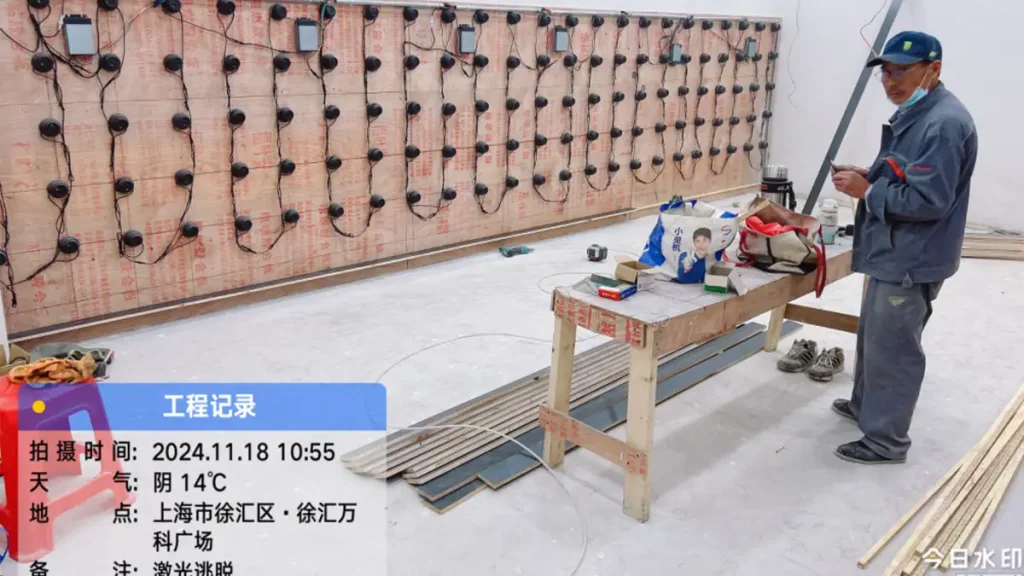
50–80㎡: Compact Add-On
This is the most common size for a commercial laser maze game added alongside another primary attraction such as an interactive game floor.
At this scale, the focus should be a clear single route, fast reset, and scoring visible from outside the room. A spectator window or open-entry design helps passing visitors understand the attraction immediately.
80–150㎡: Primary Challenge Room
At this size, the commercial laser maze game can have beam variety across multiple sections, a waiting zone, a briefing area, and a team mode that works for birthday party groups.
This is the right size for a venue where the laser maze is one of two or three featured attractions and group bookings form a core part of the revenue model.
150㎡+: Part of a Multi-Attraction Room
At larger scales, a commercial laser maze game becomes one zone inside a wider active gaming environment connecting to an interactive game floor, push button wall, or Hide-style challenge room.
For large FEC projects, the laser maze should be planned as part of the overall player flow, not as an isolated room.
How Much Does a Commercial Laser Maze Game Cost?
The cost of a commercial laser maze game varies significantly depending on room size, software functionality, customization requirements, installation scope, and after-sales support.
Unlike consumer-grade systems, commercial laser maze attractions are typically configured based on the venue layout and operational goals. Factors such as scoring software, game modes, beam density, interactive effects, and installation complexity can all influence the final investment.
Most professional suppliers provide project-based quotations after reviewing:
- Room dimensions and layout
- Expected player capacity
- Software and game mode requirements
- Custom branding or theme design
- Shipping destination and installation needs
Key factors that influence investment:
- Room size and beam configuration
- Detection and sensor accuracy
- Scoring software and leaderboard functionality
- Sound and lighting integration
- Installation complexity
- Technical support and future software updates
Rather than offering generic pricing ranges, we provide tailored proposals based on your specific project requirements.
Request a customized laser maze solution and quotation by contacting our project team today.
- For the same evaluation framework applied to interactive game floors, see our Interactive Game Floor Cost and ROI guide.
Commercial Laser Maze Game vs Escape Room
This comparison matters because both can occupy a similar room size and serve group bookings.
| Feature | Commercial Laser Maze Game | Escape Room |
|---|---|---|
| Session Length | 2–5 minutes | 45–60 minutes |
| Reset Time | Under 30 seconds | 15–30 minutes |
| Staffing Required | Low | Medium to high |
| Replay Value | High — score-driven | Lower after solving |
| Peak Hour Throughput | High | Low |
| Birthday Party Value | Good | Good |
| Content Refresh Cost | Low | High |
Escape rooms work well when the venue wants longer narrative experiences and is prepared for regular content refreshes to prevent the “already solved it” problem.
A commercial laser maze game works better when the operator needs high throughput, low reset complexity, and replay value that comes from player improvement rather than unseen content.
For venues that can afford both, having both is usually the right answer. For venues choosing one, the decision comes down to whether the business model prioritizes session depth or visit frequency.
Commercial Laser Maze Game vs Interactive Game Floor
| Feature | Commercial Laser Maze Game | Interactive Game Floor |
|---|---|---|
| Core Appeal | Individual mission, precision, speed | Group energy, team play, visible fun |
| Multiplayer Capacity | Limited | High — 4 to 20+ players |
| Spectator Appeal | Moderate | High |
| Birthday Party Value | Good | Excellent |
| Space Efficiency | High | Moderate |
| Natural Role in Room | Secondary challenge | Core anchor attraction |
The commercial laser maze game and the interactive game floor are not alternatives — they are complements.
The interactive game floor creates group energy. It is visible, colorful, and loud in the best way. The commercial laser maze game creates focused individual challenge — quieter, more intense, and more personally meaningful to players who care about competing against their own score.
A group that spends 20 minutes on the game floor and moves to the laser maze for timed individual challenges has had two completely different experiences in one visit. That variety is what drives longer dwell time and stronger revenue per visitor.
For operators building from scratch, the practical approach is to establish the Interactive Game Floor as the core anchor first, then add the commercial laser maze game as the first secondary attraction. This matches how visitor attention moves through the room — toward the biggest, most visible attraction first, then into more personal challenges.
For full room planning strategy, see our Interactive Gaming Room Games guide.
Laser Maze ROI for Family Entertainment Centers
ROI from a commercial laser maze game depends on how it is positioned commercially, not just how many people walk through.
Birthday Parties
Birthday parties are the highest-margin use case for a commercial laser maze game room. A group booking the room for themselves gets a premium private experience. The timed challenge format creates natural competition — everyone tries the route, scores are compared, and there is a clear winner.
Laser maze birthday packages work best with a fixed number of rounds per person, a printed or digital score card for the winner, and a simple online booking flow.
School and Youth Groups
School groups often book during weekday off-peak hours when the venue most needs revenue. A commercial laser maze game needs no props, no narrative setup, and no long explanation. Groups start quickly, compete naturally, and the venue processes multiple groups across the day.
Corporate Team Building
Corporate team building is a growing revenue stream for active gaming venues. A commercial laser maze game fits this market because it requires no physical strength, creates direct score comparison between colleagues, and is short enough to run multiple rounds in a lunch-hour session.
Membership and Repeat Visit Programs
For venues running membership models, a commercial laser maze game with a persistent leaderboard gives members a specific measurable reason to return each week. Members ranked on the board have a concrete stake in the next visit.
As referenced on the STM Trampoline Parks laser maze page, the format works precisely because players can challenge themselves and others repeatedly without the experience becoming stale.
Common Mistakes When Buying a Commercial Laser Maze Game
Prioritizing price over detection quality. False penalties from misaligned sensors destroy player trust on the first visit. Consistent, accurate beam detection is non-negotiable in a public venue.
No leaderboard. Without persistent scoring, a commercial laser maze game is a one-time novelty. With a leaderboard, it becomes a social competition that brings players back.
Linear room design. A single straight corridor that players solve once and stop finding interesting is a missed opportunity. A room with varied beam heights, multiple directional changes, and at least two distinct challenge zones produces significantly stronger replay rates.
Closed room, no spectator access. Players waiting outside should be able to see what is happening inside — through a window, a monitor feed, or an open entry design. Spectating builds anticipation and sells the attraction without staff involvement.
Not asking about post-sale software support. The hardware will outlast the first software version. Game modes should be updatable. Ask before you buy.
Commercial Laser Maze Manufacturer Checklist
| Item | Question to Ask |
|---|---|
| Laser safety | Can the supplier provide laser classification documentation in writing? |
| Hardware | Are emitter and receiver modules individually replaceable, or does a failure require replacing the whole unit? |
| Software | Can difficulty modes and beam patterns be updated after installation, or only at time of order? |
| Installation | Does the supplier provide a layout and mounting design based on your actual room dimensions? |
| Calibration | What’s the process for recalibrating beams if a mounting point shifts over time? |
| Support | Is spare-parts availability and after-sales support clearly defined before you order? |
How to Combine a Commercial Laser Maze Game With Other Attractions
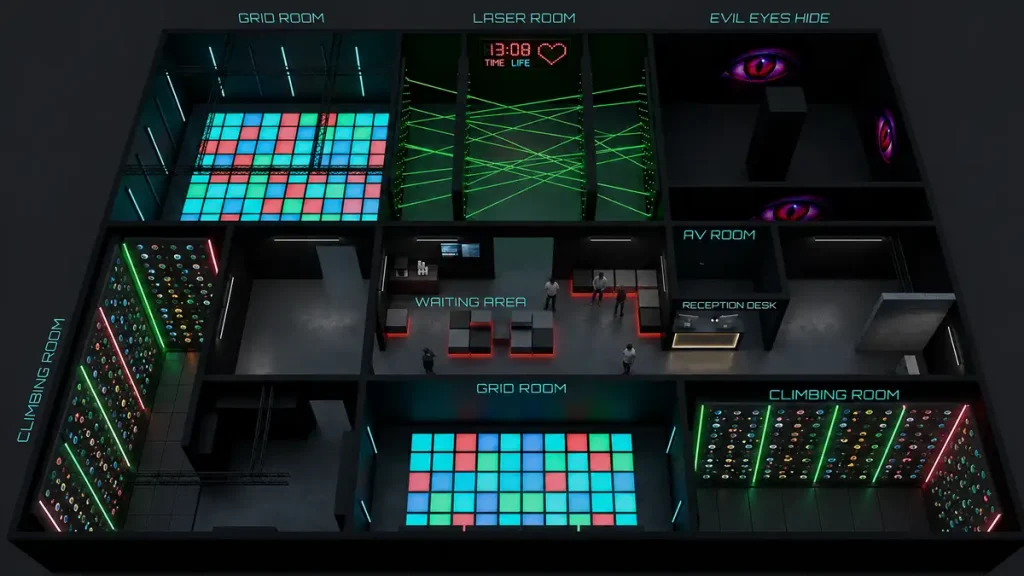
With an Interactive Game Floor: The most effective and most common combination. The floor handles group play and high visibility; the commercial laser maze game handles focused individual challenge. They serve the same audience in complementary ways without competing for the same player energy.
With a Hide Room: Two different stealth challenges that create very different feelings. The laser maze rewards precision and speed; the Hide game rewards observation and timing. Together they build a strong stealth-challenge zone.
With a Push Button Reaction Wall: A fast-turnover combination for venues targeting teenagers and competitive groups. Both attract players who respond to direct score comparison.
With an Interactive Climbing Wall: Adds vertical physical challenge to balance the floor-level laser maze. Well suited for venues targeting active older children and teenagers.
For complete room planning guidance, see our How to Build an Interactive Gaming Room guide.
Why Work With a Direct Commercial Laser Maze Manufacturer
Buying factory-direct changes what’s actually available to a buyer, beyond just price:
- OEM and custom theming built into production, not limited to a reseller’s existing catalog
- Spare parts sourced from the production line, not a middleman’s warehouse — this matters the day a single component needs replacing, not before
- Direct factory verification — a video walkthrough of production is easier to arrange when you’re dealing with the manufacturer directly, not a layer of resellers
- Global shipment coordinated by the team that built the system, which means fewer handoffs when something needs troubleshooting after delivery
When a beam module needs replacing eighteen months after installation, the difference between a factory relationship and a reseller relationship becomes very practical, very fast.
Commercial Laser Maze Game FAQ
What is a commercial laser maze game?
A commercial laser maze game is an indoor attraction where players move through laser beams without triggering them, competing against a timer and scoring system designed for repeated public use in FECs, malls, and entertainment venues.
How much does a commercial laser maze game cost?
Pricing depends on room size, beam configuration, scoring software, and customization level — a compact single-room setup and a full multi-zone installation with custom theming and advanced leaderboard software sit at very different price points. Because of this range, we don’t publish a generic price list; send us your room dimensions and project goals and we’ll come back with a tailored quotation.
How much space does a commercial laser maze game need?
A compact installation works in 50–80㎡. A full challenge room typically uses 80–150㎡. For larger multi-attraction venues, laser maze zones integrate into 150㎡+ active gaming environments.
How does a commercial laser maze game compare to an escape room?
Laser maze has shorter sessions, faster reset, lower staffing needs, and higher replay value from score competition. Escape rooms offer longer narrative experiences with lower throughput and higher operational complexity.
Can a commercial laser maze game be combined with an interactive game floor?
Yes — this is the most common and most effective combination. The game floor handles group play and visual impact; the commercial laser maze game adds an individual mission challenge.
What drives repeat visits to a commercial laser maze game?
Persistent leaderboards, difficulty levels, and competitive timing are the three strongest factors. Players who see a clear path to improvement — faster times, lower penalties, harder levels — have a specific measurable reason to return.
Plan Your Commercial Laser Maze Game Project
Whether you are adding a commercial laser maze game to an existing venue or planning it as part of a new active gaming room build, the configuration that works best depends on your space, audience, and revenue model.
If you have room dimensions, an expected visitor profile, and a sense of whether this is a standalone attraction or part of a wider project, send the details through the contact page. We will come back with a practical room configuration recommendation and equipment overview within one business day.