
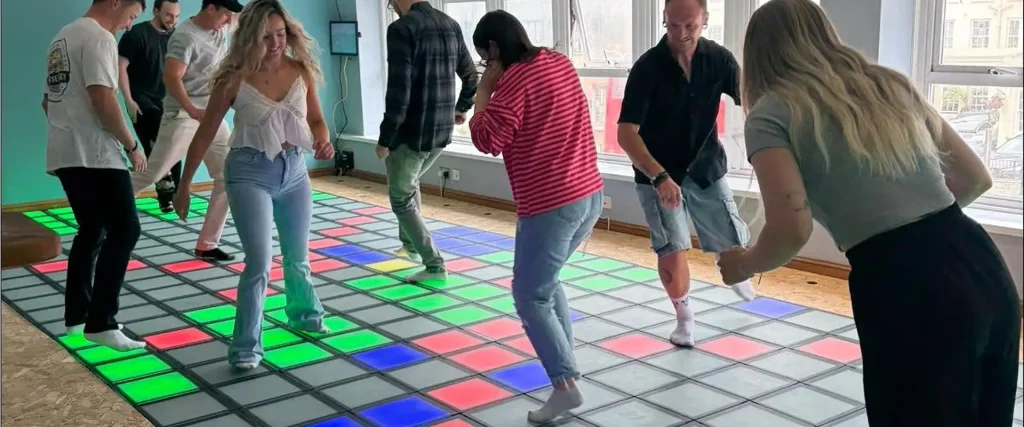
How to Choose an Interactive Game Floor Manufacturer for a Commercial Venue
An interactive game floor manufacturer is a company that designs, builds, or assembles the floor system and can provide verifiable information about its hardware, sensing technology, software, testing, customization, and after-sales support. For commercial venues, these factors are generally more important than appearance or headline price alone.
This guide explains how to evaluate a manufacturer on verifiable facts rather than sales pages — whether you’re outfitting an FEC, trampoline park, arcade, or indoor amusement venue.
For industry context on family entertainment centers, the International Association of Amusement Parks and Attractions (IAAPA) is a widely used reference.
What Is an Interactive Game Floor Manufacturer?
A “manufacturer” isn’t the same as a “supplier,” and neither is automatically the same as a “reseller.” Before you compare quotes, it’s worth knowing which type of company you’re actually talking to.
| Type | What they typically do |
|---|---|
| Manufacturer | Designs, builds, or assembles the system — usually with in-house engineering and production |
| Supplier | Sources products from one or more factories and sells them under their own or a third-party name |
| Reseller | Sells equipment produced by another company, typically without design or production control |
| Integrator | Combines multiple systems — floor, walls, lighting, software — into a complete venue |
The practical difference for a buyer is verification. A manufacturer should be able to show you production, testing, and design capability. A reseller may be able to supply the equipment, but it can be harder to verify where the system is manufactured, how it is tested, which components are used, and who is responsible for technical support after installation.
Buying directly from a manufacturer does not automatically guarantee better quality. The important question is whether the company can provide verifiable product specifications, production capability, testing procedures, warranty terms, spare parts, and technical support — whoever they are.
What Makes an Interactive Game Floor Commercial-Grade?
A commercial interactive floor is a different product from a home LED floor. The difference shows up in six areas.
Durability
A commercial attraction may operate for several sessions every day, so the system needs to be designed around repeated player interaction rather than occasional use. Ask how the floor structure handles constant jumping, running, and impact over years — not months.
Player Safety: What to Ask
Rather than accepting “safe” as a claim, ask the manufacturer to be specific about safety. Useful questions include:
- What is the floor structure, layer by layer?
- What cushioning or support material is used?
- What installation base is recommended?
- What footwear is recommended for players?
- What cleaning products can be used on the surface?
- Are there load or usage limitations?
- Are there test reports or written installation requirements?
Sensing Technology
The sensing system determines how accurately the floor detects player interaction and how reliably it performs during repeated commercial use. Different manufacturers use different approaches. Ask which technology the floor uses, how it works, and how it is tested under repeated use — not just whether it is “reliable.”
Surface Maintenance
In an FEC, the floor collects sweat, shoes, dust, and constant contact. A commercial system should have a surface that can be cleaned quickly between sessions without damaging the sensing or LED layers.
Software and Game Management
The floor is only as good as its game library. Ask how many games are included, how the software is licensed, whether updates are included, and how content is managed across multiple rooms.
Serviceability
If one module fails, can it be accessed and replaced without removing the entire attraction? A commercial operator can’t afford a floor that requires full disassembly for a single faulty tile. Ask about module-level access and spare parts before you buy.
8 Things to Check Before Choosing a Manufacturer
1. Complete Product Specifications
A real manufacturer can provide a specification sheet: floor structure, surface material, base construction, sensing technology, dimensions, load requirements, power requirements, software, game library, and installation method. If the answer to “can you send me the specs?” is vague, keep looking.
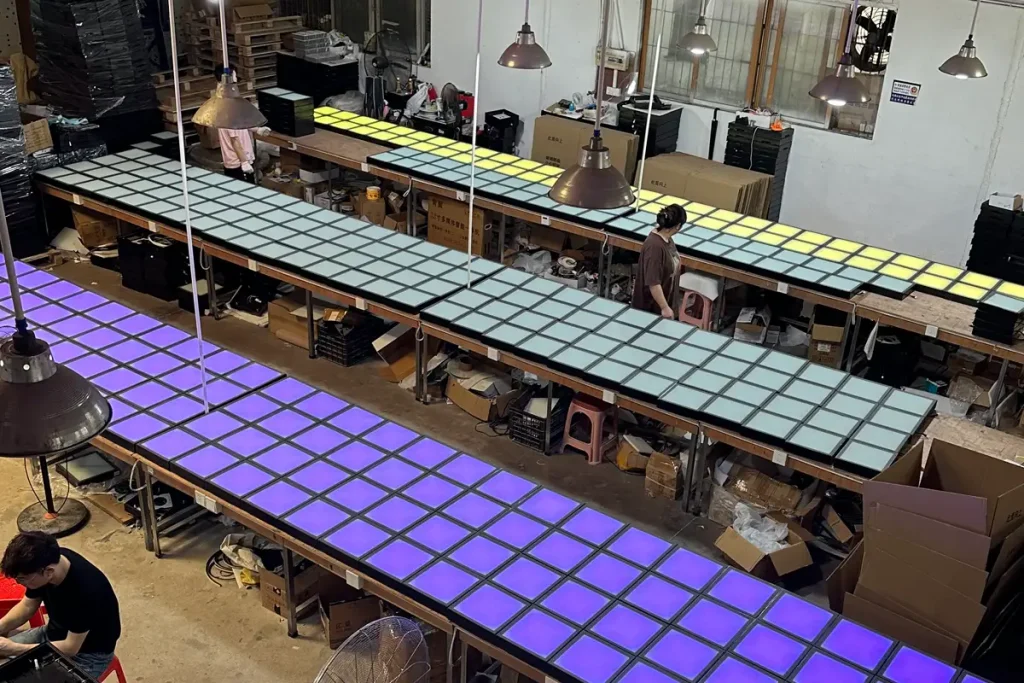
2. Manufacturing Capability
Ask about the production facility: size, workshop setup, and whether products are assembled and tested in-house. A manufacturer should be able to describe or show its production process — not just its showroom.
3. Sensing Technology
Confirm exactly how the floor detects player interaction. This is the core of an interactive floor, and it directly affects accuracy and long-term reliability. A manufacturer should be able to name its sensing technology and explain why it chose it.
4. Materials and Construction
Ask for the floor structure layer by layer: surface layer, structural layer, cushioning or support layer, and frame or base. If a supplier cannot provide a clear breakdown of the floor structure, materials and manufacturing responsibility, ask who actually builds the system before making a purchasing decision.
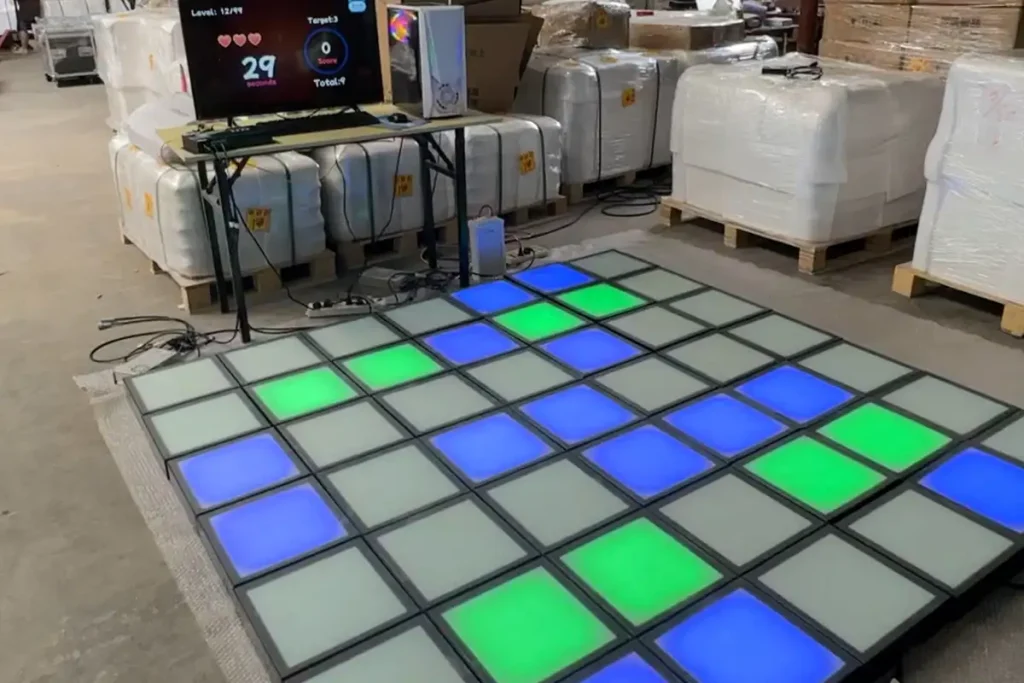
5. Factory Testing
Ask what happens before the floor ships. Serious manufacturers test components, sensors, games, and the assembled system before packing. Pre-shipment testing is the difference between discovering a problem in the factory and discovering it on your opening weekend.
6. Customization
Commercial venues rarely fit a standard size. Ask whether the manufacturer can build to your room dimensions, colors, branding, and game content — and whether customization is standard or an expensive exception.
7. Warranty and Spare Parts
Ask what the warranty covers, for how long, and get it in writing. Then ask the more revealing question: are spare parts available after installation, and who ships them? A warranty without spare parts is not much of a warranty.
8. Technical Support
Who answers when something goes wrong after opening? Ask about remote support, on-site support, response time, and software updates. Support is part of the product cost, not an afterthought.
5-Minute Manufacturer Verification Checklist
A manufacturer should be able to answer these with specific information rather than generic claims like “high quality” or “best factory.”
- Factory — Can the company show you its actual production facility?
- Production — Are products assembled and tested in-house?
- Product — Can it provide technical specifications for the exact system you’re buying?
- Projects — Can it show completed commercial installations you can verify?
- Support — Who handles technical support after delivery?
If not, ask for additional documentation or clarify who is responsible for manufacturing, warranty and technical support before placing an order.
What Should Be Included in a Factory Quote?
When you request a quotation, ask the supplier to itemize what the price covers. A useful quote breaks down into:
| Item | What the buyer should confirm |
|---|---|
| Floor size | Exact usable floor area |
| Hardware | Modules, controllers, power supplies |
| Sensing | Technology used |
| Games | Number of included games |
| Software | License and update policy |
| Installation | Included or separate |
| Spare parts | Included quantity |
| Warranty | Duration and coverage |
| Support | Remote or on-site |
| Shipping | Packaging and shipping terms |
Ask Victor for an itemized quotation based on your venue dimensions — this makes it easier to compare offers on what is actually included.
Why Interactive Game Floor Quotes Can Vary
Two quotes for a “similar” interactive floor can differ by a wide margin. That doesn’t always mean one supplier is overcharging. Quote differences can come from:
- Floor size and number of modules
- Sensing technology
- LED configuration and resolution
- Structural materials
- Game library size and software licensing
- Control system
- Installation requirements
- Spare parts included
- Packaging and shipping
- Customization work
This is why comparing only the quoted price can be misleading. A lower quotation does not necessarily mean a lower total cost, and a higher quotation does not automatically mean better quality. The useful comparison is what is included in each system.
Certifications and Compliance: What Should Buyers Ask?
Compliance requirements vary by destination market, electrical configuration, and the components included in the system. Before ordering, ask the manufacturer which certifications or test documents apply to the equipment being supplied to your country.
Documents a buyer may need to confirm include:
- CE marking, where applicable
- RoHS compliance
- EMC documentation
- Electrical safety documentation
- Applicable local requirements for the destination country
Ask for the documents that apply to your market rather than assuming every certificate is relevant to every order.
What International Buyers Should Confirm
If you’re importing from an overseas manufacturer, confirm these points before production starts:
- Power requirements — voltage, frequency, and plug configuration for your country
- Packaging — how the system is packed and protected for international shipping
- Installation — remote guidance or optional on-site installation
- Lead time — production time after the configuration is confirmed
- Spare parts — how replacement parts are supplied after delivery
- Technical support — remote support available after installation
Choosing the Right Floor Size for Your Venue
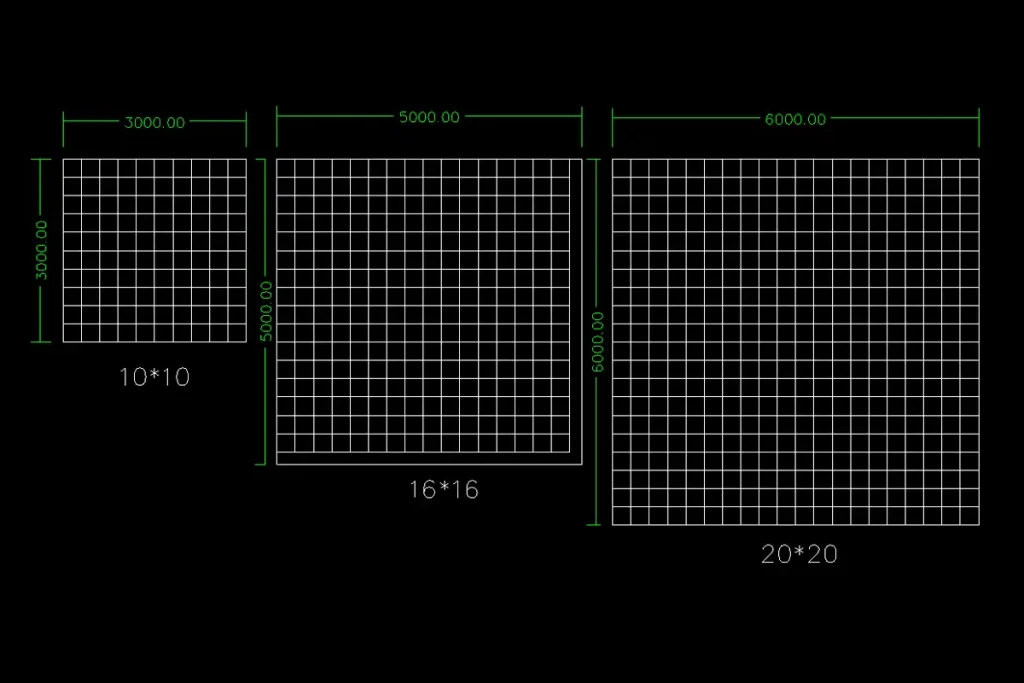
For reference, commercial projects may use configurations such as 3×3 m, 5×5 m, 6×6 m, or larger layouts. The appropriate size depends on the room dimensions, player flow, and game configuration.
Victor Activate Games can customize floor configurations according to the available venue footprint. For a detailed room-planning guide, see interactive game floor dimensions and room sizing.
What to Expect From a Factory-Direct Manufacturer
When you buy from the factory rather than through several layers of resale, you should expect more than a lower price:
- Custom configuration — the floor built to your room, not forced into a stock size
- Factory testing — the system assembled and tested before shipping
- CAD support — a layout plan based on your venue dimensions
- Installation guidance — clear setup instructions or remote/on-site support
- Spare parts — a path to replacements after the sale
- Technical support — someone responsible when issues come up
A Typical Project Workflow
A typical project moves through a defined sequence:
- Send room dimensions
- Confirm floor configuration
- Review the CAD layout
- Confirm game and software configuration
- Production
- Factory testing
- Packing and shipment
How Victor Activate Games Answers These Questions
Rather than asking you to take these claims on faith, here is what Victor Activate Games can provide and what you can verify.
| What we provide | What you can verify |
|---|---|
| Manufacturing | Guangzhou production facility |
| Product | Technical specifications |
| Sensing | Capacitive sensing |
| Configuration | Custom floor sizes |
| Software | One-time license under current policy |
| Support | CAD + remote technical support |
| Quality assurance | Written 2-year terms under Victor’s current policy |
Victor Activate Games is the commercial interactive game floor brand of Guangzhou Shengyi Photoelectric Equipment Co., LTD. The company manufactures interactive game systems in Guangzhou, China, with 12 years of experience, a 3,000+ m² production facility, and four workshops. Products ship to 60+ countries.
- Sensing technology — Victor Activate Games uses capacitive sensing for its interactive game floor. The practical advantage for a buyer is that the interaction system is based on surface-level electronic sensing rather than relying on a mechanical switch at each interaction point. Buyers should still ask about sensing accuracy, maintenance requirements, and how the system is tested under repeated commercial use.
- Game library — 90+ games across the system.
- Customization — custom floor sizes and configurations to match the venue footprint.
- Software — one-time license under the current software policy, with subsequent game upgrades provided free of charge.
- Support — CAD layout support, factory-direct supply, and lifetime technical support.
- Quality assurance — 2-year quality assurance under Victor’s current warranty policy.
See the commercial interactive game floor product page, the interactive game floor dimensions reference, and OEM interactive game floor manufacturing for more detail.
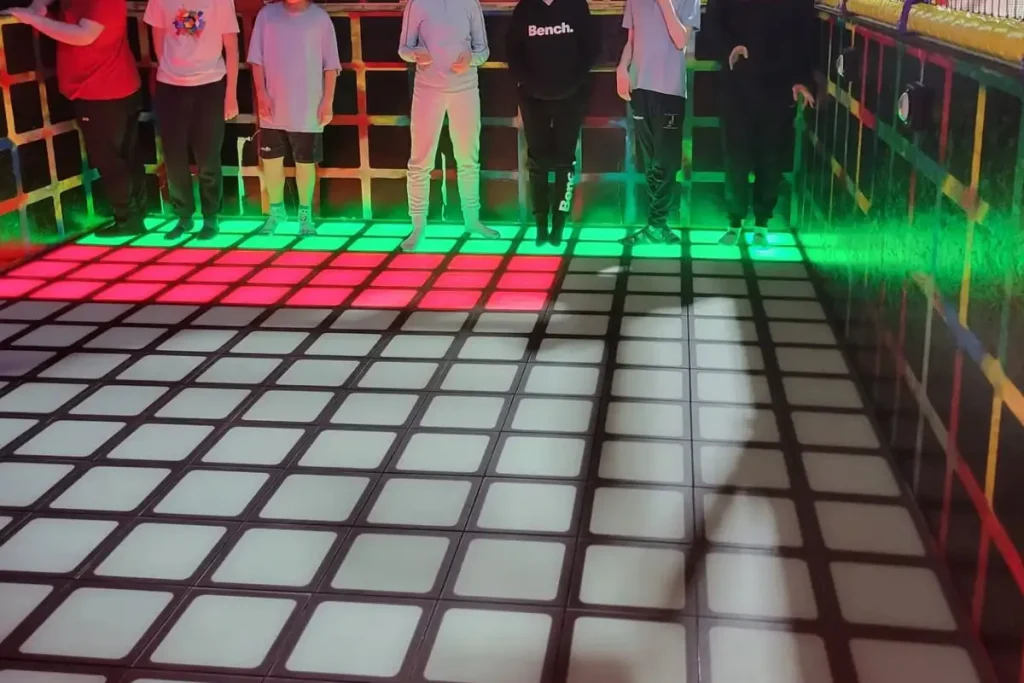
Example Commercial Project
Below is how a commercial floor project is typically configured.
| Field | Detail |
|---|---|
| Venue type | [FEC / arcade / trampoline park] |
| Country | [Country] |
| Floor size | [e.g., 8×8 m] |
| Games | [Number of games] |
| Installation | [Factory pre-assembled / on-site] |
| Configuration | [Custom layout details] |
The project illustrates why a manufacturer needs the venue dimensions before recommending a floor configuration.
10 Questions to Ask Before Ordering
- What sensing technology does the floor use?
- What materials are used in the floor structure, layer by layer?
- What floor sizes can you manufacture?
- How many games are included, and can new games be added?
- Is the software a one-time license or a subscription?
- Are software updates included after purchase?
- What is included in the warranty, and for how long?
- Are spare parts available after installation?
- Do you provide CAD layout support for my venue?
- Do you provide remote or on-site installation support?
Frequently Asked Questions
What is an interactive game floor?
An interactive game floor is a floor system with LED lighting and sensors that detects player movement and runs games on the surface — used in FECs, trampoline parks, and entertainment venues. For a full overview, see what is an interactive game floor.
What is the difference between an interactive LED floor and a traditional LED floor?
A traditional LED floor lights up for display or dance. An interactive floor adds sensing technology so players’ actions trigger responses, scores, and games in real time.
What sensing technology is used in an interactive game floor?
Approaches vary by manufacturer. Victor Activate Games uses capacitive sensing, which detects interaction at the surface. Ask the manufacturer how the sensing system is tested for commercial use.
How large should an interactive game floor be for an FEC?
For reference, commercial projects may use configurations such as 3×3 m, 5×5 m, 6×6 m, or larger layouts. The right size depends on your room dimensions, player flow, and game configuration.
How many players can use an interactive game floor?
It depends on floor size, game mode, and venue configuration. A manufacturer should be able to recommend a configuration for your room and expected traffic.
Can the floor be customized to my venue?
Yes. Victor Activate Games supports custom floor sizes and configurations based on the available venue footprint.
Does the system require monthly software fees?
Under Victor’s current software policy, the software is a one-time license, with subsequent game upgrades provided free of charge. Confirm the licensing model with any manufacturer before you buy.
Can the manufacturer provide CAD layout support?
Yes. Victor Activate Games provides CAD layout support based on the venue dimensions you provide.
What information should I send when requesting a quotation?
To prepare a useful configuration and quotation, provide your available room dimensions, ceiling height if relevant, preferred floor area, expected player capacity, venue type, and destination country.
How do I verify that a supplier is a real manufacturer?
Ask to see the production facility, request technical specifications, ask about in-house assembly and testing, request reference projects, and confirm who provides support and spare parts.
Request an Interactive Game Floor Quote
You do not need to know the exact floor configuration before contacting us. Send us your room dimensions and project requirements, and our team can recommend a suitable configuration and provide a factory-direct quotation.