
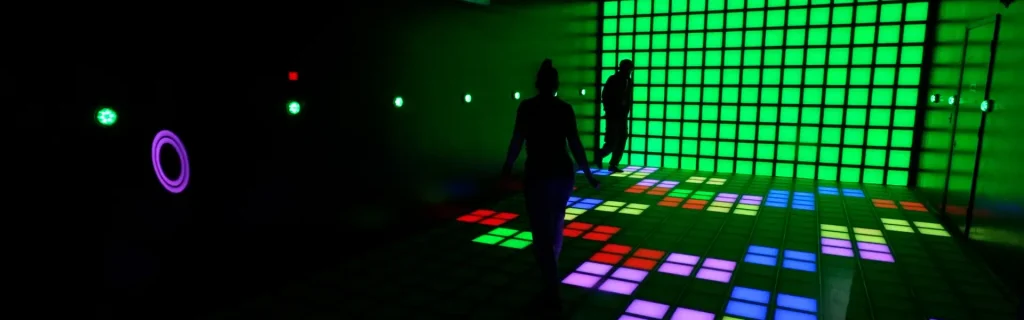
How to Build an Interactive Gaming Room for FECs & Malls 2026
Building an interactive gaming room is no longer just about placing arcade machines inside an empty space. Modern family entertainment centers, shopping malls, trampoline parks, and indoor leisure venues are now focusing on immersive attractions that combine movement, technology, teamwork, and replay value.
Today’s customers want more than passive entertainment. They want experiences that are physical, social, competitive, and visually exciting. This is why interactive gaming rooms are becoming one of the fastest-growing attraction categories for commercial entertainment businesses.
A successful interactive gaming room combines multiple attractions into one connected experience. Instead of relying on a single machine, operators now build complete activity zones using interactive game floors, laser maze games, push button game walls, interactive climbing walls, interactive hoops games, target throwing systems, and immersive challenge attractions.
For FEC operators, the goal is not only entertainment. The real goal is increasing replay value, extending customer stay time, improving group bookings, creating social media exposure, increasing revenue per square foot, and building a modern attraction that stands out from competitors.
This guide explains how to build an interactive gaming room from a commercial perspective, including layout planning, attraction selection, traffic flow, ROI strategy, and how to choose the right interactive gaming equipment supplier for long-term success.
What Is an Interactive Gaming Room?
An interactive gaming room is a commercial indoor entertainment space where players physically interact with digital games through movement, touch, sensors, light, sound, and reaction-based challenges.
Unlike traditional arcade games, interactive attractions make players become part of the gameplay experience. Instead of pressing buttons while sitting, players move through the room, jump on LED floors, avoid laser beams, hit targets, climb walls, throw objects, and compete against timers or teammates.
Modern interactive gaming rooms are now widely used in family entertainment centers, shopping mall attractions, trampoline parks, indoor playgrounds, active gaming venues, sports entertainment centers, immersive challenge rooms, and hotel entertainment zones.
The most successful interactive gaming rooms usually combine several attractions together rather than depending on a single game system.
For operators who want to understand the core floor-based attraction first, our Interactive Game Floor system explains how LED floor games work in commercial venues.
Why Interactive Gaming Rooms Are Growing So Fast
Interactive gaming rooms are growing because they solve one of the biggest challenges facing modern entertainment venues: customers want experiences they cannot easily repeat at home.
Traditional arcade zones still have value, but younger visitors are already surrounded by digital entertainment through mobile games, consoles, and short-form video platforms. Commercial venues now need attractions that combine physical movement, social interaction, competition, and visual impact.
This is why active gaming rooms and interactive entertainment rooms are becoming popular in FECs, malls, trampoline parks, and indoor playgrounds. They create a stronger emotional experience by making players move, react, compete, and cooperate inside the same space.
Social Media Visibility
One major reason why interactive gaming rooms perform well is visual attraction.
Interactive LED floors, reaction walls, laser mazes, and glowing climbing games naturally attract attention. Customers often record videos and upload them to TikTok, Instagram, and YouTube.
This gives entertainment venues free marketing exposure.
According to DataReportal’s global social media research, social platforms continue to influence how people discover places, activities, and entertainment experiences.
Multi-Age Appeal
A well-designed interactive gaming room can support children, teenagers, adults, birthday parties, school groups, and corporate team-building events.
This makes the attraction more flexible than many traditional arcade systems.
Better Revenue Per Square Foot
Many FEC operators now evaluate attractions based on space efficiency.
Interactive attractions often generate stronger engagement inside relatively compact spaces compared to traditional arcade layouts.
This is especially important for shopping malls where rent costs are high.
Best Interactive Attractions for an Interactive Gaming Room
Choosing the right attraction mix is the most important part of interactive gaming room design. A room with only one attraction may look interesting at first, but it often lacks enough variety to keep customers playing for longer sessions.
A stronger commercial interactive gaming room usually combines floor-based games, wall-based games, climbing challenges, throwing games, sports games, and immersive challenge attractions. This creates different types of movement and allows the room to serve different age groups and booking types.
The goal is not to install as many products as possible. The goal is to create a balanced experience with strong visual appeal, clear gameplay, high throughput, and repeatable revenue.
Interactive Game Floor
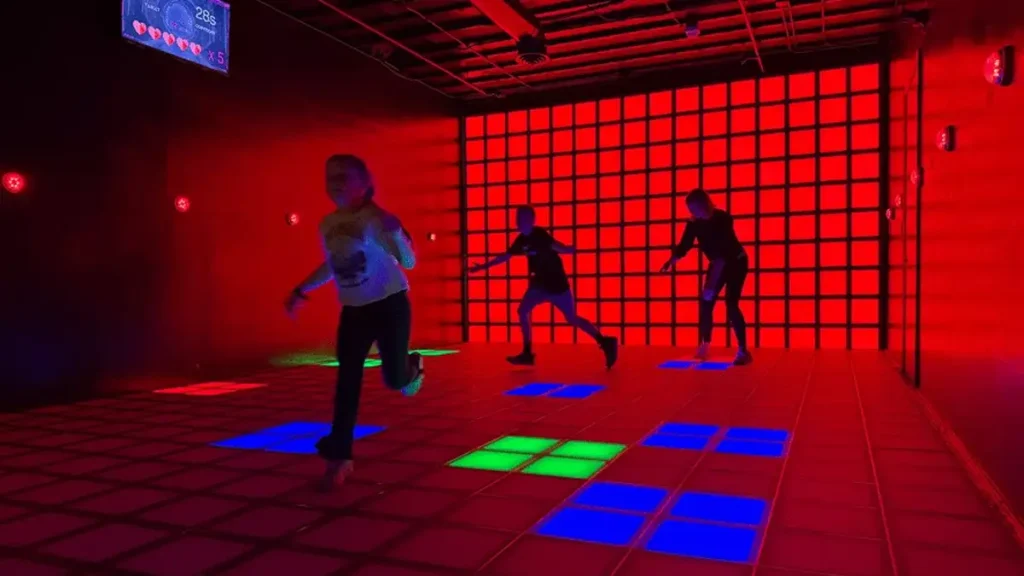
An interactive game floor is usually the centerpiece of a modern interactive gaming room.
Players step, jump, run, and compete on an immersive LED floor, triggering color-coded grids that respond instantly to movement and stepping actions. The entire sequence feeds directly into the game control system for real-time scoring and interaction.
This attraction category is also known as LED floor grid, pixel floor game, activate floor game, interactive LED floor, mega grid game, floor is lava game, interactive floor challenge, and super grid game.
Interactive game floors work especially well because players immediately understand how to play.
For commercial projects, a modular interactive game floor can be deployed as the main attraction for FECs, shopping malls, and specialized active gaming rooms, delivering maximum throughput and high replay value.
Floor Is Lava Games
Floor is lava games are extremely popular with families and children because the rules are simple and visually exciting.
Players avoid dangerous zones while jumping across safe tiles.
These games naturally create laughter, movement, and spectator engagement.
Team Battle Floor Games
Multiplayer LED floor games are ideal for birthday parties and group competitions.
These modes increase replay value because players compete repeatedly to improve scores.
For operators comparing commercial systems, our interactive game floor price guide explains how system size, sensors, and multiplayer configurations affect investment cost.
Laser Maze Game
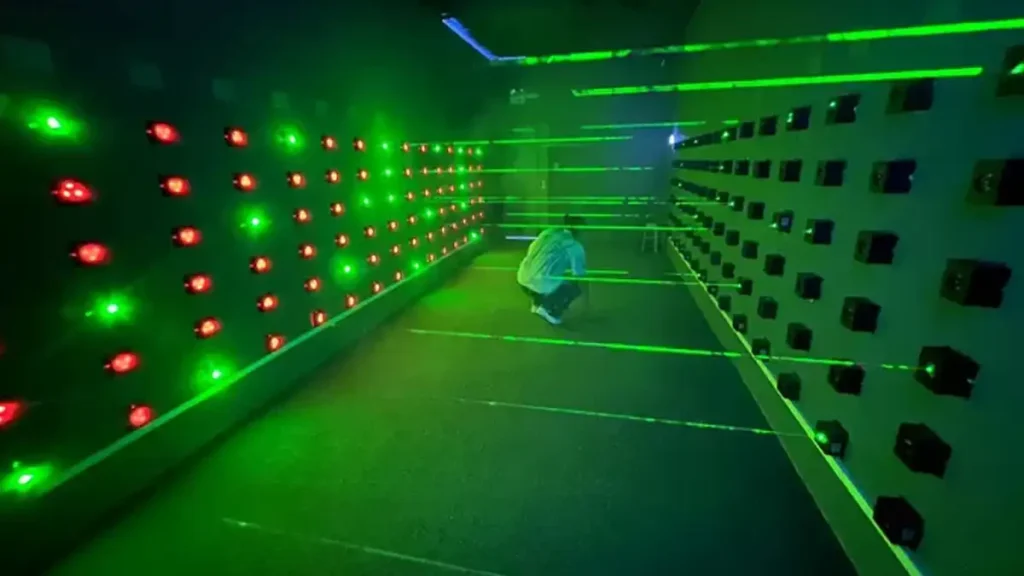
Laser maze games create mission-style gameplay where players move through laser beams without touching them.
This attraction works extremely well for teenagers, challenge rooms, escape room hybrids, corporate events, and active gaming centers.
Laser maze systems are visually powerful and generate strong social media engagement.
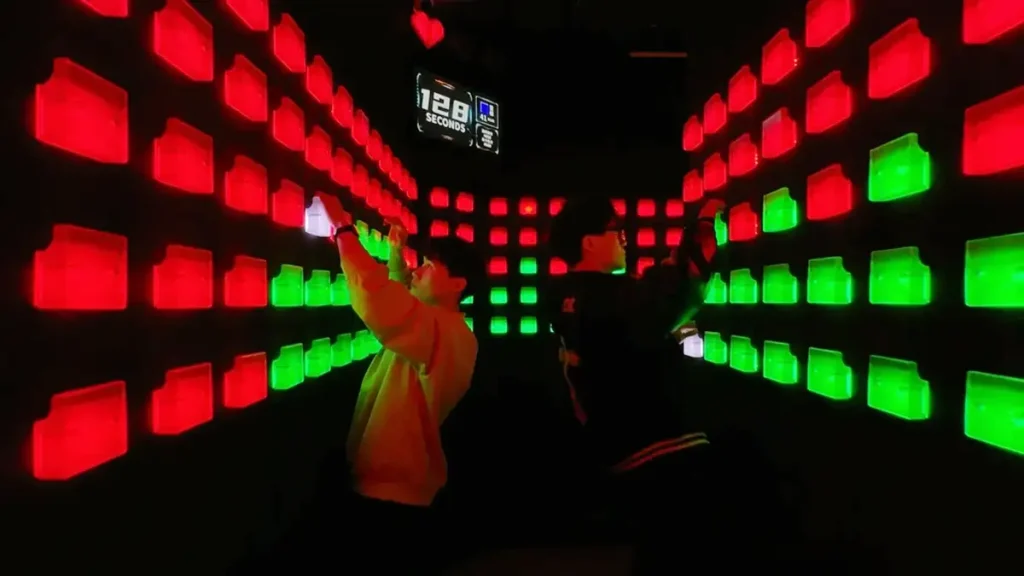
Push Button Game Wall
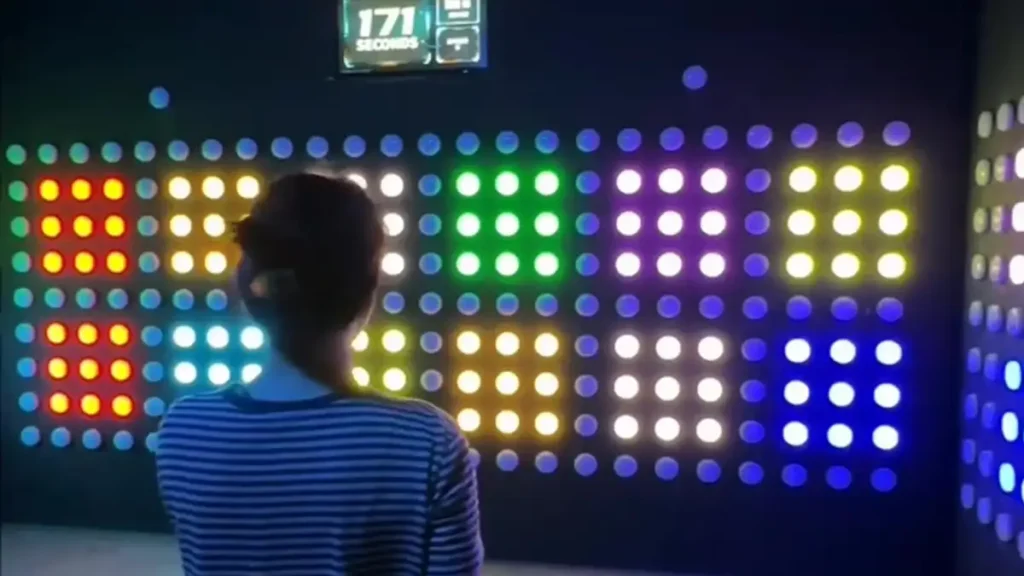
Push button game walls focus on speed, reaction, coordination, and teamwork.
Players hit illuminated targets as quickly as possible while competing against timers or other players.
These systems are excellent for reaction training, school groups, birthday parties, and team competitions.
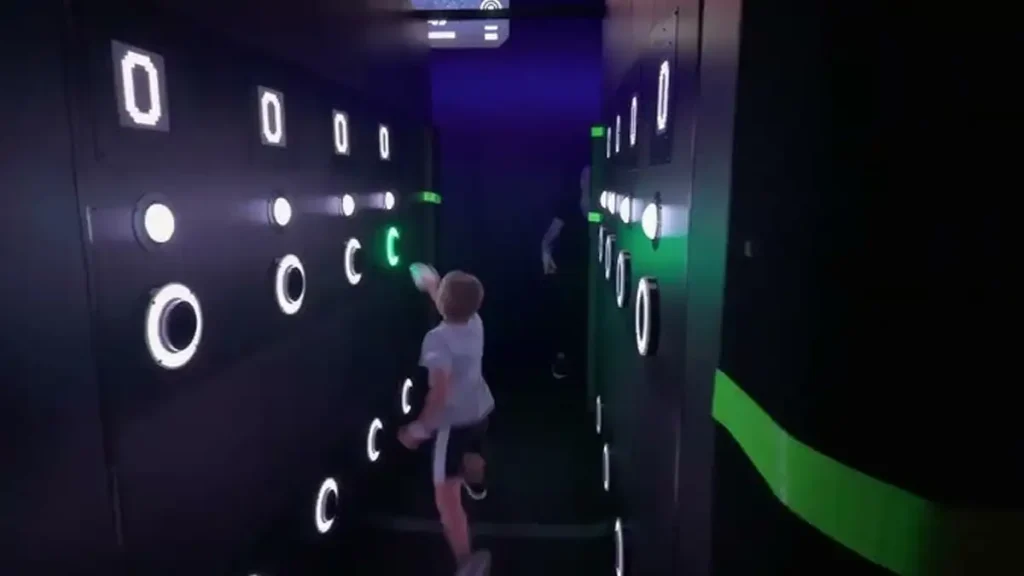
Interactive Climbing Wall
Interactive climbing walls combine physical climbing with digital scoring and light-based gameplay.
Unlike traditional climbing walls, players interact with illuminated targets while climbing.
This attraction increases physical engagement while maintaining strong replay value.
Interactive Hoops Game
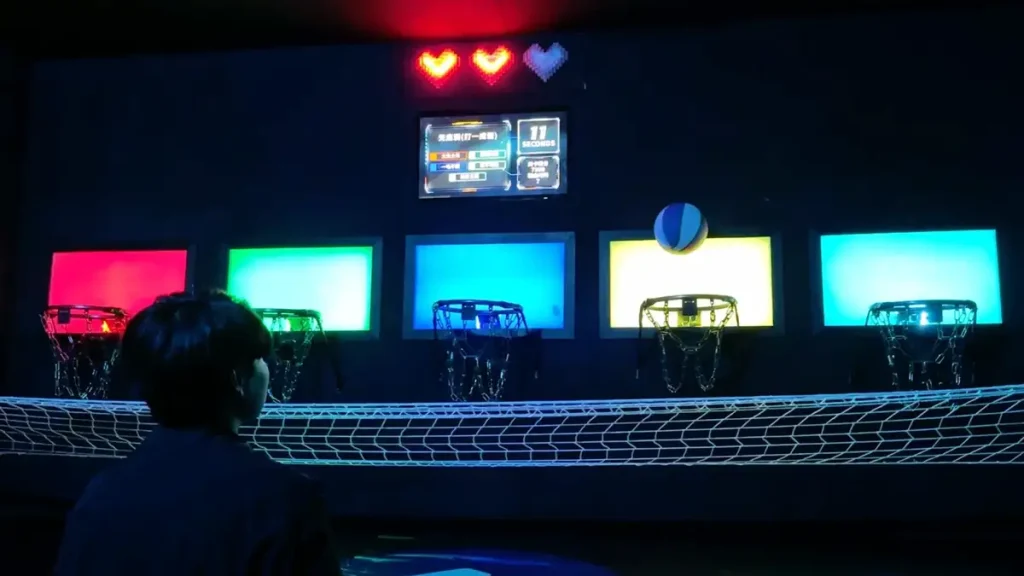
Interactive hoops games bring sports-based competition into the gaming room.
Players score points through timed basketball challenges, reaction games, and multiplayer competitions.
This attraction works particularly well for teenagers, sports entertainment venues, mall attractions, and mixed-age groups.
Interactive Target Throwing
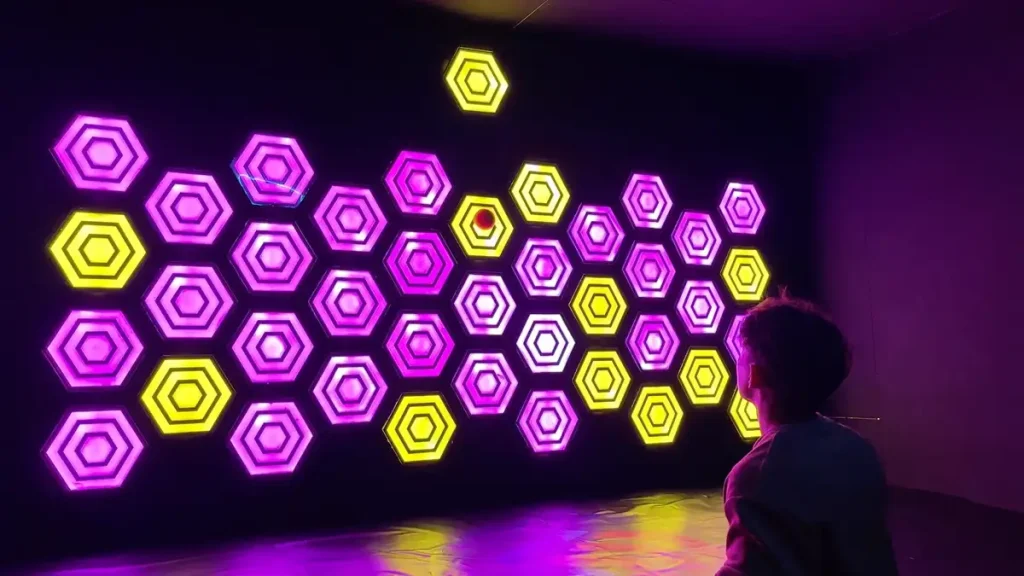
Interactive target throwing combines projection tracking and reaction gameplay.
Players throw soft balls or objects toward illuminated targets while the system tracks score and accuracy.
This attraction creates high-energy gameplay while remaining family-friendly.
Interactive Ball Pipe Wall
Interactive ball pipe walls combine airflow, movement, and interactive play mechanics.
This attraction is especially effective for younger children and family zones.
It adds a softer interactive experience inside high-energy gaming environments.
Evil Eyes HIDE Game
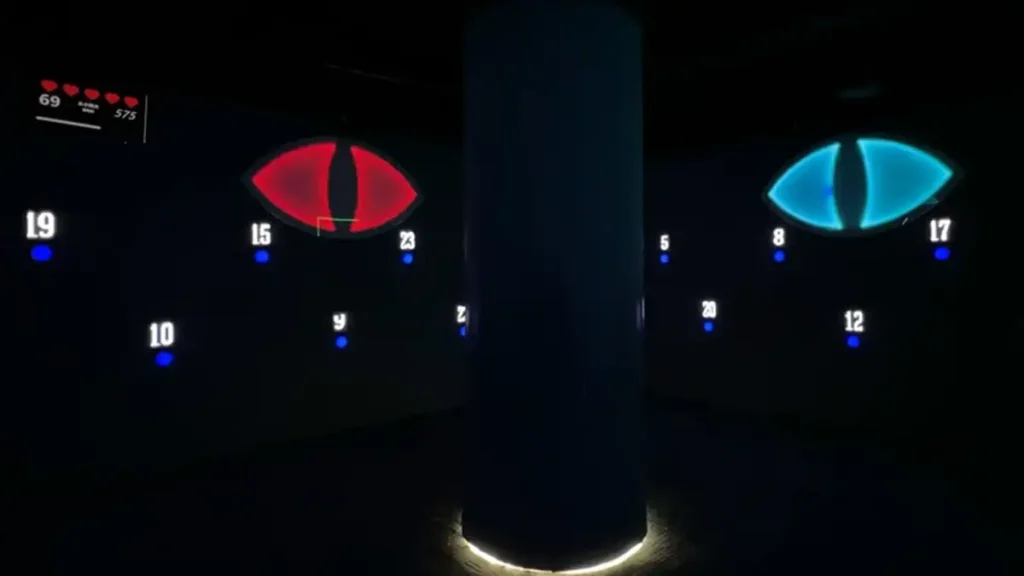
Evil Eyes HIDE introduces immersive stealth-style gameplay into the room.
Players must avoid detection while navigating interactive obstacles and reaction-based challenges.
This type of attraction adds suspense and variety to a commercial interactive gaming room.
How to Plan an Interactive Gaming Room Layout
Interactive gaming room layout is not only a design issue. It directly affects player safety, staff efficiency, customer flow, attraction visibility, and revenue performance.
Before choosing equipment, operators should understand how visitors will enter the room, where they will wait, how they will move between attractions, and how staff will supervise the experience. A good layout makes the room feel exciting but not chaotic.
For commercial venues, layout planning should always balance four goals: visibility, traffic flow, safety, and capacity.
If your venue is still comparing attraction combinations, this guide to best interactive attractions for FEC owners can help you plan a stronger equipment mix before finalizing the layout.
For a detailed breakdown of room combinations by venue size, see our interactive gaming room layout guide covering 200–500㎡ configurations.
Entrance Visibility
The most visually attractive games should usually be positioned near the front entrance.
Interactive LED floors and laser maze systems work extremely well as visual anchors because they attract attention from outside the attraction zone.
Traffic Flow Planning
Players should move naturally through the attraction.
A strong layout avoids crowd bottlenecks, blind corners, overlapping gameplay zones, and waiting area confusion.
Commercial venues should always design clear entry and exit paths.
Age Group Separation
High-speed attractions should be separated from younger children’s zones whenever possible.
For example, laser maze and hoops games can be placed near teen zones, while ball pipe walls and softer projection games can be placed closer to family or younger-child areas.
Ceiling Height and Safety Distance
Interactive gaming rooms require enough open space for movement-based gameplay.
Operators should avoid low ceilings, exposed corners, sharp obstacles, slippery flooring, and crowded layouts.
For general indoor play safety expectations, operators can also reference ASTM F1918 standards for soft contained play equipment when planning family entertainment environments.
Interactive Gaming Room Ideas for Different Venues
Different venue types need different interactive gaming room strategies. A shopping mall attraction should not be planned exactly like a trampoline park room, and a corporate team-building space should not use the same flow as a children’s indoor playground.
The best concept depends on your target audience, average visit time, ticket model, available space, and whether the room is used for walk-in customers, birthday parties, group events, or premium bookings.
Below are several practical planning ideas for common commercial venue types.
Shopping Mall Interactive Gaming Rooms
Shopping mall attractions should prioritize visual impact, quick gameplay understanding, short-session turnover, and social media appeal.
Interactive LED floors near storefront entrances perform especially well.
FEC Interactive Gaming Rooms
Family entertainment centers should focus on multiplayer attractions, replay value, birthday party integration, and group competition.
This is where combining multiple attractions becomes extremely important.
For operators researching interactive attractions for FEC, combining floor games, laser challenges, and wall games often creates the strongest long-term business performance.
Trampoline Park Gaming Rooms
Interactive gaming rooms can help trampoline parks create non-trampoline revenue zones.
This increases attraction diversity and expands the customer audience.
Corporate Team-Building Rooms
Challenge-based attractions such as laser maze games and reaction walls work especially well for corporate groups.
Competitive scoring systems improve engagement and repeat bookings.
Common Mistakes When Building an Interactive Gaming Room
Many interactive gaming room projects fail not because the idea is wrong, but because the room is planned like a product purchase instead of a commercial attraction system.
Operators often focus on equipment price first, then think about layout, customer flow, staff operation, game variety, and repeat play later. This can lead to a room that looks exciting during installation but performs poorly after the first few months.
Avoiding the following mistakes can help protect your investment and improve long-term revenue.
Buying Only One Attraction
Many operators assume one interactive game floor is enough.
In reality, the strongest gaming rooms combine multiple gameplay styles together.
Choosing Equipment Only by Price
Low-cost systems may create long-term maintenance problems.
Commercial venues should prioritize durability, sensor quality, support, game variety, spare parts, and software updates.
Ignoring Replay Value
Interactive attractions must encourage repeat play.
If visitors experience everything within five minutes, replay value becomes weak.
Poor Lighting Design
Projection games require different lighting conditions compared to LED floor systems.
Lighting planning should happen before installation.
Why More Operators Choose Factory-Direct Interactive Gaming Equipment
For commercial buyers, supplier choice can affect installation quality, maintenance cost, future upgrades, and long-term profitability. This is why many FEC operators now prefer working directly with a factory instead of buying generic reseller products.
Factory-direct cooperation often provides better pricing, stronger customization, OEM branding, replacement parts, long-term support, and easier expansion planning.
A professional manufacturer should understand commercial entertainment operations rather than simply selling hardware. The right supplier can help you compare attraction combinations, plan room layout, evaluate power and installation requirements, and prepare for future venue expansion.
If you are comparing long-term suppliers, this guide to choosing an active gaming equipment supplier explains what commercial buyers should check before placing an order.
You can also explore our interactive game floor manufacturer solution if your project needs a factory-direct LED floor game system for FECs, malls, or active gaming rooms.
FAQ About Interactive Gaming Rooms
Before investing in an interactive gaming room, most operators have questions about space, equipment selection, profitability, customization, and commercial operation.
The answers below cover the most common questions from FEC owners, shopping mall investors, trampoline park operators, and active entertainment venue planners.
How much space is needed for an interactive gaming room?
Small gaming rooms may start around 40–60㎡, while larger FEC projects often exceed 150㎡ depending on attraction quantity.
What is the best attraction for an interactive gaming room?
Interactive game floors are usually the most versatile attraction because they support multiplayer gameplay, high visibility, and strong replay value.
Can interactive gaming rooms work for adults?
Yes. Many active gaming venues now focus heavily on teenagers, adults, and corporate team-building groups.
How profitable is an interactive gaming room?
Profitability depends on ticket pricing, throughput, replay value, and venue traffic. Strong interactive rooms often improve overall venue engagement and customer stay time.
What equipment is commonly included?
Most commercial interactive gaming rooms include interactive game floor, laser maze, reaction wall, climbing game, hoops game, projection games, and challenge attractions.
Can interactive gaming rooms be customized?
Yes. Many commercial projects customize layout, branding, game difficulty, and attraction combinations based on venue type.
Final Thoughts
Building an interactive gaming room is no longer about adding random attractions into an empty room.
The most successful commercial projects are carefully planned systems that combine movement, competition, immersion, and replay value into one connected experience.
For family entertainment centers, shopping malls, trampoline parks, indoor playgrounds, and active gaming venues, a well-designed interactive gaming room can become one of the strongest traffic-driving attractions inside the business.
If you are planning a commercial interactive gaming room project, you can start by reviewing our interactive game floor system or comparing complete active gaming equipment supplier solutions for your venue.
The key is choosing the right combination of interactive attractions, planning the layout carefully, and working with an experienced manufacturer that understands long-term commercial operation rather than only equipment sales.