
Interactive Game Floor Cost & ROI (Commercial Investment Guide)
Discover Interactive Game Floor cost and ROI breakdown.

Understanding the cost and return on investment of a Interactive Game Floor is essential when planning a modern commercial entertainment project. As the industry shifts toward immersive, movement-based attractions, more operators are replacing traditional arcade setups with advanced interactive gaming floor systems. These platforms are heavily inspired by activate games floor concepts but offer significantly improved flexibility, scalability, and operational efficiency.
To better understand the fundamentals of how these systems work, we recommend reading:
👉 https://victoractivategames.com/what-is-interactive-game-floor/
Unlike fixed installations, a Interactive Game Floor is built using modular LED Game Tiles, allowing businesses to start small and expand over time. Whether you begin with a compact Pixel Floor setup or invest in a large-scale Super Grid LED floor, the system adapts to your venue size and business strategy. This flexibility is critical in today’s competitive market, where maximizing revenue per square foot is a top priority. More importantly, these systems are designed to deliver high engagement, repeat play value, and consistent monetization opportunities.
Key Takeaways
- A Interactive Game Floor offers flexible pricing and scalable deployment
- ROI is driven by player throughput and repeat engagement
- LED Game Tiles enable easy maintenance and expansion
- Lower total cost compared to Activate Game Equipment
- Strong long-term profitability with multiple revenue models
Cost Structure of Interactive Game Floor
The total investment for a Interactive Game Floor depends on several key components, including hardware quality, system performance, and software capabilities. Unlike traditional attractions, where costs are heavily tied to physical construction, interactive gaming floor systems distribute cost across modular elements, making them easier to manage and optimize.
Key Cost Factors
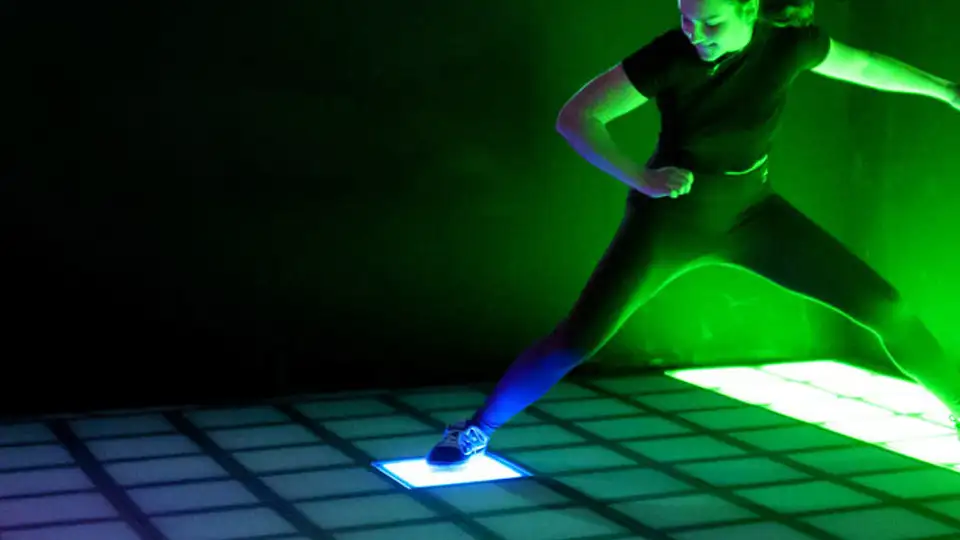
First, the quality of LED Game Tiles plays a major role in pricing. High-end tiles typically feature tempered glass surfaces, higher load capacity, and better LED brightness, ensuring durability in high-traffic environments. Second, sensor accuracy directly impacts gameplay responsiveness, which is crucial for systems inspired by LED lighted floor games.
Third, software complexity affects both cost and long-term value. Basic systems may offer limited game modes, while advanced platforms integrate LED Grid Game mechanics, multiplayer features, and real-time scoring systems. Finally, customization options—such as branding, game design, and layout configuration—can influence the final investment.
Entry-Level vs Premium Systems
Entry-level solutions are suitable for small venues and focus on simple gameplay. In contrast, premium systems provide advanced analytics, cloud-based management, and dynamic content updates. These features significantly enhance player retention and increase lifetime customer value, making them ideal for large-scale entertainment centers.
Product Specification Table
| Feature | Specification |
|---|---|
| Tile Size | 300mm x 300mm |
| Material | Tempered Glass + ABS |
| Load Capacity | ≥300 kg/m² |
| Waterproof | IP65 |
| System Type | LED Grid Game |
| Game Modes | 99+ |
| Lifespan | 50,000 hours |
ROI and Revenue Strategy
Industry Benchmark: Business Performance & ROI Comparison
| Business Case | Activate Games (Flagship Model) | Pixel Game (High-Traffic Retail) | JumpRace (Boutique/Add-on) |
| Market Segment | Professional Immersive Centers | FEC & Shopping Malls | Escape Rooms & Social Hubs |
| Typical Investment | $250,000 – $500,000+ | $40,000 – $85,000 | $15,000 – $30,000 |
| Ticket Price | $35.00 / person | $12.00 / person | $18.00 / person |
| Game Duration | 75 Minutes | 15 Minutes | 30 Minutes |
| Avg. Daily Revenue | $8,000 – $15,000 | $1,500 – $4,000 | $800 – $2,200 |
| Labor Requirement | 3-5 Staff per shift | 0-1 Staff (Self-service) | Existing Staff (0 Extra) |
| Net Profit Margin | 65% | 85% (Ultra-High) | 90% (Max Efficiency) |
| Real-world ROI | 6 – 10 Months | 3 – 5 Months | 2 – 4 Months |
One of the biggest advantages of a Interactive Game Floor is its ability to generate consistent revenue through high player turnover. Unlike traditional attractions that require longer session times, these systems are designed for short, repeatable gameplay cycles. This allows operators to serve more players per hour, significantly improving revenue efficiency.
Revenue Models
Operators can implement multiple monetization strategies. Pay-per-play remains the most common approach, especially in high-traffic locations. Membership packages encourage repeat visits, while group challenges and team competitions create social engagement that drives higher spending. These strategies are particularly effective when combined with gameplay formats inspired by the Mega Grid system, which emphasizes speed, competition, and collaboration.
ROI Timeline
In most commercial scenarios, businesses achieve ROI within 6 to 12 months. This depends on factors such as location, pricing strategy, and marketing execution. A well-designed interactive gaming floor not only attracts new customers but also increases repeat visits, which is essential for long-term profitability.
For a commercial-ready solution, explore:
👉 https://victoractivategames.com/product/interactive-game-floor
Why It Outperforms Traditional Systems
Compared to traditional Activate Game Equipment, a Interactive Game Floor requires significantly less space and offers greater flexibility. Instead of dedicating multiple rooms to different challenges, a single floor can host multiple game modes, reducing both construction and operational costs.
Additionally, maintenance is far simpler. If one tile fails, it can be replaced individually without shutting down the entire system. This modular advantage minimizes downtime and ensures continuous operation, which is critical for revenue-driven environments.
Many successful venues also enhance their offering by integrating complementary attractions such as:
👉 https://victoractivategames.com/product/laser-maze-game
By combining multiple interactive experiences, operators can increase dwell time, improve customer satisfaction, and create a more competitive entertainment environment.
FAQ
-
How much does a Interactive Game Floor cost?
The cost varies depending on size, features, and customization, but modular systems allow flexible investment levels.
-
What factors affect ROI the most?
Player throughput, pricing strategy, and game engagement are the key drivers of ROI.
-
Is a Interactive Game Floor scalable?
Yes, it can be expanded easily by adding more LED Game Tiles.
-
What is a Pixel Floor?
A Pixel Floor is a modular LED-based system used to create interactive gameplay environments.
-
Is it better than Activate systems?
In most cases, yes. A Interactive Game Floor offers better scalability, lower cost, and higher operational efficiency.