Interactive Game Floor Price Guide: Factory MOQ, OEM Options & Buying Tips for FEC Owners (2026)
If you’re planning to buy an interactive game floor for a family entertainment center, trampoline park, or active gaming venue, one question usually comes first:
How much does an interactive game floor actually cost?
Many operators quickly discover that there is no universal interactive game floor price list. Interactive game floor price depends on room size, hardware configuration, sensor technology, game packages, OEM customization, and factory MOQ requirements.
The bigger challenge is not finding a supplier.
The real challenge is understanding what you’re buying.
For most FEC projects, interactive game floor price depends on hardware quality, multiplayer capacity, software systems, OEM customization, and long-term maintenance planning.
- wholesale Interactive Game Floor pricing strategies
- MOQ expectations
- OEM possibilities
- replacement module planning
- distributor strategies
- factory support considerations
Last year I reviewed a multi-location FEC project where the original plan looked surprisingly simple.
Buy one system.
Test the attraction.
Open the venue.
But three meetings later, the conversation looked completely different.
How many replacement modules should be stocked?
Can multiple venues share identical configurations?
Can branding remain consistent?
What happens if one location expands next year?
Can future projects use the same hardware architecture?
This is usually where wholesale discussions begin.
In my experience, wholesale buyers rarely focus only on lower prices.
Once projects become real, the discussion shifts toward operational predictability.
Factory pricing.
OEM flexibility.
Replacement planning.
Lead times.
Repeat purchasing.
Long-term support.
An interactive game floor price strategy is not simply about getting a lower quotation.
It is usually the beginning of a repeatable business model.
For FEC operators, shopping mall attraction investors, indoor playground groups, distributors, and active gaming equipment wholesalers, the main question is no longer “Can this attraction work?” The question becomes “Can this system be purchased, deployed, maintained, and expanded across multiple projects?”
That is why this guide focuses on the wholesale buying strategy behind interactive game floor projects in 2026.
Why Interactive Game Floor Price Matters for Wholesale FEC Projects
FEC purchasing is changing from single equipment buying to project-based procurement. For large commercial venues, interactive game floor price is no longer judged only by initial hardware cost. Buyers also evaluate replay value, maintenance efficiency, throughput, and future expansion flexibility. Buyers increasingly need batch pricing, repeat supply, spare parts, OEM branding, and long-term factory support instead of one-time product quotations.
Industry resources from IAAPA also show how attraction operators increasingly focus on guest experience, revenue growth, and long-term operational planning rather than only equipment selection.
As projects become larger, a wholesale Interactive Game Floor approach often provides stronger long-term purchasing consistency and deployment efficiency.
The Shift From Single Purchase To Project Purchasing

In early FEC projects, many buyers purchase one attraction at a time.
One trampoline area.
One arcade zone.
One climbing wall.
One interactive floor system.
This single-purchase model works when the buyer is testing a concept or opening one small venue. But as interactive game floors become more common in commercial entertainment spaces, many buyers are moving from single purchase to project purchasing.
The buying path often looks like this:
| Stage | Buyer Focus | Typical Question |
|---|---|---|
| Single venue | Test one attraction | Can this fit my space? |
| Full project | Build an entertainment zone | Can this work with other attractions? |
| Multi-location plan | Repeat the model | Can we standardize the system? |
| Distributor model | Resell locally | Can we get wholesale pricing and support? |
| OEM partnership | Build private label | Can the system carry our brand? |
Last year we reviewed a Chicago shopping mall entertainment project covering approximately 120㎡.
At first glance, the project looked relatively straightforward.
The client planned one Interactive Game Floor installation as a family attraction inside a mixed-use entertainment area.
However, after reviewing floor drawings and traffic simulations, several problems appeared.
Large support columns interrupted movement paths.
Two corners created dead zones.
Family traffic and teenage traffic crossed in several locations.
The original standard layout would have reduced usable gameplay area by nearly 18%.
Instead of using a fixed module arrangement, we redesigned tile placement and adjusted player movement routes.
We also modified family gameplay rotation to reduce congestion during peak periods.
Results after opening:

- Repeat visits increased by 28%
- Throughput reached approximately 15–18 players per hour
- Staffing dropped from three operators to one
More importantly, the same module structure later became the template for future venue planning.
This project showed that wholesale Interactive Game Floor planning works best when standardization and customization are balanced together.
Large FEC Projects Need Different Buying Strategies
Large FEC projects often involve several decision makers.
The owner may care about ROI.
The designer may care about layout.
The operator may care about traffic flow.
The procurement team may care about price and delivery.
The maintenance team may care about spare parts.
An interactive game floor price plan for commercial projects has to satisfy more than one decision maker.
For example, a shopping mall FEC may need an interactive floor for a central attraction zone. A children’s play center may need a smaller floor but with simpler software and safer movement patterns. A branded chain may need the same interface and game logic across multiple branches.
These projects cannot be handled only with a product catalog.
Wholesale buyers usually need:
- clear factory pricing
- different size options
- MOQ explanation
- lead time planning
- module quantity confirmation
- spare parts list
- shipping and packaging details
- OEM branding options
- installation documents
- warranty terms
- future expansion support
If any of these are unclear, the project risk increases.
How Procurement Teams Think In 2026
Procurement teams are becoming more practical.
Several years ago, many buyers compared mainly price, size, and visual effects. Today, more procurement teams ask about operating details before they confirm an order.
Common questions now include:
- How many replacement modules should we prepare?
- Can the system be expanded later?
- How long does production take for repeat orders?
- Can we lock the same specification for future projects?
- What is included in the wholesale quotation?
- Can the software support our local language?
- Can we get distributor pricing?
- What happens if a module fails after installation?
- Can the factory support remote troubleshooting?
This change is healthy.
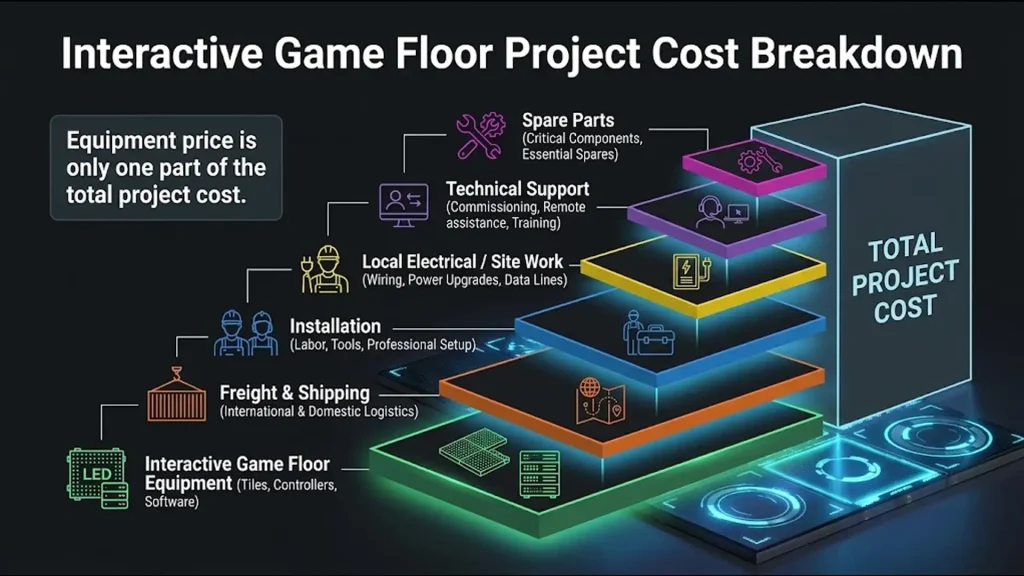
Interactive game floor price should not be judged only by the first purchase quotation. It should be judged by total project value: purchase cost, installation cost, maintenance cost, downtime risk, and repeat order support.
Why Interactive Game Floor Price Demand Is Growing In 2026
Wholesale interactive game floor demand is growing because buyers want lower cost per square meter, factory direct pricing, flexible expansion, and better replacement module planning for commercial entertainment projects.
How Interactive Game Floor Price Changes Per Square Meter
One of the most direct reasons buyers consider wholesale purchasing is cost control.
Interactive game floor systems are usually calculated by area, module quantity, software configuration, and hardware specification. When buyers purchase multiple systems or larger quantities, the cost per square meter can often become more competitive.
This does not mean every wholesale order automatically becomes cheap. The final price still depends on sensor type, glass thickness, control system, software, OEM requirements, and packaging.
But wholesale purchasing can help reduce costs in several ways:
| Cost Area | Wholesale Advantage |
|---|---|
| Module production | Larger orders improve production efficiency |
| Software setup | Configuration work can be reused |
| OEM branding | Design cost can be spread across more units |
| Packaging | Batch packing can reduce handling cost |
| Spare parts | Buyers can stock standard parts more efficiently |
| Shipping | Consolidated shipments may reduce unit freight cost |
For FEC operators planning multiple venues, this matters.
A single attraction may be judged by whether it can pay back in one location. A wholesale interactive game floor strategy is judged by whether the model can be repeated profitably across several projects.
Factory Direct Interactive Game Floor Price Advantages

Many wholesale buyers prefer factory direct purchasing because they want better control over price, configuration, and after-sales support.
Many buyers compare interactive game floor price between factory-direct suppliers and local distributors before making long-term procurement decisions.
Factory direct purchasing may offer several advantages:
- clearer technical communication
- more flexible OEM customization
- better access to replacement modules
- faster feedback on production changes
- more transparent configuration details
- stronger support for repeat orders
For example, our commercial Interactive Game Floor system uses modular architecture designed for long-term operation and future expansion planning.
This is especially important when the buyer needs a custom interactive game floor layout, not only a standard package.
For example, one venue may need a rectangular system. Another may need an L-shaped configuration. A third may need the same brand interface but different game difficulty. If the buyer works directly with the factory, these adjustments are usually easier to discuss.
This is why wholesale buyers often start from product pricing but end up evaluating factory capability.
Many Interactive Game Floor China projects initially begin with pricing discussions, but purchasing teams usually shift toward evaluating manufacturing capability, replacement support, and long-term factory cooperation.
In large FEC environments, the Interactive Game Floor manufacturer often becomes more important than the initial quotation itself.
Long-Term Interactive Game Floor Price Flexibility
Many buyers do not know their final expansion plan at the beginning.
A first venue may test the concept.
A second venue may copy the same system.
A distributor may start with one sample order.
A regional partner may later request private label branding.
A wholesale interactive game floor should support this kind of growth.
Expansion flexibility may include:
- adding more modules later
- keeping the same tile size
- using the same controller system
- updating software across multiple systems
- changing branding for different customers
- connecting future wall interaction
- supporting new game libraries
This is where wholesale purchasing connects naturally with custom interactive game floor solutions. Once buyers understand that layout, software, and branding can be customized, the next question is how to purchase those systems at scale.
A good wholesale model allows the buyer to start reasonably, then expand without rebuilding everything from zero.
Interactive Game Floor Price and Lead Time Expectations
Replacement modules are one of the most overlooked parts of wholesale purchasing.
In a single installation, the buyer may assume the system will simply work after installation. In wholesale or distributor projects, that assumption is risky.
Commercial venues run under pressure.
Children jump.
Teenagers compete.
Groups play during peak hours.
Staff need fast recovery when something fails.
Replacement module planning should be discussed before the order.
Wholesale buyers should ask:
- How many spare modules are recommended?
- Can modules be replaced independently?
- Are controllers replaceable separately?
- Are cables and connectors standard?
- Can spare parts ship separately?
- How long does spare parts production take?
- Can the distributor keep spare parts locally?
A wholesale interactive game floor without spare parts planning can create after-sales pressure later.
For distributors, this is even more important. Local customers will expect quick support. If every replacement must wait for a new international shipment, the distributor’s reputation may suffer.
Most experienced Interactive Game Floor manufacturers recommend preparing replacement modules before shipment rather than waiting for failures to occur.
This approach reduces downtime and creates a more predictable after-sales structure for wholesale buyers.
What Wholesale Buyers Usually Ask Before Ordering
Before placing a wholesale interactive game floor order, serious buyers usually ask about MOQ, lead time, shipping, packaging, OEM support, spare parts, and whether the supplier can support repeat projects.
Interactive Game Floor Price and MOQ Requirements
When discussing interactive game floor price, MOQ usually refers to the minimum order quantity required for wholesale purchasing, OEM production, or distributor cooperation.
For interactive game floor projects, MOQ may be defined in different ways:
- minimum square meters
- minimum number of modules
- minimum order value
- one complete system
- minimum quantity for OEM branding
- minimum quantity for distributor pricing
This is why buyers should not only ask, “What is your MOQ?”
A better question is:
“What is the MOQ for standard wholesale, OEM branding, and distributor pricing?”
These may be different.
| Order Type | Typical MOQ Logic | Suitable Buyer |
|---|---|---|
| Sample order | One complete small system | First-time distributor or project tester |
| Standard wholesale order | Minimum area or module quantity | Small reseller or FEC buyer |
| Bulk order | Larger quantity for better price tier | Chain operator or distributor |
| OEM wholesale order | Higher MOQ due to branding work | Regional partner or brand owner |
In my experience, buyers sometimes misunderstand MOQ because they think it only means quantity. But for technical products, MOQ also relates to production setup, software configuration, packaging, and support workload.
A small order can still be possible, but the unit price may be higher.
Wholesale Interactive Game Floor suppliers often define MOQ differently for standard projects, OEM requirements, and distributor partnerships.
This is one reason buyers should evaluate supplier structure rather than comparing quantity alone.
Lead Time Expectations
Lead time depends on the order type.
A standard wholesale interactive game floor may be faster if the factory already has regular module production. An OEM order usually takes longer because branding, interface design, software adjustment, or packaging changes may be involved.
Common lead time factors include:
- system size
- module quantity
- sensor type
- glass specification
- OEM branding
- software customization
- factory production schedule
- testing requirements
- packaging method
| Order Type | Typical Lead Time Consideration |
|---|---|
| Standard sample | Faster if regular model is available |
| Small wholesale order | Depends on module stock and production schedule |
| Bulk order | Needs production planning and batch testing |
| OEM order | Needs extra time for design, confirmation, and testing |
| Custom layout order | Needs drawing review before production |
A serious buyer should confirm lead time before making local sales promises.
For distributors, this is critical. If you promise your local customer a delivery date before confirming factory production time, you may create unnecessary pressure.
Shipping and Packaging
Interactive game floors are not simple small parcels.
For international buyers, interactive game floor price should always include shipping structure, export packaging, and long-distance transportation risk.
They include LED modules, glass surfaces, controllers, cables, accessories, and sometimes customized packaging. Shipping and packaging affect both cost and risk.
For international wholesale orders, buyers should also understand Incoterms rules from the International Chamber of Commerce, because terms such as EXW, FOB, CIF, and DDP define different responsibilities between buyer and seller.
Wholesale buyers should confirm:
- packaging material
- wooden case use
- module protection
- moisture protection
- shock protection
- labeling method
- packing list
- spare parts packaging
- shipping terms
- insurance responsibility
Common shipping terms include EXW, FOB, CIF, and DDP. Buyers should understand what each term includes before comparing prices.
| Shipping Term | Buyer Responsibility | Common Use |
|---|---|---|
| EXW | Buyer handles pickup and export process | Experienced importers |
| FOB | Supplier delivers to departure port | Common for sea freight |
| CIF | Supplier covers freight to destination port | Buyers needing easier freight arrangement |
| DDP | Supplier handles door delivery where available | Buyers wanting simplified logistics |
A low product price can become expensive if packaging is weak or shipping responsibilities are unclear.
For a wholesale interactive game floor order, packaging should be treated as part of the product, not an afterthought.
OEM Support
OEM support is often where wholesale buyers start building long-term value.
A distributor selling generic products may compete mainly on price. A distributor with OEM branding can build a stronger market position.
OEM options may include:
- logo on startup screen
- branded user interface
- custom colors
- local language
- custom game themes
- distributor model name
- branded packaging
- score display customization
- promotional videos
- sales documents
An OEM interactive game floor can help buyers avoid looking like every other reseller in the market.
However, OEM support should be clearly defined before ordering.
Buyers should ask:
- What OEM items are included?
- What requires extra cost?
- What file formats are needed?
- How many design revisions are allowed?
- Does OEM affect lead time?
- Is there a higher MOQ?
- Can the same branding be used for repeat orders?
Clear OEM communication prevents misunderstanding later.
Technical Considerations For Wholesale Interactive Game Floor Orders

Wholesale buyers should evaluate technical specifications carefully because sensor type, glass thickness, power requirements, and replacement module strategy directly affect resale value, maintenance pressure, and long-term customer satisfaction.
Sensor Options
Sensor selection affects accuracy, maintenance, cost, and product positioning.
A budget-focused wholesale interactive game floor may use one sensor structure, while a premium commercial FEC system may need a more durable solution.
| Sensor Type | Advantages | Limitations | Best Use |
|---|---|---|---|
| Pressure sensor | Lower cost, simple structure, easy to understand | Mechanical wear over time, sensitivity may decline | Entry-level projects and lower-traffic venues |
| Infrared sensor | Contact-free, fast response | May be affected by lighting, reflection, or installation conditions | Controlled indoor spaces |
| Capacitive sensor | Higher precision, less mechanical wear, better durability | Higher initial cost | Commercial FECs and premium active gaming equipment wholesale |

For capacitive systems, technical references from Infineon capacitive sensing explain how capacitance changes can be used to detect touch or proximity, which is why this technology is widely used in modern interaction systems.
For wholesale buyers, the right sensor depends on the target market.
If your customers are small children’s centers with limited budgets, a lower-cost system may be acceptable. If your customers are shopping mall FECs or high-traffic commercial venues, durability becomes more important.
I usually suggest wholesale buyers avoid choosing sensor type only by price. The after-sales cost may be higher than the initial savings if the system is used in the wrong environment.
Glass Thickness Differences
Surface glass is another important technical factor.
For wholesale orders, buyers should confirm the glass thickness, surface treatment, and replacement method before placing an order.
| Glass Thickness | Typical Use | Traffic Level | Wholesale Positioning |
|---|---|---|---|
| 10mm tempered glass | Standard commercial use | Medium to high | Common FEC model |
| 12mm tempered glass | Higher intensity movement | High | Premium FEC and active gaming venues |
| 15mm tempered glass | Special heavy-duty project use | Very high | Large commercial or demanding installations |
A 10mm surface may work well for many family entertainment projects. A 12mm surface may be better for more intense movement. A 15mm option may be used for special projects, but buyers should also consider weight, cost, installation structure, and shipping.
Thicker glass is not automatically better for every wholesale order.
It increases weight and freight cost. It may also require stronger framing and more careful installation.
The correct specification depends on the venue type, user age, movement intensity, and local market positioning.
Power Requirements
Wholesale buyers should ask for power consumption details early.
This information affects electrical planning, local installation, and customer confidence.
Important questions include:
- What is the power consumption per square meter?
- How many controllers are required?
- What voltage options are available?
- How are cables arranged?
- Is heat dissipation passive or active?
- Can the system run for long business hours?
- What should local electricians prepare?
| System Type | Estimated Power Consumption | Planning Notes |
|---|---|---|
| Basic LED interactive floor | 60–90W/㎡ | Suitable for lighter interaction |
| Commercial interactive game floor | 80–120W/㎡ | Common for FEC projects |
| High-intensity active gaming system | 120–150W/㎡ | Needs stronger electrical planning |
For distributors, technical documents are part of the sales package.
If you cannot explain power requirements to local customers, they may hesitate to buy. A good factory should provide wiring diagrams, installation instructions, and basic electrical guidance.
Module Replacement Strategy
Module replacement is one of the strongest signs of whether a system is suitable for wholesale distribution.
A wholesale interactive game floor should not require factory engineers for every small issue.
The system should support:
- independent module replacement
- clear module numbering
- spare module stock
- plug-and-play connections
- controller-level diagnosis
- remote troubleshooting
- replacement video guidance
| Replacement Factor | Why It Matters |
|---|---|
| Independent modules | Avoid full system shutdown |
| Spare parts | Reduce customer waiting time |
| Numbered wiring | Makes installation and repair easier |
| Plug-and-play design | Lowers local technical barrier |
| Remote support | Helps distributors solve issues faster |
For multi-project buyers, replacement strategy directly affects profitability.
If every technical issue becomes a long support case, the product may not be suitable for wholesale channels.
Case Study: Three Wholesale FEC Projects
Real wholesale projects show why buyers need different strategies depending on whether they operate mall venues, chain projects, or regional distribution businesses.
USA Mall Group Project
A buyer in the United States planned multiple shopping mall entertainment zones. At first, the inquiry was for one interactive game floor system, but after reviewing the project pipeline, the buyer realized that several mall locations might use a similar model.
The main concerns were:
- consistent visual style
- repeatable system size
- fast installation
- family-friendly gameplay
- spare module planning
- stable delivery schedule
Instead of treating the order as one isolated purchase, we discussed a wholesale interactive game floor structure.
The buyer started with one pilot venue and prepared the same module specification for future locations. This reduced redesign work for the second and third projects.
| Project Item | Strategy |
|---|---|
| First venue | Pilot installation |
| Future venues | Same module and software structure |
| Branding | Unified interface |
| Spare parts | Standard replacement module list |
| Main benefit | Easier repeat deployment |
The biggest lesson was that wholesale planning should begin before the second venue. If the first system is not standardized properly, future expansion becomes harder.
Canada Active Gaming Chain
A Canadian buyer planned a more movement-focused entertainment concept. The project required interactive floors, scoring, and higher replay value.
This was not a simple one-time attraction purchase. The buyer wanted to know whether the same system could support more than one location.
Key questions included:
- Can game difficulty be adjusted?
- Can software be updated later?
- Can modules be replaced quickly?
- Can branding stay consistent across venues?
- Can wall interaction be added in future projects?
For this type of buyer, the wholesale interactive game floor was part of a larger active gaming equipment wholesale strategy.
The solution needed to support both current installation and future expansion.
| Project Requirement | Wholesale Planning Response |
|---|---|
| Multiple venues | Standardized hardware configuration |
| Replay value | Adjustable game difficulty |
| Maintenance | Spare parts and module replacement plan |
| Brand consistency | OEM UI and score display |
| Future growth | Expansion-ready system structure |
The lesson here was that wholesale does not always mean cheaper and simpler. Sometimes wholesale means stronger standardization for a scalable business model.
Middle East Distributor Project
A Middle East distributor wanted to add interactive game floors to an existing entertainment equipment portfolio.
Their customers included indoor playgrounds, mall attractions, and family entertainment centers. The distributor needed a product that could be explained, installed, maintained, and resold across different project types.
The distributor cared about:
- factory direct pricing
- product catalog support
- OEM branding
- packaging quality
- spare parts supply
- installation documents
- regional resale margin
In this case, the wholesale interactive game floor was not only a product. It was a business line.
We discussed how to prepare local sales materials, how many spare modules to stock, and which system size would be easiest to promote first.
| Distributor Need | Factory Support |
|---|---|
| Local sales | Product photos, videos, and specifications |
| Technical confidence | Installation guide and wiring diagram |
| After-sales | Spare module list |
| Branding | OEM interface and packaging options |
| Repeat orders | Stable wholesale pricing structure |
The lesson was clear: distributors need more than a low price. They need a supplier system that helps them sell and support the product locally.
Lessons Learned
Across these three project types, several patterns appeared.
First, wholesale buyers need stable specifications. If every project changes too much, repeat purchasing becomes inefficient.
Second, spare parts planning must happen early. Replacement modules are not optional for serious commercial use.
Third, OEM branding becomes more valuable when the buyer plans to resell or expand.
Fourth, factory direct support matters more when the project moves from one venue to multiple installations.
A wholesale interactive game floor project should be planned as a repeatable operating model, not only a bulk discount order.
Common Mistakes Wholesale Buyers Make
Many wholesale buyers lose profit or create after-sales pressure because they focus only on price and ignore spare parts, factory capability, documentation, and long-term support.
Choosing Lowest Price
The lowest quotation is not always the lowest cost.
A cheaper wholesale interactive game floor may exclude important items such as:
- spare modules
- OEM design
- software updates
- export packaging
- installation support
- technical documents
- controller replacements
- after-sales guidance
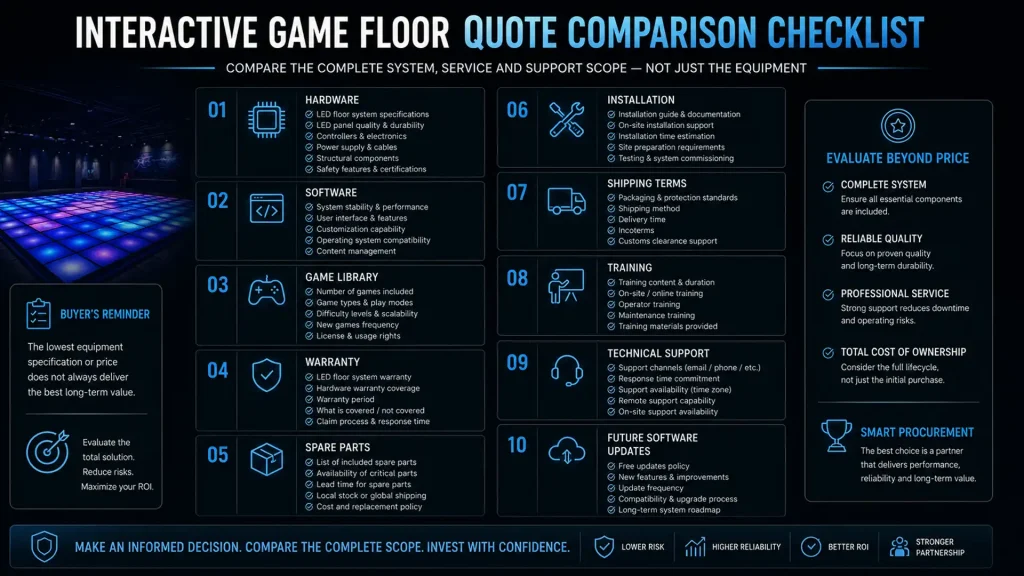
When buyers compare only the total price, they may miss these differences.
A better comparison should include:
| Comparison Item | Why It Matters |
|---|---|
| Sensor type | Affects durability and cost |
| Glass thickness | Affects safety and freight |
| Software package | Affects replay value |
| Spare parts | Affects after-sales speed |
| Packaging | Affects shipping damage risk |
| Support | Affects distributor workload |
| OEM scope | Affects resale value |
For wholesale buyers, margin is important. But margin disappears quickly if the product creates too many technical problems.
Ignoring Spare Parts
This is one of the most common mistakes I see.
Some buyers order only the main system and forget replacement parts. After installation, if one module, cable, controller, or glass panel needs replacement, the buyer has to wait for international shipping.
For a distributor, this can damage local customer trust.
A better approach is to prepare a spare parts package with the first wholesale order.
Recommended spare parts may include:
- LED modules
- sensors
- controllers
- power supplies
- cables
- connectors
- glass panels
- installation accessories
The exact quantity depends on system size and expected traffic.
A wholesale interactive game floor order should always include a spare parts discussion.
Buying From Traders Instead Of Factory
Trading companies are not always bad. Some provide good service and export communication.
But wholesale buyers need to understand what type of supplier they are working with.
If the supplier cannot answer technical questions, cannot explain production details, and cannot support module replacement, the buyer may face problems later.
For serious procurement, I recommend reading our Interactive Game Floor manufacturer guide before confirming long-term cooperation.
That article explains how to distinguish manufacturers, trading companies, and resellers in China.
For wholesale buyers, this distinction matters because you may need the same supplier for repeat orders, OEM changes, software support, and spare parts over several years.
Wholesale Interactive Game Floor FAQ
These technical FAQ answers help wholesale buyers understand MOQ, replacement modules, OEM branding, production time, factory support, and distributor cooperation before placing bulk orders.
MOQ means minimum order quantity.
MOQ means minimum order quantity. For a wholesale interactive game floor, MOQ may be based on square meters, module quantity, order value, one complete system, or OEM branding requirements. Standard wholesale MOQ is usually lower than OEM wholesale MOQ because custom branding requires extra design and production work.
Can replacement modules ship separately?
For interactive game floor price calculations, MOQ usually affects production setup, OEM customization, export packaging, and wholesale pricing structure.
Can distributors customize branding?
Yes. Many factories support OEM branding for distributors, including startup screens, logos, UI colors, score displays, game themes, packaging, and local language settings. The exact scope depends on the MOQ, software structure, and whether the buyer needs simple logo customization or deeper OEM development.
How long is production?
Production time depends on order quantity, module configuration, OEM requirements, and factory schedule. A standard wholesale interactive game floor may be faster, while OEM or custom layout projects require more time for design confirmation, software adjustment, production, testing, and packaging.
Do factories provide support?
A reliable factory should provide installation guidance, wiring diagrams, operation manuals, software instructions, remote troubleshooting, spare parts support, and warranty terms. Wholesale buyers should confirm these before ordering because they may need to support local customers after resale.
Can wholesale buyers become regional distributors?
Yes, some wholesale buyers can become regional distributors if they have local sales channels, installation capability, after-sales service capacity, and repeat purchase potential. Before discussing distributor cooperation, buyers should usually test the product, understand market demand, and confirm whether they can support local customers.
Can replacement modules be stored locally?
Yes. For distributors and multi-location projects, local spare module storage often reduces downtime significantly. Many Interactive Game Floor manufacturers recommend preparing spare modules during the initial shipment rather than waiting until maintenance becomes necessary.
Personalized Project Consultation
Wholesale interactive game floor purchasing depends on quantity, venue type, budget, branding needs, and long-term deployment plans. A technical review can help buyers choose the right procurement strategy before ordering.
Every wholesale project starts with different assumptions.
Some buyers operate one venue.
Some plan multiple installations.
Some want to become regional distributors.
Some need OEM branding.
Some are comparing China factories for long-term supply.
Some already have customers waiting for a quotation.
The right strategy depends on the buyer’s real situation.
If you already have:
- expected quantities
- venue size
- target market
- budget range
- preferred module size
- branding requirements
- shipping destination
- local installation capability
- future expansion plan
I can help review:
- procurement strategy
- wholesale configuration
- MOQ planning
- factory pricing structure
- deployment planning
- spare parts preparation
- throughput assumptions
- OEM feasibility
- future expansion possibilities
A wholesale interactive game floor order should not begin and end with a price list.
It should start with a practical review of what you plan to build, how many systems you may need, how your local customers will use them, and what support you must provide after installation.
If you are still comparing suppliers, the next step is to evaluate whether the company can truly support wholesale cooperation, OEM customization, spare parts, and long-term service.
You can continue with our Interactive Game Floor Supplier China guide to understand how to evaluate China suppliers before choosing a long-term partner.
You can also send your project requirements for technical review.